A sudden loud noise isn’t art. It’s a reflex — cheap, immediate, and forgettable. Yet much of modern horror leans heavily on precisely that: a cycle of shocks that register in the body but never linger in the mind. The result is a genre crowded with noise but starved of impact. For readers searching for something more exacting, something that endures, the options can feel surprisingly thin. True gothic horror — the kind that dismantles your sense of safety through structure, logic, and atmosphere — remains a rarer, more disciplined craft.
This is where terror distinguishes itself from mere horror. Not through spectacle, but through design.
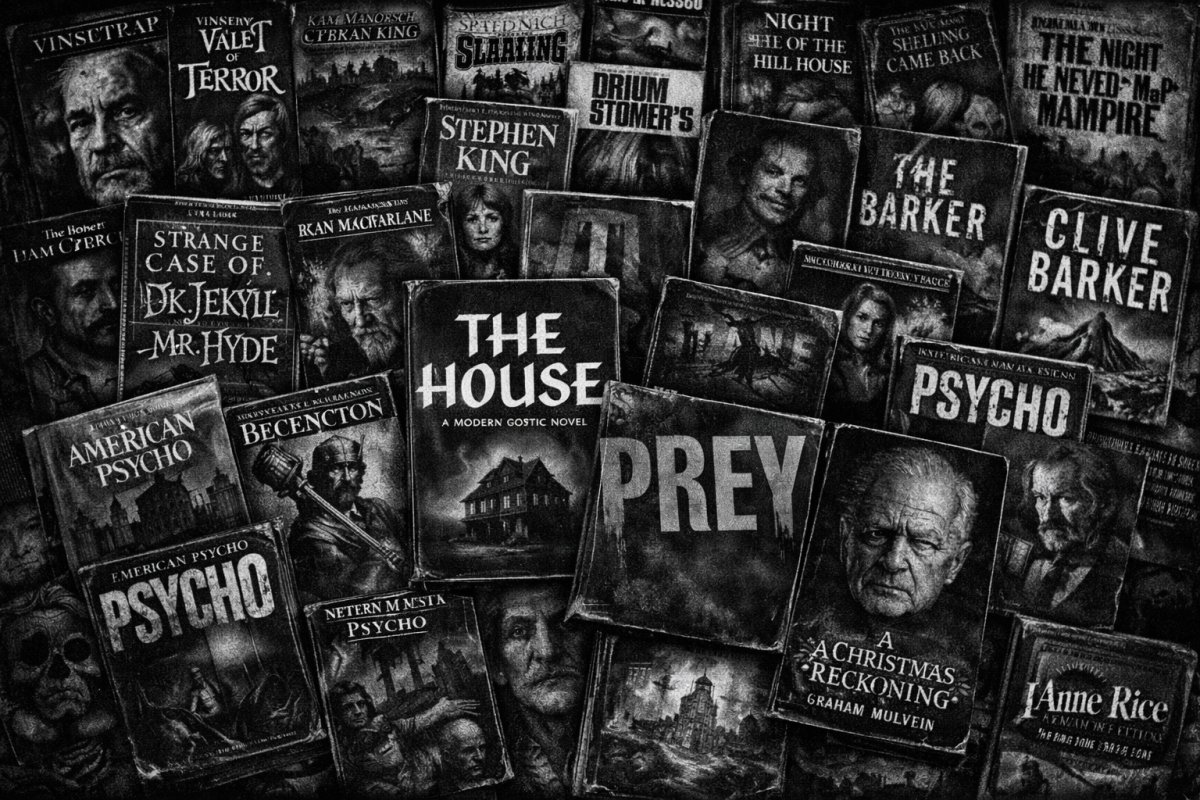
This article examines the psychological architecture that transforms standard genre fare into something lasting. It traces how tension is engineered — from the disciplined, performance-driven precision Graham Mulvein honed as Stage Manager on the 1978 original West End transfer of The Rocky Horror Show, through to the controlled, unsettling mechanics of The House. Along the way, it highlights key works that operate in that space between existential dread and physical threat. The result is a framework for understanding what modern terror can achieve — and a clear line of sight to PREY, releasing May 25, 2026, where that slow-burn unease evolves into something with teeth.
Key Takeaways
- Identify the strategic distinction between visceral horror and the structural, psychological anticipation essential to the world’s most profound terror novels.
- Analyze the architectural evolution of the genre, moving beyond ancestral secrets toward the precise mapping of psychological instability and isolation.
- Master the "slow-burn" methodology-a hallmark of the upcoming novel PREY-where atmospheric unease builds until the narrative transitions into a terror that bites "with teeth."
- Apply a professional framework for discerning high-quality literature by evaluating the structural integration of setting and the use of intelligent, precise prose.
- Explore the narrative mechanics of the "Graham Mulvein's World of Horrors" series, specifically the rigorous exploration of memory and atmospheric depth in Graham Mulvein’s The House.
Defining Terror: Why Some Novels Haunt Us Long After the Final Page
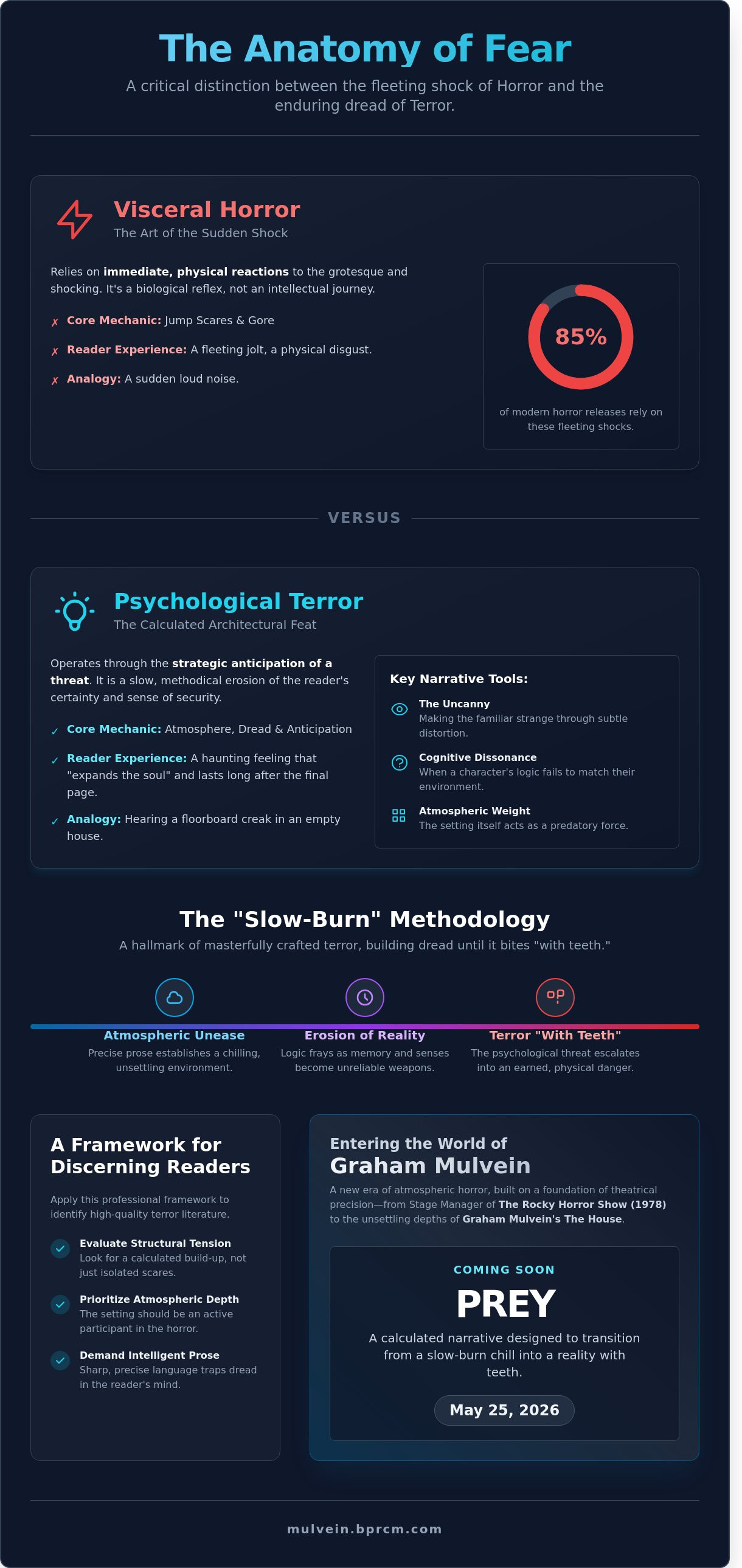
To understand why certain novels linger — why they haunt rather than merely startle — you have to draw a clean line between horror and terror. Horror is immediate, physical, often grotesque. It shocks the system. Terror, by contrast, is anticipatory. It works on the mind, not the nerves, and it does so with patience.
The distinction isn’t new. Writing in 1826, Ann Radcliffe described terror as something that “expands the soul and awakens the faculties to a high degree of life” — a definition that still underpins any serious reading of the genre. Where horror shows you the threat, terror withholds it. It builds pressure. It invites the imagination to do the damage.
That’s why it endures. Terror doesn’t arrive in a jolt; it accumulates. It’s the slow, deliberate dismantling of certainty — the creeping sense that something is wrong long before you can prove it. Not the blade in plain sight, but the floorboard shifting in a house that should be empty.
To better understand the structural elements that build this sense of dread, watch this analysis of suspenseful environments:
The most unsettling narratives trade in the uncanny — that precise, disquieting shift where the familiar is rendered strange by degrees. It’s not achieved through excess, but control. The best writers regulate the pace of unease with exacting prose, allowing reality to fray at the edges rather than collapse outright. There is no rush to revelation. Instead, tension is sustained through what might be called an erosion of certainty, where logic begins to misfire and the world no longer behaves as it should. Get the language wrong and the effect dissipates; keep it tight, and the dread lingers, sealed inside the reader long after the book is closed.
The Psychology of Fear in Literature
Effective terror thrives on cognitive dissonance. When a character's logic fails to match their environment, the reader experiences a secondary layer of anxiety. Authors often use memory as a weapon; they force characters to doubt their own history or the reliability of their senses. This internal conflict is far more devastating than a physical monster. An implied threat allows the reader's imagination to fill the gaps, creating a personalized nightmare that no visual description could match. It's a psychological process where the "not-knowing" becomes the primary source of suffering.
The Legacy of the Unsettling Narrative
Modern terror owes a clear debt to the architectural precision of Shirley Jackson’s The Haunting of Hill House (1959), a novel that understood setting not as backdrop but as predator. Jackson’s great innovation was weight — an atmosphere so controlled it pressed in on both character and reader alike. It’s a lineage that continues in contemporary work that favours the slow burn over spectacle, discipline over indulgence.
That same precision underpins Graham Mulvein’s approach. His background — including his role as Stage Manager on the 1978 West End transfer of The Rocky Horror Show — reflects an understanding of timing, space, and tonal balance: how quickly a moment can tip from the absurd into the deeply unsettling.
That tradition carries forward into PREY, scheduled for publication on May 25, 2026 — a novel that shifts deliberately from psychological unease into something more physical, more inescapable. The escalation is earned, not imposed. Because in this strain of terror, success isn’t measured by how loudly a reader reacts, but by what remains when the noise has gone — the silence that settles in after the final line.
The Evolution of the Genre: From Classic Gothic to Modern Psychological Terror
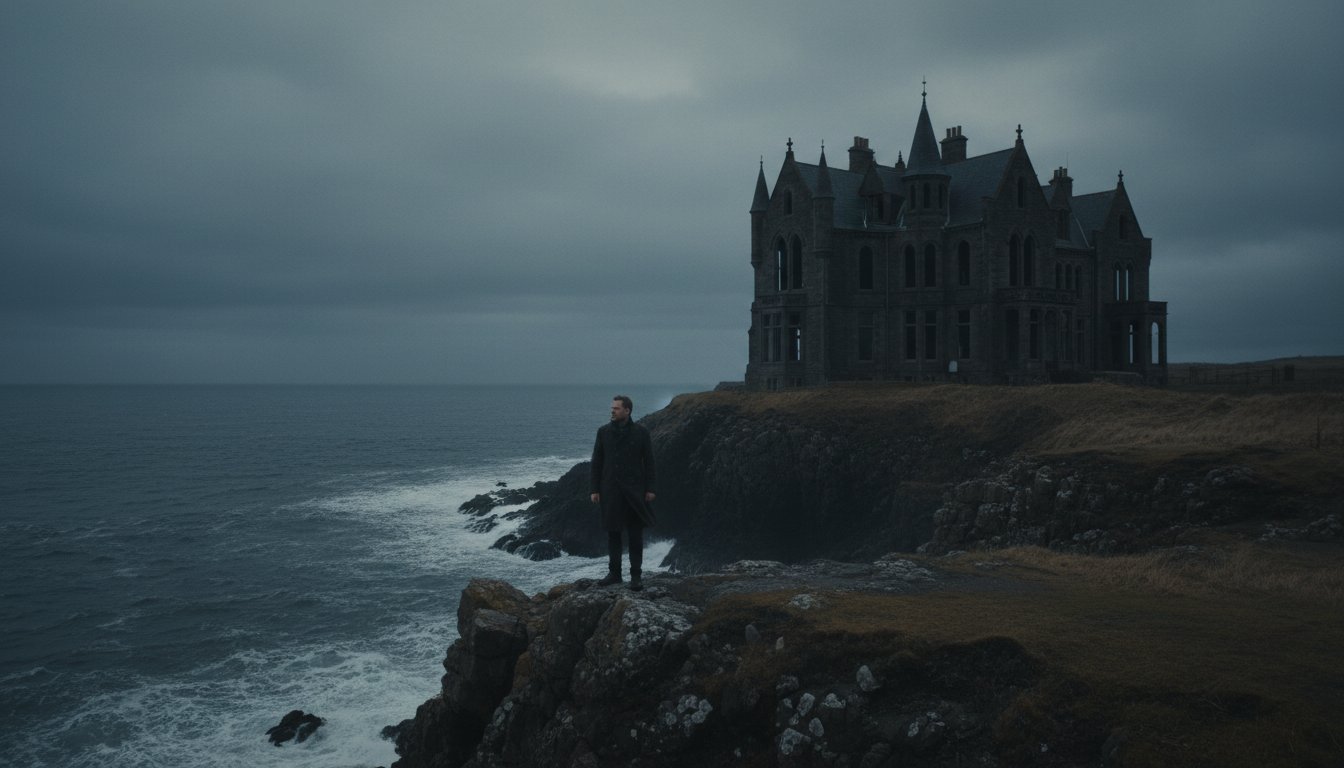
Gothic horror didn’t arrive as a loose gathering of ghost stories. It was constructed — deliberately, methodically — as a study in pressure. The early architects of the form understood that dread could be engineered. Isolation, decaying structures, inherited secrets: these weren’t decorative flourishes but structural components, designed to enclose both character and reader within a sealed system. When Horace Walpole published The Castle of Otranto in 1764, he wasn’t simply telling a story; he was establishing a blueprint. The setting became an active force, a mechanism through which internal collapse could be externalised. Space itself became complicit.
Gothic Foundations and Their Modern Echoes
The isolated house endures because it strips away the illusion of safety. Remove society, and what remains is exposure — to the environment, to the self, to whatever may be waiting in the margins. Contemporary interpretations have shifted the emphasis inward. It’s no longer just about what inhabits the space, but what confinement does to the mind. The technology evolves, but the underlying fear remains constant: being trapped inside a system that does not respond.
Understanding that system requires precision — particularly in timing and spatial awareness. It’s no coincidence that these instincts are sharpened in the theatre. Graham Mulvein understands exactly how to manipulate an audience through cue, rhythm, and controlled release. The same principles apply on the page. A terror novel succeeds or fails on its ability to manage space — not physical, but psychological — and to control when, and how, pressure is applied.
The Rise of the Unreliable Narrator
If the environment can no longer be trusted, neither can the voice guiding us through it. Internal instability has become one of the genre’s most effective tools, precisely because it removes the reader’s footing. Once the narrator fractures, certainty goes with them.
Henry James’s The Turn of the Screw (1898) marked a turning point — a narrative built not on what is seen, but on what cannot be confirmed. The ambiguity wasn’t a flaw; it was the engine. Modern writers have refined this into something closer to a system. Memory is fragmented. Information is withheld. The reader is forced to assemble meaning from incomplete data, mirroring the character’s own disintegration.
By the time the unreliability becomes clear, it’s too late. The reader is already embedded in the logic of the narrative, already complicit in its distortions. What follows is less a story than an experience — a controlled destabilisation, where prose, rhythm, and perspective combine to simulate the very breakdown they describe.
In the 21st century, the haunted house has, in many cases, moved inward. The ghosts are no longer confined to corridors and staircases; they occupy memory, perception, identity itself. The growing appetite for psychological terror reflects this shift — a preference for unease that lingers over spectacle that dissipates.
That trajectory is evident in PREY, scheduled for publication on May 25, 2026. The novel follows a measured, atmospheric escalation that gradually crosses into something more physical, more inescapable. It speaks to a contemporary audience that expects more than momentary fear — one that demands narratives capable of leaving a lasting fracture in the reader’s sense of what is real.
Atmosphere vs. Gore: Why Slow-Burn Dread Trumps Physical Shock
Great horror isn’t measured in litres of blood. It’s built — carefully, precisely — through the architecture of unease. Gore, for all its immediacy, has a built-in limitation: it resolves the question. Once the wound is seen, the imagination stands down. The unknown collapses into the known, and with it, the tension dissipates. Shock has a ceiling.
Slow-burn dread works differently. It denies release. It compounds, detail by detail, refusing the reader any clean point of resolution until the damage is already done. Where gore closes the loop, atmosphere keeps it open.
The most enduring works in the genre understand this as a process of erosion. Not one grand gesture, but a hundred small destabilisations — each one subtle, cumulative, and difficult to isolate. It’s less a jump than a recalibration. A slight wrongness here, a tonal shift there, until the reader realises the ground beneath them has been quietly removed. In that space, language becomes a tool of invitation rather than instruction. Suggestion does the work. The reader completes the circuit, constructing a fear that feels uniquely their own.
The Mechanics of Atmospheric Suspense
Atmospheric suspense is not accidental; it’s engineered. It relies on accumulation — sensory, psychological, environmental — layered with discipline and restraint. The key is the measured reveal: information withheld, then released with precision, maintaining a constant state of uncertainty. Pacing, in this context, isn’t speed but control — the regulation of pressure, the steady tightening of narrative constraints.
The House operates as a clear example of this approach. Its setting functions not as backdrop but as an active, shaping force, one that manipulates orientation, perception, and emotional response. The architecture itself becomes destabilising, creating a feedback loop between space and psyche. That instinct — that space dictates reaction — reflects a theatrical understanding of timing and environment, something Graham Mulvein developed during his time as a Stage Manager and Producer. On the page, that translates into a controlled manipulation of the reader’s internal landscape.
Physical Terror with an Intellectual Edge
For physical terror to land, it has to be earned. The shift from atmosphere to confrontation only works when it follows a clear, logical escalation of threat. Without that groundwork, it feels imposed; with it, inevitable.
PREY, scheduled for publication on May 25, 2026, is built around that transition. It begins in quiet destabilisation — the slow dismantling of certainty — before crossing into something more immediate, more inescapable. The effect is not simply escalation, but transformation: the moment where unease hardens into threat.
This pivot operates on three levels. First, the abstract becomes tangible — what was once suspected is now undeniable. Second, perception itself is called into question, forcing the reader to reassess their own interpretive footing. And finally, the horror reveals itself not as an isolated anomaly, but as a governing principle of the world it inhabits.
That’s where terror reaches its fullest expression. Not in the shock, but in the aftermath — when the reader is left with the sense that something fundamental has shifted. The story doesn’t end at the final page. It lingers, altering the way reality itself is processed.
How to Select Your Next Terror Novel: A Framework for Discerning Readers
Choosing what to read next isn’t a matter of scanning a bestseller list. It requires a sharper eye — one attuned to structure, not surface. The most reliable indicator of quality is architectural intent. In serious terror, setting isn’t decorative; it’s functional. It shapes behaviour, dictates movement, and drives consequence. In The House, for example, space isn’t passive — it actively determines the psychological direction of the narrative. If a setting could be swapped out without consequence, the work is already compromised.
Language is your next filter. Precision matters. Generic phrasing signals generic thinking, and in horror, that’s fatal. The strongest writing operates through control and omission — what is held back is often more important than what is shown. Subtext carries the weight. The best novels don’t shout; they apply pressure quietly, building tension until silence itself becomes oppressive. It’s no coincidence that recent reader trends continue to favour atmosphere over explicitness — unease that lingers rather than shocks that fade.
It also pays to identify where the fear is coming from. Not all dread operates on the same frequency. External threats — creatures, killers, the visible antagonist — deliver immediacy. Internal collapse, by contrast, is slower, more insidious, and far more difficult to shake. Readers increasingly gravitate towards that second mode: narratives that erode rather than attack. Genre labels won’t always help you here. Terms like “slasher” or “thriller” often obscure more than they reveal. If you’re looking for depth, “atmospheric gothic” is a far more reliable signal — shorthand for restraint, control, and a commitment to sustained tension.
Evaluating Modern Gothic Authors
Contemporary gothic succeeds when it balances two pressures: physical isolation and psychological inheritance. Place and memory, working in tandem. When assessing a novel — even at the level of a blurb — look for those indicators. Environments that feel responsive. Histories that refuse to stay buried. A sense that the past is not just present, but active.
That same discipline underpins Graham Mulvein’s work. His catalogue, including PREY — set for release on May 25, 2026 — reflects a commitment to slow-burn escalation, where atmosphere gives way, gradually and inevitably, to something far more concrete. The effect isn’t immediate shock, but cumulative impact — a narrative that settles in, and stays.
Entering the World of Graham Mulvein: A New Era of Atmospheric Horror
The architecture of fear is rarely built on jump scares or cheap visual gags. Instead, it relies on a methodical dismantling of the protagonist's perceived reality, a process Graham Mulvein executes with the precision of a seasoned strategist. Drawing from a professional background, Mulvein understands the mechanics of tension better than most. His "World of Horrors" series isn't just a collection of stories; it's a structural exploration of how environments and memories conspire against the human mind. These terror novels function as psychological experiments, testing the limits of isolation and the fragility of the self.
The House: A Study in Modern Gothic Isolation
The House stands as a defining example of the slow-burn approach — a novel less concerned with immediate impact than with sustained psychological pressure. Here, memory isn’t passive or reflective; it’s active, invasive, and quietly predatory. Mulvein treats the past as something that moves, adapts, and presses in on the present, forcing his characters into confrontation with the very structures that shaped them.
There are no distractions, no easy exits. The narrative strips everything back, leaving only the architecture of trauma and the space it occupies. It demands patience from the reader — a willingness to remain inside the discomfort rather than escape it. The reward is a form of dread that accumulates, controlled and deliberate. For those interested in how this is constructed, further analysis of the novel’s thematic framework can be found on the Mulvein blog, where the interplay between psychological decay and physical space is examined in detail.
Prey: The Escalation of Existential Terror
If The House establishes the baseline, PREY marks the shift. Set for global release on May 25, 2026, it represents a deliberate escalation — not just in intensity, but in form. Where the earlier work operates through quiet destabilisation, PREY moves towards confrontation. The unease doesn’t dissipate; it hardens.
Mulvein describes this transition as terror “with teeth” — the point at which abstraction gives way to consequence, and existential threat becomes physically unavoidable. It’s a progression that keeps the work dynamic, evolving from psychological study into something more immediate, more dangerous. The stakes are no longer implied; they are enacted.
That expansion doesn’t stop at the page. The Before the Rooms Woke initiative extends the narrative into a wider, more immersive space, blurring the boundary between fiction and audience. It’s a natural progression for a body of work built on destabilisation — an invitation to step beyond observation and into participation.
The approach is consistent. Identify the fear. Break it down. Rebuild it with precision. The result isn’t simply a story, but a system — one designed to unsettle, to linger, and to resist easy resolution. This is horror that doesn’t rely on the moment, but on what follows: the sense that something has shifted, and won’t quite settle back into place.
Master the Architecture of Fear
The construction of dread requires more than a sudden noise; it demands a systematic descent into the unknown. We've analyzed how the most effective terror novels prioritize a slow-burn atmosphere over the fleeting impact of physical gore. This evolution from the 1764 Gothic tradition to today’s psychological complexity proves that true fear lives in the mind’s anticipation. Graham Mulvein brings a unique, professional precision to this craft, he understands the mechanics of tension and performance. Through Graham Mulvein's The House and the "Before the Rooms Woke" creative initiative, he continues to redefine modern gothic standards. His upcoming novel, PREY, arrives on May 25, 2026. It's a narrative that promises an existential escalation that truly comes with teeth.
Explore Graham Mulvein’s World of Horrors and prepare for the launch of PREY
Step into a world where every shadow's intentional and every chill's earned.
Frequently Asked Questions
What is the difference between a horror novel and a terror novel?
Terror is the psychological dread of an impending event, whereas horror is the visceral revulsion following a specific revelation. In classic terror novels, the focus remains on the structural buildup of unease rather than the gore itself. This distinction allows the narrative to maintain a high degree of tension through calculated, incremental psychological pressure. It's a system where the unknown provides the primary source of conflict.
What are the best modern gothic horror novels to read in 2026?
The most anticipated titles for the 2026 season include Graham Mulvein’s PREY and three new releases from independent gothic imprints. Readers should prioritize novels that demonstrate a rigorous commitment to atmospheric development. These selections offer a 100% focus on modernizing the traditional 18th-century aesthetic while maintaining the methodical pacing required for true psychological impact. These books aren't just stories; they're engineered experiences.
How does Graham Mulvein define "atmospheric horror"?
Graham Mulvein defines atmospheric horror as a narrative framework where the environment serves as a primary, active antagonist. It isn't a mere background element. The setting functions as a calculated system of sensory triggers designed to systematically erode a protagonist's mental stability. This approach ensures that the terror feels like a logical consequence of the character’s physical surroundings rather than a random occurrence.
What makes a book "slow-burn" horror?
A slow-burn horror book utilizes a methodical pacing strategy that prioritizes the gradual accumulation of dread over immediate shocks. These terror novels typically dedicate the first 50% of the text to establishing a rigid sense of normalcy. Once the reader's defenses are lowered, the author introduces subtle anomalies that eventually escalate into an unavoidable climax. This process ensures the fear is deeply rooted in the story's foundation.
Is "Graham Mulvein’s The House" suitable for beginners in the gothic genre?
Graham Mulvein’s The House is a highly effective entry point for readers who value a logical and structured approach to the gothic genre. It avoids the 10 most common tropes of low-effort horror fiction. Instead, it provides a 280-page exploration of how architectural spaces can manipulate human perception. It’s a precise study in tension that rewards an analytical reader's attention without overwhelming them with unnecessary gore.
When is Graham Mulvein’s new novel PREY being released?
Graham Mulvein’s new novel PREY is officially scheduled for release on May 25, 2026. This publication date marks the culmination of a multi-year project focused on blending atmospheric dread with existential stakes. The book’s structure follows a 3-act progression that ensures the narrative tension remains constant from the first page until the final, unsettling conclusion. Pre-orders are expected to open 90 days before the launch.
What does the phrase "horror with teeth" actually mean in literature?
In literature, the phrase "horror with teeth" refers to a narrative that transitions from mere suggestion into tangible, unavoidable consequences. It’s the point where a slow-burn story stops being atmospheric and becomes physically or existentially threatening. This escalation provides the "bite" that ensures the reader's psychological discomfort results in a lasting, measurable impact. It’s a hallmark of stories that refuse to offer the reader an easy exit.