The most effective weapon in a creator’s arsenal is not what’s shown, but what’s withheld. The absence of information — carefully controlled and deliberately deployed — is what allows fear to take root. Too often, promising narratives unravel the moment they begin to explain themselves, reducing something primal into a sequence of manageable, and ultimately forgettable, facts.
For Graham Mulvein, ambiguity is not a stylistic flourish but a structural discipline — one that many contemporary creators overlook in favour of familiar tropes that offer immediacy but little psychological depth. The result is horror that is seen, but rarely felt.
That understanding was shaped early. As Stage Manager on the 1978 West End transfer of The Rocky Horror Show, Mulvein observed how tension is often generated not by what occupies the stage, but by what remains just beyond it. What is withheld becomes active. Silence carries weight.
That same principle runs through The House and continues into his forthcoming novel, PREY, due for publication on 25 May 2026. Both works favour controlled revelation over exposition, allowing unease to build gradually rather than forcing it into view.
This analysis explores how that approach can be applied in practice — examining the mechanics of terror versus horror, the function of the unreliable narrator, and the construction of a slow-burn narrative that does not simply startle, but endures.
That keeps it disciplined and leaves space for the rest of the article to breathe.
Key Takeaways
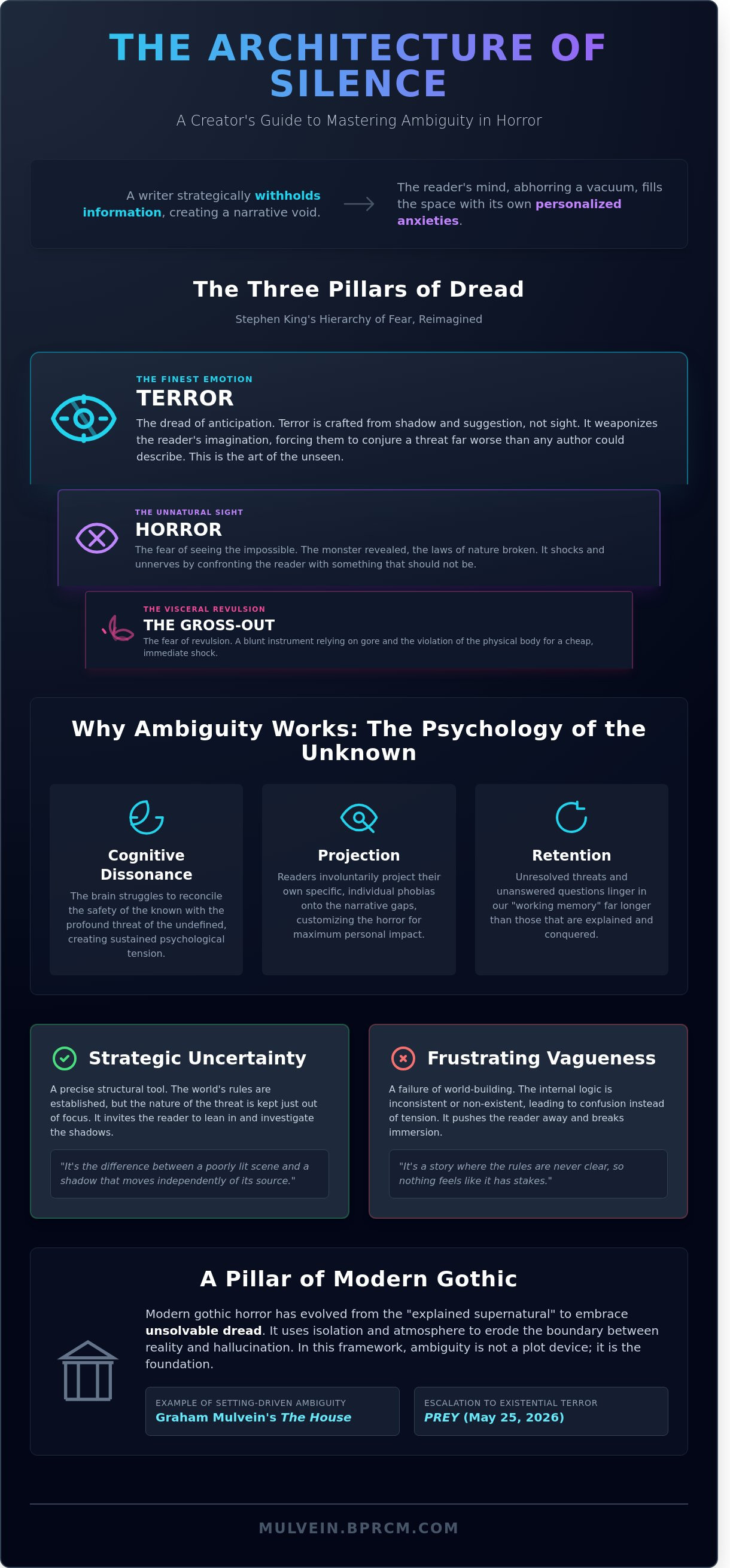
- Mastery of horror begins with what can be described as the architecture of silence — the disciplined act of withholding information so that the reader is compelled to fill the void themselves, often with projections drawn from their own psychological vulnerabilities.
- Effective horror depends on an understanding of the mechanics of the unknown — a shift away from blunt, visceral shocks towards a more sophisticated ambiguity, where what cannot be fully grasped becomes the true source of terror.
- The deliberate use of the ambiguity of self allows narrative certainty to erode — through fractured memory, shifting perspective, and unreliable narration, the reader’s trust is steadily destabilised.
- A process-first approach to narrative design places structural mystery ahead of spectacle, ensuring that tension is methodically constructed before any calculated, high-impact payoff is delivered.
- The progression from atmospheric dread to a more existential form of terror — one that carries real consequence — is central to this approach, evident in The House and further developed in PREY.
Defining Ambiguity: The Space Between Suggestion and Terror
Ambiguity in horror is often mistaken for a lack of clarity. In reality, it is something far more deliberate — a structural decision designed to turn the reader’s own mind against them. At its most effective, it operates as an architecture of silence, where what is left unsaid carries more weight than anything explicitly stated. By withholding certainty, the narrative creates a vacuum, and the reader — instinctively resistant to absence — begins to fill it. What emerges is rarely neutral. It is shaped by personal anxieties, private fears, and the quiet logic of imagination. In this way, the reader becomes complicit in the construction of their own unease.
For Graham Mulvein, this is not an accidental by-product of storytelling but a controlled mechanism. The absence is engineered. The silence is doing the work. And it requires a level of precision that far exceeds the blunt force of explicit horror.
There is, however, a necessary distinction to be made.
Vagueness is not ambiguity. It is the by-product of weak construction — a failure of internal logic where the world itself cannot sustain scrutiny. Strategic uncertainty, by contrast, depends on structure. The rules are understood, even if the threat is not. The reader senses coherence beneath the surface, even as meaning remains just out of reach.
It is the difference between a scene that is merely obscured and one in which the shadow behaves incorrectly — where it detaches, shifts, or lingers longer than it should.
When executed with control, this form of ambiguity does not resolve itself at the final page. It resists closure. The dread it creates is not contained by the narrative, but carried outward — following the reader beyond the text, into quieter, darker spaces where explanation no longer offers protection.
To better understand how this tension operates within a narrative structure, watch this helpful video analysis:
The Psychology of the Unknown
The human mind is not built to tolerate absence. Cognitive theory — particularly the principles associated with Gestalt psychology — suggests a deep, almost reflexive drive towards completion. Presented with an incomplete pattern, the brain does not rest; it works to resolve, to close, to make whole. Denied that closure, it experiences tension.
Horror, at its most effective, exploits this impulse.
By refusing to provide a complete picture, the narrative sustains a state of unresolved anxiety. A fully realised monster can be measured. It has limits, boundaries, a shape that can be understood. But something only partially seen — a suggestion, a silhouette, a presence without form — expands in the imagination. Its scale is dictated not by the writer, but by the reader’s capacity for fear.
This is the point at which ambiguity becomes active. The reader is no longer observing the horror, but participating in it.
- Cognitive dissonance emerges as the mind attempts to reconcile the familiar with the undefined, creating a persistent sense of unease.
- Projection fills the narrative gaps, with readers importing their own specific fears into the space left open.
- Retention ensures that what is unresolved lingers — remaining in the mind far longer than anything conclusively explained.
Ambiguity as a Modern Gothic Pillar
If early gothic fiction often resolved its mysteries — the supernatural revealed, the ghost unmasked — modern gothic horror moves in the opposite direction. It resists explanation. The unknown is not clarified; it is sustained.
Isolation becomes the mechanism through which this is achieved. Remove certainty, remove witnesses, remove the structures that confirm reality, and the boundary between perception and hallucination begins to erode. The setting itself becomes complicit.
This is particularly evident in The House, where architecture is not simply a backdrop but an active, uncooperative presence — a structure that observes, withholds, and offers no clear exit, either physically or psychologically.
Mulvein’s approach is informed, in part, by his background in theatre. As Stage Manager on the 1978 West End transfer of The Rocky Horror Show, he worked within a form that depends as much on absence as presence — on what is suggested beyond the stage as much as what is shown upon it.
That sensibility carries into his forthcoming novel, PREY, scheduled for publication on 25 May 2026. Here, ambiguity is stretched across landscape rather than architecture, with a slow-burn structure that allows uncertainty to accumulate before tightening into something more tangible, more consequential.
The escalation is deliberate.
Atmosphere gives way to pressure.
Uncertainty sharpens into threat.
And when it arrives, the horror does not simply startle.
It lands.
The Three Pillars of Dread: King’s Hierarchy of Fear
In Danse Macabre, Stephen King outlines a now widely accepted framework for understanding how fear operates within narrative: the Gross-out, the Horror, and the Terror. It is a hierarchy not simply of intensity, but of sophistication. While the gross-out delivers immediate impact — visceral, confrontational, impossible to ignore — it is also the least enduring. It shocks, then recedes.
Terror, by contrast, lingers.
Positioned at the apex of King’s hierarchy, it operates through absence. It is not concerned with what is seen, but with what is implied — the space where the imagination is forced to complete the image the author refuses to provide. A breath in an empty room. A shadow that does not behave correctly. The quiet, dawning recognition that something is wrong, without ever fully understanding why.
This is where ambiguity finds its most effective form.
The Gross-out vs. The Terror
Explicit horror, particularly in its more graphic forms, often functions as a release valve. The moment the threat is fully revealed — defined, contained, made visible — the tension begins to dissipate. The unknown has been resolved into something measurable.
Terror resists that resolution.
It sustains itself through scarcity. Information is controlled, rationed, withheld with intent. The writer does not reveal the source of the threat, but its consequences — the marks it leaves behind, the disturbances it causes. A locked door bearing damage from the inside. A sound without origin. A presence suggested only through absence.
Maintaining this across a longer narrative demands precision. The withholding cannot feel arbitrary; it must feel designed. The reader remains in a state of heightened attention, scanning for meaning that never fully settles into certainty.
Shock is immediate. Terror endures.
Weaponizing the Familiar
Perhaps the most effective expression of this approach lies in what might be described as the “exact substitute” — the subtle corruption of the familiar. A space, a figure, a detail that appears unchanged, yet carries an indefinable wrongness.
This is the territory of the uncanny.
When the domestic environment begins to shift — imperceptibly at first — the reader’s sense of stability erodes. The ordinary becomes unreliable. A chair is no longer where it was left. A portrait seems to hold its gaze a fraction too long. These are not overt disruptions, but precise alterations, signalling that the underlying reality has begun to move.
This level of control is central to The House, where the environment itself functions as an active participant in the narrative — not through spectacle, but through incremental, calculated deviation.
That same sensibility carries into his forthcoming novel, PREY, scheduled for publication on 25 May 2026. Structured as a slow escalation, it begins in quiet isolation before tightening into something more physical, more immediate — a confrontation that transforms ambiguity into consequence.
The progression is deliberate.
What begins as unease becomes pressure.
What remains undefined becomes unavoidable.
And in that transition, ambiguity reveals its true function — not as a lack of direction, but as a controlled surrender of certainty, allowing the reader’s own mind to complete the design.
The Ambiguity of Self: Unreliable Narrators and Fractured Memory
The most effective horror rarely begins with an external threat. It emerges from within — from the gradual failure of perception itself. When a narrator can no longer be relied upon to interpret their own reality, the structure of the story begins to fracture. This ambiguity of self becomes a precise narrative tool, eroding the reader’s confidence and forcing a fundamental question: is the threat real, or is it being constructed by a mind already in decline?
In this space, certainty is no longer available.
This internal instability sits at the core of modern psychological horror, a genre that has evolved beyond traditional ghost stories into something more disquieting — an examination of memory, trauma, and the slow dissolution of identity.
In The House, this principle is central. The protagonist’s inability to reconcile past and present creates an environment where reality itself feels unstable. Memory does not function as a reliable record, but as a distortion — a lens that reshapes the familiar into something threatening. A corridor becomes unfamiliar. A space once known begins to resist recognition.
What is being experienced may be real.
But it may not be.
And the narrative refuses to resolve the distinction.
This breakdown follows its own internal logic:
- The erosion of chronological order, where time no longer behaves consistently.
- The intrusion of conflicting sensory information, destabilising perception.
- A quiet refusal, on the part of the narrator, to acknowledge changes that appear increasingly undeniable.
Constructing the Unreliable Narrator
This effect is not accidental. It is constructed.
Writers achieve it through controlled inconsistency — not errors, but deliberate fractures in the narrative’s internal logic. Small deviations accumulate. Details misalign. The story remains outwardly coherent, even as something beneath it begins to slip.
The technique often relies on what might be termed the ambiguity of suggestion: the act of circling a trauma without naming it directly. The absence becomes active. The reader fills it.
Crucially, the prose itself remains disciplined. Structured. Precise.
That contrast — between formal control and perceptual instability — is what allows the unease to take hold.
Memory as a Haunting Force
In this form of horror, memory becomes something more than recollection. It behaves like an intrusion. A presence. Something that reshapes the present rather than simply reflecting the past.
Isolation accelerates this process. Without external confirmation, perception turns inward. Memory begins to overwrite reality, and the boundary between the two becomes increasingly difficult to locate.
This slow-burn destabilisation underpins PREY, scheduled for publication on 25 May 2026. The narrative begins with subtle distortions — small inconsistencies that can be dismissed — before tightening into something more immediate, more physical.
By the time the threat fully emerges, the foundation has already shifted.
The reader is no longer certain of what is real.
And by then, it is too late to recover that certainty.
What remains is not simply fear, but disorientation — the sense that the narrative itself has moved, leaving both character and reader struggling to find stable ground.
Narrative Strategy: How to Construct a Slow-Burn Masterpiece
At the centre of any effective slow-burn horror lies a disciplined, process-first approach. The emphasis is not on the monster, but on the architecture that allows it to emerge. Rather than building towards a singular shock, the narrative is designed as a system — one in which the protagonist’s grasp on reality begins to fail in controlled, deliberate increments. Every detail serves a function. Every disturbance contributes to a larger mechanism of unease.
For Graham Mulvein, ambiguity is not the absence of information, but the careful arrangement of conflicting signals that resist resolution. The reader is not denied meaning; they are given too many possibilities, none of which settle into certainty.
Pacing, in this context, becomes a matter of control. Too much clarity, and the tension collapses. Too little, and the narrative risks losing its internal logic. The balance lies in the gradual release of detail — fragments that suggest coherence, but never quite confirm it. The reader is led forward not by answers, but by the promise of them.
Mulvein’s background in theatre offers a useful parallel. Timing was not an accessory but a necessity. A moment either landed or it didn’t. The same principle applies here: rhythm governs impact. Each line contributes to a progression that feels both measured and inevitable.
The Mechanics of Atmospheric Suspense
Atmospheric dread is rarely the result of overt threat. It is cumulative — built through the layering of subtle, often sensory details that register before they are consciously understood. The environment begins to shift, not dramatically, but persistently.
Three key mechanisms underpin this effect:
- Olfactory and thermal disruption — a sudden, inexplicable drop in temperature, or the presence of a scent that cannot be traced to any visible source.
- Pressure and weight — the suggestion that the air itself has substance, pressing inward, creating a low-level physiological unease.
- Rhythmic control of prose — sentence structures that regulate pace and breathing, avoiding the volatility of jump-scare writing in favour of sustained tension.
These elements operate beneath the surface, bypassing rational interpretation. The reader does not analyse them; they experience them. Over time, the setting itself begins to function as an antagonist — not through action, but through presence.
The 'With Teeth' Escalation
A slow burn cannot remain abstract indefinitely. There comes a point at which suggestion must give way to consequence — where the unseen asserts itself in tangible form. This is the pivot: the transition from atmosphere to impact.
What begins as uncertainty becomes unavoidable.
This shift — what might be described as horror with teeth — is not a departure from ambiguity, but its culmination. The groundwork laid through restraint and suggestion allows the escalation to feel earned rather than imposed. The threat, once theoretical, becomes immediate.
This progression is central to PREY, scheduled for publication on 25 May 2026. The narrative begins in quiet instability — a landscape that feels subtly, persistently wrong — before tightening into a confrontation that is both physical and existential.
The effectiveness of this transition depends on discipline. The escalation must arise from what has already been established, not override it. When handled with precision, the result is not simply a moment of fear, but a sustained impact — something that carries weight beyond the page.
For a deeper exploration of this structured approach to horror, visit Mulvein Horror Universe, where narrative design is treated not as instinct, but as craft.
From The House to PREY: The Evolution of Atmospheric Horror
Effective horror is not built around the monster, but around the conditions that allow fear to take hold. It requires an understanding of how the mind responds to uncertainty — how suggestion, rather than exposure, can be used to construct something far more enduring. For Graham Mulvein, this has become a defining principle. His work resists the immediacy of jump scares in favour of a slower, more deliberate erosion — one that positions the reader not as observer, but as participant in the construction of dread.
The Legacy of The House
The House stands as a clear example of this approach. Rather than simply situating its narrative within a haunted environment, it transforms the setting into an active, uncooperative presence. The architecture does not merely contain the story; it shapes it, withholds from it, and ultimately resists resolution.
This precision is not incidental. Mulvein’s background informs a method rooted in control: of timing, of space, of what is revealed and what is deliberately held back. The result is a narrative that unfolds with measured restraint, where isolation and fractured memory combine to produce a sustained, psychological pressure.
The reader is not simply following the protagonist’s experience.
They are subject to the same distortions.
Across his wider body of work, including the broader “World of Horrors” framework, this methodology becomes increasingly refined. Each text functions as a variation on a central principle: that horror, to be effective, must operate according to an internal logic, even as the world it depicts begins to destabilise. Without that discipline, tension dissolves into excess. With it, even the smallest disruption carries weight.
What emerges across Mulvein’s work is a clear and consistent thesis: ambiguity is not the absence of information, but its most strategic deployment. It is the mechanism through which the reader becomes complicit — filling gaps, resolving tensions, constructing fears that the narrative itself only gestures towards.
When executed with precision, this approach does not conclude with the final page. It persists.
Not because everything has been revealed,
but because it hasn’t.
For further insights into this approach to horror and updates on PREY, visit Mulvein's World of Horror.
Looking Forward: PREY and Existential Terror
This progression leads directly to PREY, scheduled for publication on 25 May 2026. Where earlier work explored the persistence of memory and the instability of place, PREY extends these ideas into a broader, more exposed landscape — one that shifts from psychological unease into something more immediate, more physical.
The structure remains consistent: a slow accumulation of detail, a careful calibration of uncertainty. But the stakes are heightened. What begins as subtle dislocation develops into a form of existential threat — a confrontation that moves beyond suggestion into consequence.
Central to this is a principle that might be described as disproportionate revelation: only a fraction of the horror is ever made explicit. The rest is implied, anticipated, constructed in the reader’s mind long before it is confirmed. The effect is cumulative. The impact, when it arrives, feels less like a shock than an inevitability.
Master the Mechanics of the Unseen
At the heart of effective horror lies control — not of what is shown, but of what is withheld. The structural integrity of a narrative depends on the precise application of silence, a principle long understood but rarely executed with discipline. As frameworks such as Danse Macabre make clear, it is the psychological tremor — not the immediate shock — that sustains fear.
For Graham Mulvein, ambiguity is not a gap in the narrative, but a system. The reader is not simply guided through the story; they are positioned within it, compelled to complete what the text refuses to confirm. This approach reflects a background grounded in precision, where timing, absence, and controlled revelation defined the audience’s experience.
That same methodology carries through his work — from the conceptual framework of Before the Rooms Woke to the architectural unease of The House — where narrative becomes less a sequence of events and more a constructed environment. The objective is not simply to tell a story, but to engineer a progression: from atmosphere, to tension, to something more immediate.
Something with consequence.
This system finds its next expression in PREY, scheduled for publication on 25 May 2026. Here, the slow-burn structure is pushed further, systematically dismantling the reader’s sense of stability before allowing the threat to fully emerge.
The approach remains consistent.
The stakes do not.
For those seeking to understand how modern horror operates at a structural level, the work itself provides the clearest entry point. Begin with The House. Follow the progression. And prepare for what comes next.
Further exploration and updates are available at Mulvein's World of Horror.
Frequently Asked Questions
What is the difference between ambiguity and a plot hole in horror?
Ambiguity is a deliberate narrative choice where the author provides multiple, conflicting interpretations of an event. It's a strategic tool used to heighten tension. A plot hole is a failure in the story's internal logic or a breakdown in the system of the world. In Graham Mulvein's The House, the uncertainty isn't a mistake; it's a calculated mechanism designed to keep the reader's mind working long after the book is closed.
Why is the unseen monster often scarier than a revealed one?
The unseen monster exploits the reader's personal fears by remaining a formless, infinite threat. Once a creature is revealed, it becomes a biological entity with physical limits and measurable weaknesses. Before that reveal, the horror is psychological and absolute. This escalation from atmospheric dread into physical terror must be handled with teeth, a transition explored deeply in the upcoming novel PREY, which arrives on May 25, 2026.
How do you write a satisfying ending that is still ambiguous?
A satisfying ambiguous ending provides emotional closure for the protagonist while withholding a factual resolution for the plot. You've got to resolve the character's internal arc so the reader feels the journey was worth the effort. If 100% of the narrative remains open, it feels like a structural failure. Aim for a 70/30 split where the emotional stakes are settled, but the external threat remains a lingering, dangerous question mark.
Can an unreliable narrator work if the reader knows they are lying?
An unreliable narrator is often more effective when the reader detects the deception because it creates a layer of dramatic irony. This builds a psychological power struggle between the text and the audience. It forces you to analyze the ambiguity in horror through a lens of manipulation rather than just supernatural events. This technique of shifting perspectives was a core element in the 1978 West End transfer of The Rocky Horror Show, where Graham Mulvein served as Stage Manager.
What are some classic examples of ambiguity in horror literature?
Henry James's 1898 novella The Turn of the Screw is the definitive benchmark for literary ambiguity. It presents a binary choice between a supernatural haunting and a psychological breakdown. Shirley Jackson's 1959 masterpiece The Haunting of Hill House similarly uses architectural space to blur the lines of reality. These 19th and 20th-century texts prove that a lack of clarity creates a more enduring form of dread than any graphic description could achieve.
How does setting contribute to the ambiguity of a horror story?
Setting functions as a psychological mirror that distorts a protagonist's perception of reality. Liminal spaces, like the shifting corridors in Graham Mulvein's The House, prevent the reader from grounding themselves in a stable environment. When a physical space lacks fixed rules, the narrative logic begins to dissolve. This foundation of existential terror eventually bites with teeth, transforming a simple location into a predatory participant in the story's events.
Is ambiguity more effective in short stories or full-length novels?
Short stories sustain ambiguity more effectively because they don't require the extensive world-building that often demands a rational explanation. In a 5,000-word piece, a single unexplained event feels like a haunting. In a 90,000-word novel, prolonged lack of clarity can lead to reader fatigue. Full-length works like PREY, launching on May 25, 2026, must balance atmospheric mystery with enough concrete data to maintain a sense of progression and stakes.
What is the Terror vs Horror distinction in Stephen King's philosophy?
Stephen King defines terror as the anticipation of a threat, while horror is the visceral reaction to the reveal. In his 1981 non-fiction work Danse Macabre, he identifies terror as the finest emotion because it relies on the ambiguity in horror to let the mind create its own monsters. It's the sound of something scratching at the door. Horror is the moment the door opens and you see the creature's rot, which is often less frightening than the unknown.