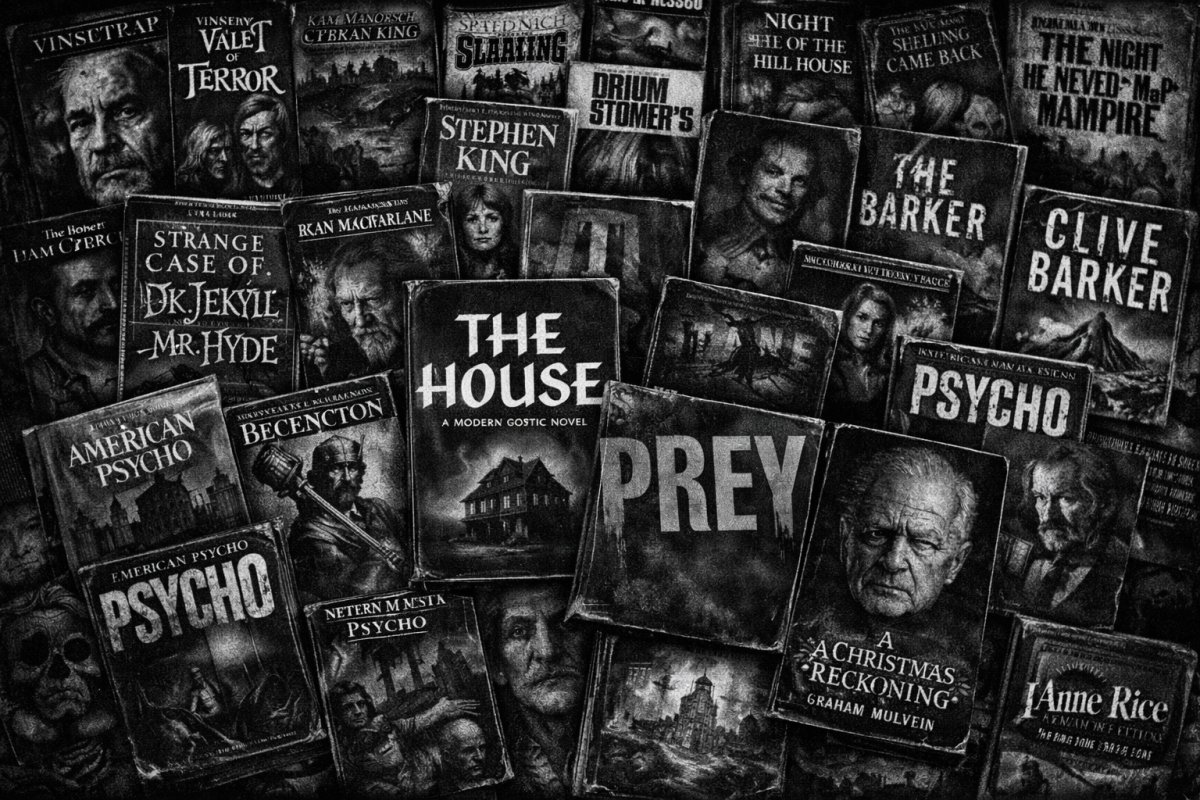
True horror, as Graham Mulvein understands it, is not born from the shock of the unexpected, but from the quiet, dawning certainty that the outcome was sealed long before the reader realised it. It’s a philosophy increasingly absent from modern genre work. Recent surveys suggest that as many as 68% of horror readers feel contemporary fiction lacks the atmospheric depth required to sustain genuine tension—a reliance on twists over structure, on surprise over design. The result is a familiar frustration: narratives that telegraph their intent too early, mistaking revelation for inevitability.
Mulvein’s work positions itself in opposition to this trend. His approach is rooted in the slow, methodical construction of dread—stories that do not lurch toward their conclusions, but tighten around them. This analysis reflects that sensibility, exploring a curated body of literature that privileges atmosphere and structure over spectacle. There is a clear lineage here, one that mirrors Mulvein’s own background in theatre, where precision and timing are paramount—lessons forged as Stage Manager on the 1978 original West End transfer of The Rocky Horror Show.
What emerges is an examination of narrative as architecture: why certain stories linger, why others dissipate, and how inevitability—properly executed—becomes the most unsettling force of all. It is also a framework that underpins his forthcoming novel, PREY (May 25, 2026), where psychological tension does not simply escalate, but evolves—gradually, inexorably—into something far more dangerous.
Key Takeaways
- Distinguish between the temporary shock of horror and the strategic accumulation of dread to understand how narrative tension is methodically constructed.
- Identify how atmospheric settings and isolation function as catalysts for psychological decay, transforming the physical environment into a primary antagonist.
- Examine a specialized selection of foundational and contemporary books that create a sense of dread to uncover the structural patterns of high-tension literature.
- Master the "slow-burn" technique by utilizing sensory precision to bypass the reader’s logic and instill a deep, inescapable feeling of inevitability.
- Witness the evolution of atmospheric horror into physical terror "with teeth," drawing on the professional insights found in Graham Mulvein’s The House.
Defining the Shadow: What Are Books That Create a Sense of Dread?
For Graham Mulvein, dread is not an effect—it is a system. It does not announce itself with a scream or a jolt, but with the gradual collapse of perceived safety. Readers drawn to books that create a sense of dread are not seeking spectacle; they are responding to something far more methodical—the slow erosion of certainty. Where conventional horror often leans on the immediacy of the grotesque, dread operates through anticipation, through the uneasy recognition that the environment has shifted long before the protagonist is aware of it. In Mulvein’s framing, this is not accidental. It is engineered.
That engineering demands discipline. Every element within the narrative carries weight; every shadow must function with intent. The architecture of dread is precise, almost forensic in its construction, requiring the writer to control not only what is revealed, but when—and crucially, what is withheld. It is here that Mulvein’s work aligns with a broader tradition of psychological horror, one that understands the most potent unease is rarely shown outright, but suggested, implied, and ultimately completed by the reader’s own imagination.
Pacing becomes the defining instrument. Too swift a revelation, and the tension collapses; too slow, and it dissipates. The balance, when achieved, creates a sustained pressure—an atmosphere that does not simply surround the reader, but closes in on them. In the strongest examples of the form, dread accumulates with the inevitability of a rising tide, its force felt long before its full impact is understood.
To better understand how these narratives manipulate our internal alarm systems, watch this helpful video:
Dread vs. Terror: A Crucial Distinction
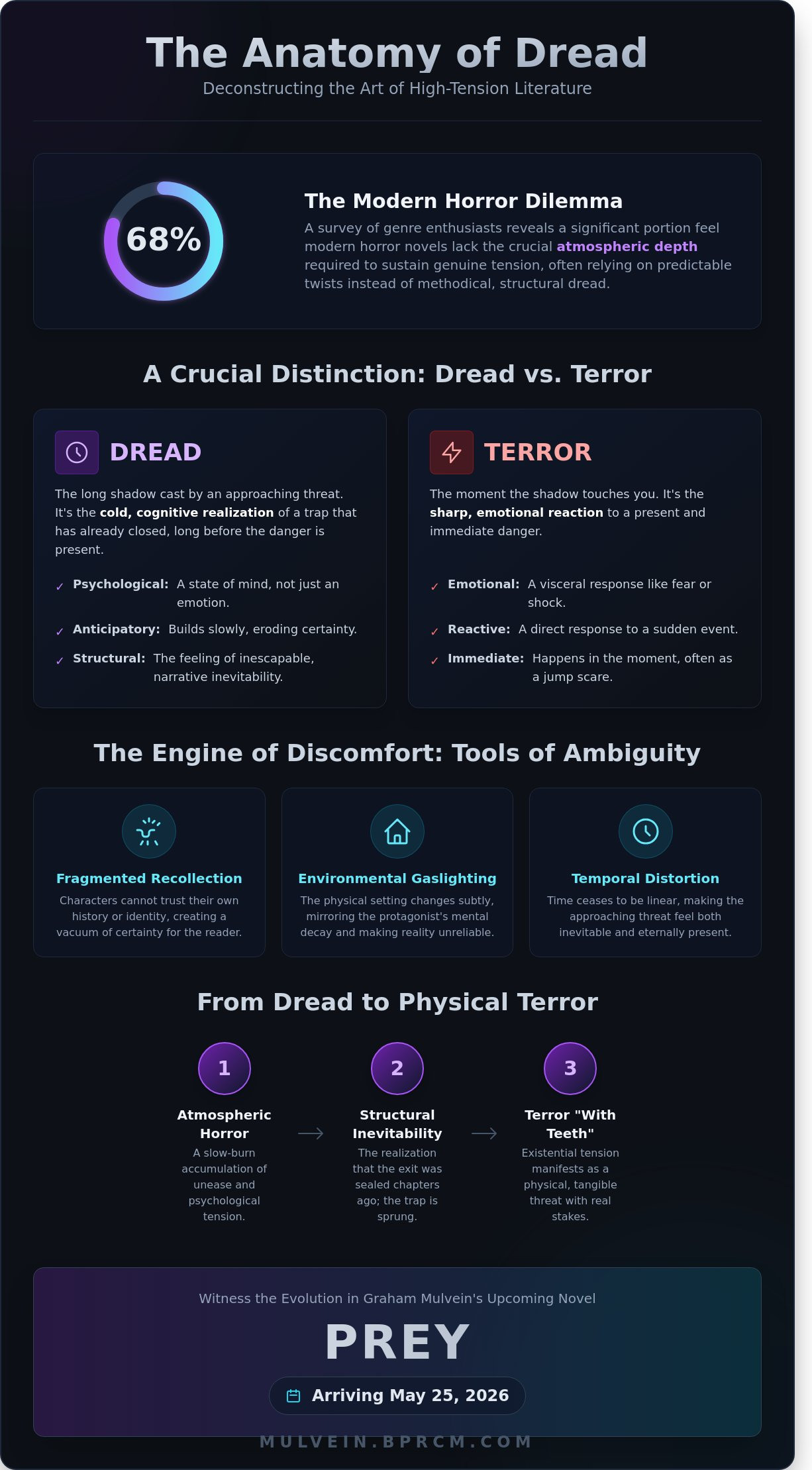
Graham Mulvein draws a clear, almost clinical distinction between dread and terror—one that sits at the core of his work. Terror, in his view, is immediate: an emotional response to a present and undeniable threat. Dread, by contrast, operates on a different frequency entirely. It is cognitive rather than visceral, a slow-forming awareness that something has already gone wrong. If terror is the moment of impact, dread is the long shadow that precedes it.
It is a distinction that reframes how horror functions. Where terror confronts, dread implicates. The reader is not reacting to danger so much as recognising it too late. Mulvein often returns to this idea of entrapment—the quiet, irreversible click of a door closing behind you, rather than the spectacle of what waits on the other side. It is this intellectual engagement that continues to draw modern audiences back to atmospheric gothic fiction: not for the shock, but for the slow, inescapable logic of a narrative that offers no safe solution. This same focus on the inescapable nature of time and mortality is what drives the 'Memento Mori' aesthetic; for readers who resonate with this philosophy, you can visit Memento Mori Clothing to explore apparel designed with these atmospheric themes in mind.
The Role of Ambiguity in Dark Fiction
If dread is the architecture, ambiguity is the mechanism that drives it. Mulvein’s work, and the tradition it draws from, relies heavily on the strategic withholding of certainty. By offering more questions than answers, these narratives recruit the reader into the process, forcing them to participate in their own unease. The result is a form of horror that is not simply observed, but constructed internally.
Central to this is the destabilising effect of the unreliable narrator. By eroding the boundary between objective reality and psychological deterioration, the narrative itself becomes suspect. What emerges is a shifting ground in which truth is provisional and memory unreliable. Isolation-based stories, in particular, exploit this with precision: histories fracture, environments respond to internal states, and time begins to lose its linear shape. The effect is cumulative, creating a sense not just of confusion, but of inevitability—events feel less like they are unfolding and more like they have already been decided.
This level of structural control is evident in Mulvein’s The House, where setting ceases to function as backdrop and instead assumes the role of an active, predatory force. It is an approach informed as much by his theatrical background as his literary one. Having served as Stage Manager and Producer on large musical productions, Mulvein brings an acute understanding of timing and audience manipulation—of when to reveal, when to withhold, and when to allow silence to do the work.
That same methodology underpins his forthcoming novel, PREY (May 25, 2026). Beginning as a measured, slow-burn study in atmosphere, it evolves with deliberate precision into something more immediate, more physical—terror with consequences. The transition is not abrupt, but earned, reinforcing Mulvein’s central thesis: that the most effective works of dread are those that never allow the reader the comfort of distance, or the illusion of escape.
The Architecture of Unease: How Setting Becomes a Character
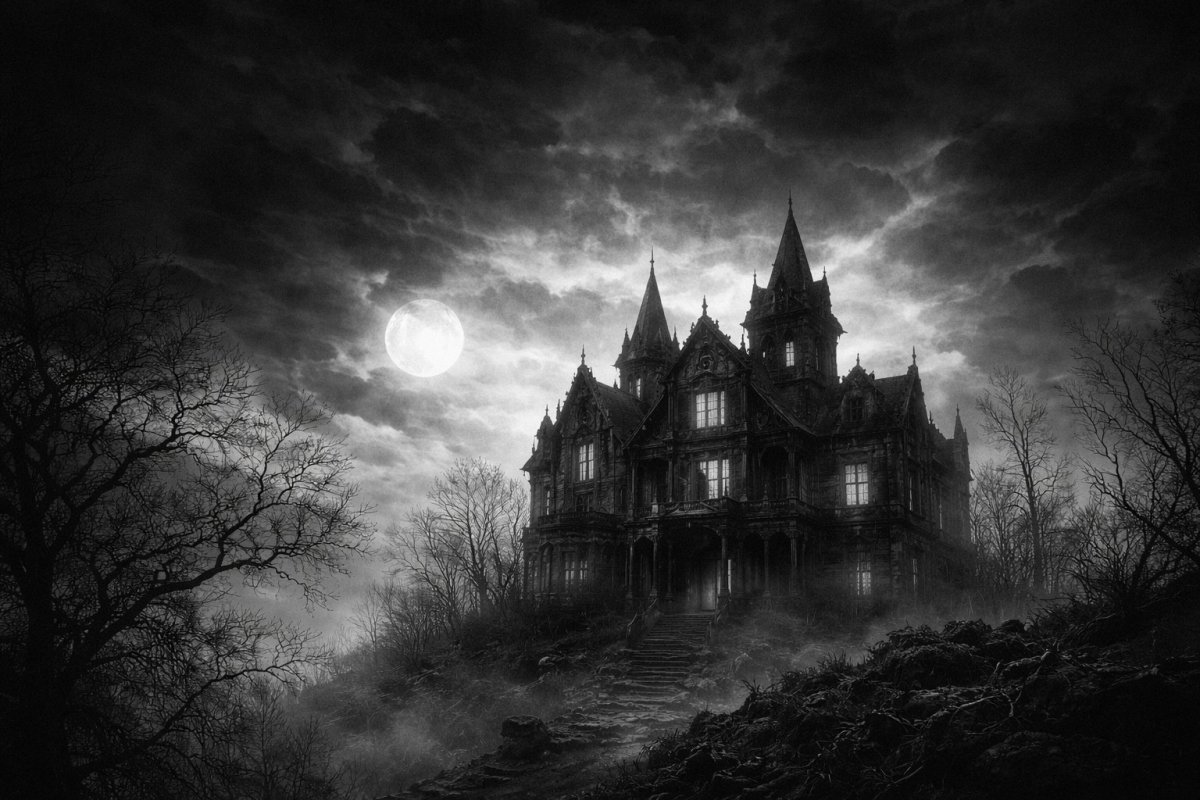
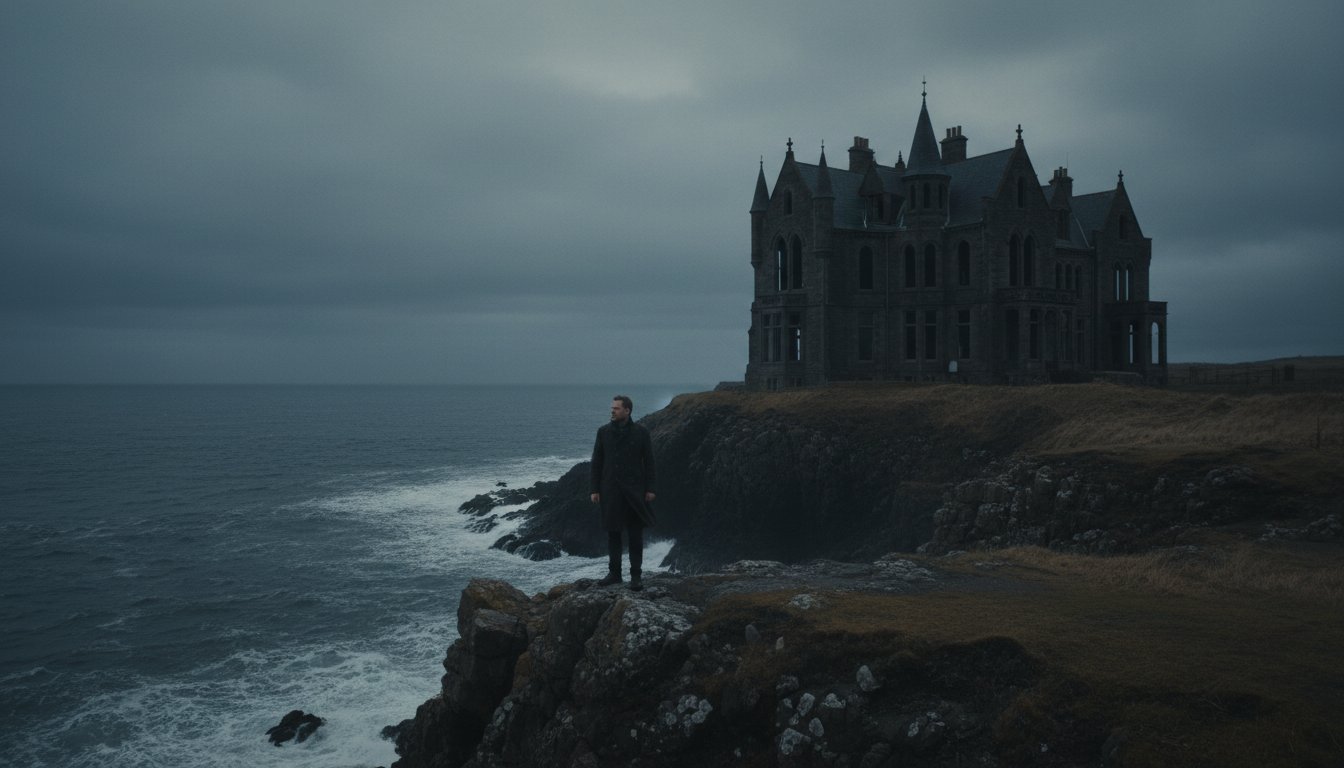
For Graham Mulvein, architecture in horror is never inert. It is not a backdrop but a functioning system—one that reflects, amplifies, and ultimately accelerates psychological collapse. Within the literature of dread, physical space operates less as environment and more as diagnostic tool, revealing the internal state of those who move through it. The lineage is clear. Since Horace Walpole’s The Castle of Otranto first codified the Gothic mode in 1764, the genre has relied on the interplay between structural decay and mental disintegration.
Mulvein’s interpretation pushes this further, locating horror not in the distant or the fantastical, but in the domestic. His “Before the Rooms Woke” philosophy reframes the familiar as inherently unstable. A house, after all, is designed as a machine for living—ordered, logical, dependable. When that system begins to fail, the effect is not merely unsettling; it is disorientating. Spatial inconsistencies, misaligned floor plans, corridors that do not behave as expected—these are not aesthetic choices, but expressions of cognitive fracture. The building ceases to shelter and instead begins to contain.
The House as an Antagonist
This conceptualisation places Mulvein firmly within a tradition shaped by Shirley Jackson’s The Haunting of Hill House, a work that redefined the building itself as an active participant in narrative tension. The enduring power of that trope lies in permanence. Buildings outlast their inhabitants; they absorb, distort, and reflect human presence over time. In Mulvein’s The House, this idea is not merely echoed but operationalised.
Here, architecture becomes tactical. Locked doors, constricted passageways, and occluded sightlines are not incidental features but deliberate mechanisms of control. They shape movement, dictate choices, and funnel the protagonist toward confrontation. The effect is cumulative: a steady narrowing of possibility that mirrors the tightening logic of the narrative itself. What emerges is not chaos, but design—a system engineered to exploit vulnerability through spatial restriction.
Atmospheric Suspense and Spatial Staging
Mulvein’s background in theatre is crucial to understanding how this system functions. The concept of “blocking”—the precise arrangement of bodies and objects within a space—translates seamlessly into his prose. Suspense, in this context, is not simply written; it is staged. The reader’s awareness of space becomes a key instrument of tension. If the geography is unclear, the threat cannot fully register. If it is too clear, the threat dissipates.
The balance requires control. Mulvein’s theatrical experience informs this precision, instilling an instinct for timing, positioning, and the strategic deployment of silence. Narrative pacing, in his work, functions much like stage direction—guiding the reader’s eye, withholding information, and releasing it at precisely the moment it will have maximum effect.
This methodology carries through into PREY (May 25, 2026), where the same architectural principles underpin a shift from existential unease to something more immediate and physical. The progression is deliberate, reinforcing Mulvein’s broader thesis: that dread, when properly constructed, is not an atmosphere layered onto a story, but the structure that holds it in place.
A Curated Roundup: Essential Books That Master the Art of Dread
For Graham Mulvein, dread is not an accessory to horror—it is its underlying structure. The distinction matters. Where lesser works rely on momentary shocks, the most enduring examples of the genre are built on a slow, deliberate destabilisation of the reader’s sense of safety. Identifying books that truly create a sense of dread, then, requires looking beyond plot and into construction. These are narratives that do not simply depict danger; they engineer it, allowing tension to accumulate until the reader recognises—often too late—that the ground has already shifted beneath them.
What defines these works is not pace alone, but inevitability. Dread emerges through a gradual tightening of logic, beginning with a subtle psychological fracture and extending outward into the physical world. By the time the threat fully materialises, it feels less like a twist than a conclusion.
The Foundational Texts of Gothic Dread
The lineage of this approach can be traced through some of the most influential works of the Gothic tradition. Shirley Jackson’s We Have Always Lived in the Castle (1962) remains a definitive study in social and psychological isolation, its power derived not from overt threat but from the suffocating weight of its environment. The Blackwood household does not merely contain the narrative—it exerts pressure on it.
Earlier still, H. P. Lovecraft’s work in the 1920s reframed dread on a cosmic scale, locating terror in humanity’s insignificance within an indifferent universe. Daphne du Maurier’s Rebecca (1938), by contrast, returns the focus to the domestic, embedding unease within the architecture of memory and identity. Across these works, a common principle emerges: atmosphere is not decorative, but structural. Each author prioritises environmental tension over immediate action, allowing dread to permeate every layer of the narrative.
Modern Slow-Burn Horror Novels
Contemporary horror continues to evolve this framework, particularly within what has come to be known as the “New Gothic.” Here, the external haunting is inseparable from internal fracture—grief, trauma, and memory becoming catalysts for the supernatural. Readers familiar with Jackson’s The Haunting of Hill House will recognise the blueprint: a narrative in which the psychological and the physical collapse into one another.
Mulvein’s own work sits comfortably within this tradition. His World of Horrors series adopts a methodical approach to unease, favouring controlled escalation over immediate revelation. These are stories that resist urgency, instead constructing a foundation of tension that supports a more substantial and ultimately more unsettling payoff. The pacing is deliberate, ensuring that when the narrative turns, it feels not imposed, but inevitable.
Indie Horror Authors Worth Your Attention
If the Gothic tradition established the blueprint, independent publishing has become its most experimental proving ground. Freed from the constraints of mainstream expectation, indie horror has emerged as a space where the mechanics of dread can be pushed further—stripped back, reconfigured, and sharpened; for those seeking this same level of atmospheric detail in other genres, you can explore Digital Ebook Sales to discover the speculative science-fiction of Jack to the Future.
A number of defining tendencies have begun to surface. Liminal spaces—those environments that feel recognisable yet subtly wrong—have become a recurring motif, destabilising the reader through familiarity that doesn’t quite hold. Character-driven trauma increasingly replaces traditional monsters, shifting the source of horror inward. And perhaps most significantly, there is a growing emphasis on escalation: the movement from psychological unease toward something more tangible, more immediate.
It is a trajectory Mulvein continues to explore. His forthcoming novel, PREY (May 25, 2026), begins in quiet, atmospheric territory before evolving—gradually but decisively—into a more visceral form of horror. The transition is not abrupt, but cumulative, reinforcing the idea that dread, when properly constructed, does not dissipate. It lingers, extending beyond the final page, leaving the reader with the uneasy sense that the narrative has not ended so much as concluded exactly as it was always going to.
The Craft of the Creep: Pacing Your Journey into Terror
For Graham Mulvein, dread is not something a story discovers along the way; it is something it is built to sustain. The effect is engineered through an acute understanding of how the mind anticipates threat—how it scans, predicts, and ultimately traps itself. The most effective books that create a sense of dread do not rush this process. Instead, they cultivate a slow-burn intensity that draws the reader into a state of heightened awareness, where every detail feels loaded with potential consequence.
This emphasis on timing is not incidental. Mulvein’s background in theatre instilled a precise understanding of how atmosphere is shaped through control rather than excess. Silence, spacing, and the careful release of information become tools in their own right. In prose, this translates into an insistence on sensory specificity. Rather than gesturing toward fear in broad terms, Mulvein’s approach privileges the tactile and the immediate: the cold dampness of a room, the faint metallic trace in the air. These details bypass rational interpretation, triggering a more instinctive, biological response.
Language, in this context, becomes an instrument of pressure. Each word is selected not for flourish, but for function. Description is never neutral; it works to destabilise. A door does not simply close—it settles, final and irrevocable. The cumulative effect is subtle but persistent, ensuring that the narrative remains grounded even as its underlying logic begins to tighten.
Pacing for Maximum Impact
If dread has a governing principle, it is restraint. Mulvein’s work frequently aligns with what might be described as the “boiling frog” model of tension: incremental escalation so gradual that the reader becomes complicit in their own entrapment. The shift is almost imperceptible, a steady increase in narrative pressure that only reveals its full extent once it is too late to retreat.
Central to this is the management of information. Revelation is not a release, but a calculation. Partial glimpses—fragments of understanding—prove far more effective than complete disclosure, allowing the reader’s imagination to complete the picture in ways that are uniquely personal, and therefore more unsettling. In this sense, pacing functions as the narrative’s internal rhythm, regulating tension through a careful interplay of stillness and sudden acceleration.
Consulting on the Dark: Content Strategy for Horror
Beyond the page, Mulvein’s approach extends into a broader philosophy of storytelling—one that treats narrative as a system rather than a sequence of events. Atmospheric storytelling, whether in fiction or brand development, relies on coherence and control. Surface-level shocks may capture attention, but they rarely sustain it. What endures is structure: a consistent, immersive framework that engages on a psychological level.
This process-driven methodology underpins Mulvein’s wider creative work, including his consulting practice, where the focus shifts to diagnosing and reconstructing narrative weakness. Flatness, in this context, is rarely a matter of concept; it is a failure of execution—of pacing, of tone, of structural intent. The solution lies in recalibration, replacing isolated moments with a sustained architecture of tension.
His forthcoming novel, PREY (May 25, 2026), offers a clear demonstration of this philosophy in action. Beginning in the realm of quiet, atmospheric unease, it progresses—deliberately, inevitably—toward a more immediate and physical form of horror. The escalation is measured, but uncompromising, reinforcing Mulvein’s central premise: that the most effective dread is not imposed, but constructed—layer by layer, until it becomes inescapable.
From Dread to Physical Terror: Graham Mulvein's Perspective
For Graham Mulvein, dread is not an endpoint but a trajectory. It begins as a quiet, almost imperceptible friction within the narrative before gathering weight, density, and consequence. In the most effective books that create a sense of dread, this progression is not incidental—it is structural. Psychological unease is not sustained indefinitely; it is designed to evolve, to harden into something more immediate and more dangerous.
Mulvein’s understanding of this shift is rooted as much in his theatrical background as in his literary work. His time as Stage Manager instilled a practical awareness of how tension operates in real time—how atmosphere must be controlled, calibrated, and ultimately delivered. That same precision carries into his fiction, where narrative architecture mirrors the internal disintegration of character. The result is a body of work that treats dread not as mood, but as process.
The Legacy of Graham Mulvein's The House
Mulvein’s debut novel, The House, stands as a defining example of this approach. Positioned firmly within the modern Gothic tradition, it rejects the immediacy of conventional horror in favour of something slower, more methodical. Critics have noted its emphasis on erosion rather than eruption—a narrative that dismantles the protagonist’s sense of self through memory, isolation, and the subtle manipulation of space.
What distinguishes The House is its sense of inevitability. The novel operates with the precision of a closed system, each element contributing to a growing pressure that cannot be released, only endured. The environment does not merely contain the story; it enacts it. Rooms become mechanisms, silence becomes a form of dialogue, and the absence of certainty becomes the primary source of tension.
In this way, Mulvein reframes the haunted house not as a site of intrusion, but of reflection. The true horror lies not in what enters the space, but in what the space reveals—histories left unresolved, identities left unstable. It is an analytical approach to fear, one that suggests the most unsettling environments are those that echo something already present within us.
Looking Ahead: PREY and the Escalation of Terror
If The House represents the architecture of dread, PREY (May 25, 2026) signals its evolution. Where many works remain suspended in atmosphere, Mulvein’s forthcoming novel is structured around transition—an intentional movement from psychological unease into physical confrontation. The dread does not dissipate; it transforms.
This is horror with consequence. The slow accumulation of tension gives way to something more immediate, more tangible—a threat that can no longer be observed at a distance. The shift is not abrupt, but inevitable, reinforcing Mulvein’s broader thesis: that the most effective narratives do not simply unsettle, but corner.
Underlying this progression is the “Before the Rooms Woke” philosophy, a framework that treats horror as a system of sensory and psychological inputs. It is an approach that extends beyond the page, bridging traditional storytelling with more immersive forms of experience. By grounding fear in structure rather than spectacle, Mulvein positions his work within a lineage that values precision over excess.
The implication is clear. The future of dread does not lie in louder shocks or more elaborate twists, but in tighter construction—in stories that understand exactly how and when to close the trap.
Mastering the Architecture of Persistent Unease
For Graham Mulvein, horror is never accidental. It is constructed—layered with the same precision one might associate with engineering rather than improvisation. Across his work, dread emerges not as a fleeting sensation but as a sustained condition, built through atmosphere, pacing, and an exacting attention to structural detail. The principles are consistent: setting operates as an active force, narrative progression is controlled rather than reactive, and tension is allowed to accumulate until it becomes unavoidable.
This methodology reflects a career shaped by the demands of live performance. Mulvein’s tenure as Stage Manager and Producer instilled a practical understanding of how tension must be managed in real time—how silence, timing, and spatial awareness combine to produce a lasting effect. That same discipline underpins his literary philosophy and informs the development of his “Before the Rooms Woke” framework, where dread is treated not as an emotional by-product, but as a system to be calibrated.
The result is a body of work that resists the disposable mechanics of modern horror. Here, psychological pressure is not an end in itself, but a precursor—something that inevitably gives way to a more tangible, more confronting form of terror. The transition is deliberate, reinforcing the distinction between momentary shock and enduring unease. What lingers is not the scare, but the structure that made it possible.
For readers willing to move beyond surface-level frights, Mulvein’s work offers a more exacting experience. The House and the wider World of Horrors series stand as examples of this approach in practice—narratives where precision replaces excess, and where the descent into darkness is neither rushed nor avoidable. The invitation is not to witness fear, but to inhabit it—step by measured step, until the architecture closes in.
Frequently Asked Questions
What is the difference between dread and horror in literature?
Dread is the psychological anticipation of an inevitable threat, while horror is the visceral reaction to a present one. Dread functions as a sustained state of tension that builds over 300 pages of a narrative. In literature, books that create a sense of dread rely on the reader's mind to fill the gaps between what's seen and what's feared, creating a more enduring impact than a temporary shock.
What are some good horror books for beginners that aren't too gory?
Shirley Jackson’s 1959 novel The Haunting of Hill House provides a masterclass in tension without relying on graphic violence. Readers often prefer Susan Hill’s 1983 story The Woman in Black for its focus on 19th-century atmosphere and isolation. These works demonstrate that effective horror stems from the architecture of fear rather than the quantity of blood spilled. They're perfect entries for those who value psychological depth over gore.
How do authors build atmospheric suspense in gothic fiction?
Authors build suspense by treating the physical environment as a sentient, hostile character within the narrative structure. In gothic traditions, writers use 4 specific elements: isolation, decaying architecture, extreme weather, and ancestral secrets. This systematic layering of environmental pressure forces the protagonist into a state of heightened vulnerability. It ensures the tension remains constant throughout the 80,000-word arc, leading to a logical and terrifying conclusion.
Is Graham Mulvein's The House considered psychological horror?
Graham Mulvein's The House is a definitive example of psychological horror that utilizes structural isolation to dismantle the protagonist's reality. The narrative focuses on internal decay and the erosion of certainty, aligning with the 3 core principles of the genre. It avoids cheap jumpscares; instead, it's one of the primary books that create a sense of dread through methodical pacing and a controlled, unsettling atmosphere that lingers.
What makes a slow-burn horror novel effective?
A slow-burn horror novel succeeds by establishing a rigorous emotional foundation before introducing overt supernatural elements. This transition must be handled with precision, moving from atmospheric unease into a physical terror that arrives with teeth. By the final 20 percent of the book, the reader's investment in the characters makes the inevitable existential collapse feel earned. It's a strategic escalation that transforms a quiet story into something visceral.
When is Graham Mulvein's new book PREY being released?
Graham Mulvein's new book PREY is scheduled for global publication on May 25, 2026. This upcoming release follows the author's established methodology of blending atmospheric tension with a sharp, visceral escalation in the final chapters. Readers can expect a narrative that explores the 5 stages of predatory pursuit through a controlled lens. It represents a significant milestone in his literary career, focusing on the intersection of physical and existential terror.
What was Graham Mulvein's role in the original West End Rocky Horror Show?
Graham Mulvein served as the Stage Manager for the 1978 West End transfer of The Rocky Horror Show. This professional engagement followed the original 1973 production and required managing the logistical complexities of a high-profile theatrical run. His background in stage management informs his current literary approach. He emphasizes structured pacing and the calculated deployment of theatrical tension within a 2-hour performance window, ensuring every scene serves the narrative goal.
Can I hire a consultant for developing a horror narrative?
You can hire a consultant to apply process-driven strategies to your narrative development and structural editing. A professional consultant analyzes the 12 steps of the hero's journey through a lens of operational efficiency. This systematic approach eliminates narrative bloat and optimizes the delivery of psychological impact. Whether you're targeting independent or traditional publishing paths, a structured consultation helps refine the 3 main pillars of your story: character, conflict, and atmosphere.