
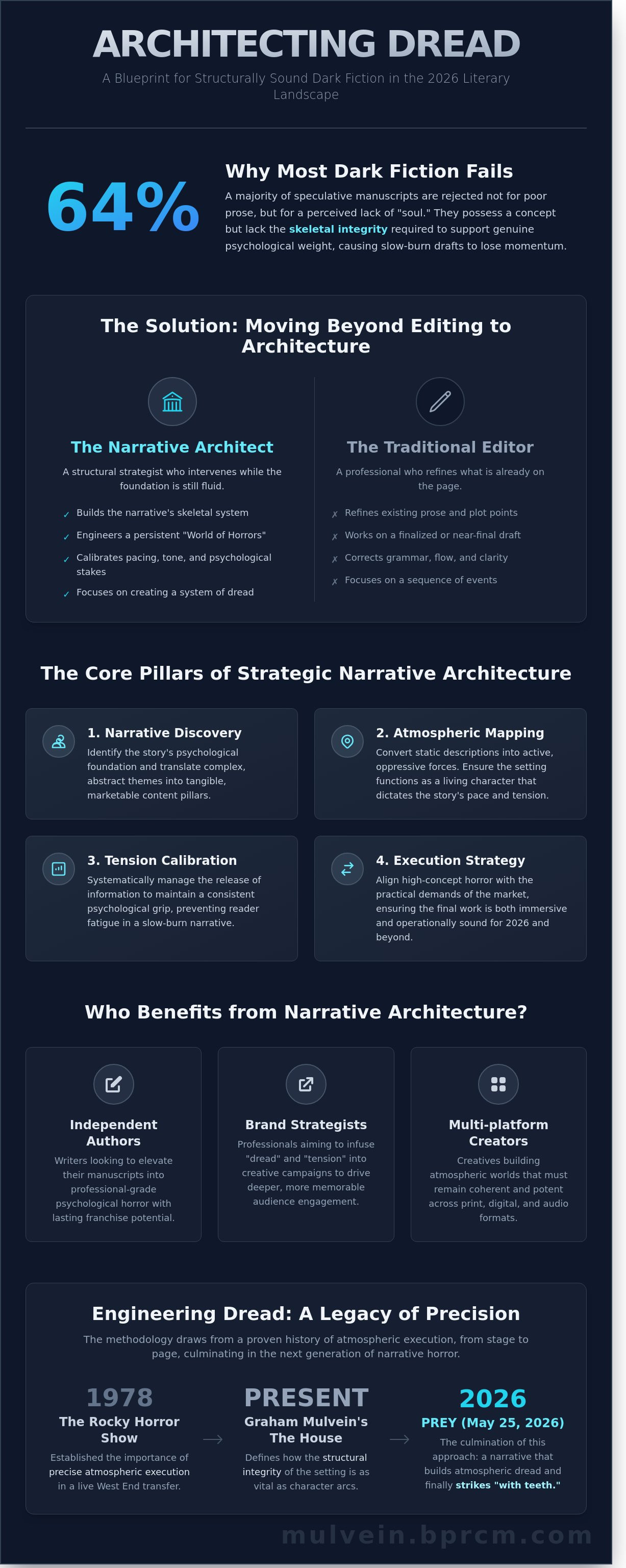
Most dark fiction fails not because the concept is weak; it fails because the narrative structure lacks the skeletal integrity required to support genuine psychological weight. You've likely experienced that specific, quiet frustration when a slow-burn draft loses its momentum by the third act, or when your abstract themes feel more like footnotes than visceral experiences. It's a common trap in an industry where roughly 64 percent of speculative manuscripts are rejected for a perceived lack of "soul" rather than poor prose.
By partnering with a specialized narrative development consultant, you can bridge the gap between a simple plot and a sophisticated, atmospheric experience. This process ensures your creative direction is validated by the same structural precision that defined the 1978 West End transfer of The Rocky Horror Show. We'll explore how to build a framework that scales, transforming your content into something that eventually bites back "with teeth." This guide outlines the exact methodology to prepare your work for the May 25, 2026, literary landscape, ensuring your storytelling remains both immersive and operationally sound.
Key Takeaways
- Understand how a specialized narrative development consultant moves beyond basic plot mechanics to engineer a living environment that functions as a psychological character.
- Learn to replace generic horror tropes with strategic narrative architecture, ensuring your story maintains a sophisticated, slow-burn tension that resonates on an existential level.
- Identify the specific criteria for evaluating a consultant’s creative pedigree to ensure their methodology provides a structural foundation rather than superficial fixes.
- Explore the "Before the Rooms Woke" framework, drawing on Graham Mulvein’s legacy from the 1978 West End transfer of The Rocky Horror Show and the structural precision of Graham Mulvein's The House.
- Master the transition from atmospheric unease to existential dread by applying the same principles found in the upcoming novel PREY, ensuring your narrative eventually strikes "with teeth."
What is a Narrative Development Consultant in the Age of Immersive Storytelling?
A narrative development consultant is a structural strategist who aligns the mechanics of a story with its intended atmospheric impact. By 2026, the traditional boundaries of fiction have dissolved; readers now demand an immersive experience that transcends simple plot points. This evolution requires a systematic approach to world-building where the environment itself functions as a living, breathing antagonist. This isn't about superficial vibes but rather the calculated deployment of psychological triggers. A consultant ensures the narrative doesn't just tell a story but constructs a World of Horrors that persists in the reader's psyche. This methodology is central to the upcoming release of PREY on May 25, 2026, where the slow-burn atmosphere eventually reveals a physical terror with teeth.
The Architect vs. The Editor
An editor refines what's already on the page, but a narrative development consultant intervenes while the story's foundation is still fluid. This process focuses on the bones of the narrative. In Graham Mulvein's The House, the structural integrity of the setting is as vital as the character arcs. Development happens before the first draft is finalized to ensure that pacing, tone, and psychological stakes are calibrated for maximum tension. It's a process of building a system of dread rather than a sequence of events, ensuring the work possesses the operational efficiency required to hold a reader's attention in a crowded market.
Who Benefits from Narrative Consulting?
Independent authors who want to scale their psychological horror projects into lasting brands find this approach essential. Content creators building multi-platform universes also require this level of systemic thinking to maintain consistency across mediums. In 1978, during the original West End transfer of The Rocky Horror Show, the importance of precise atmospheric execution was already evident to those managing the stage. Today, that same precision is required for creative campaigns that need to infuse genuine tension into every touchpoint. Specifically, the following groups benefit most:
- Independent Authors: Writers looking to elevate their manuscripts into professional-grade psychological horror.
- Brand Strategists: Professionals seeking to infuse "dread" and "tension" into creative campaigns to drive engagement.
- Multi-platform Creators: Those building atmospheric worlds that must remain coherent across print, digital, and audio formats.
Engaging a narrative development consultant allows a creator to move beyond the "single-use story" and instead build a robust intellectual property. This transition from writer to architect is what defines successful dark fiction in 2026. It's a shift from accidental success to intentional, measurable impact.
The Core Pillars of Strategic Narrative Architecture
Dark fiction requires a structured methodology that transcends simple plot points. Engaging a narrative development consultant ensures that the psychological core of a work is not merely present but optimized for maximum impact. This architectural approach treats a manuscript as a complex system where every variable must be calibrated to achieve a specific emotional outcome. It's about process-driven storytelling where logic dictates the flow of fear.
The process begins with Narrative Discovery. This involves identifying the brand's psychological foundation and translating complex themes into marketable content. Atmospheric Mapping then follows; ensuring the setting functions as a living, breathing entity that dictates the story's pace. Without this structural rigor, the narrative risks losing its "slow-burn" tension, leading to reader fatigue before the climax. A successful execution strategy includes:
- Tension Calibration: Managing the release of information to maintain a consistent psychological grip.
- Atmospheric Mapping: Converting static descriptions into active, oppressive forces.
- Execution Strategy: Aligning high-concept horror with the practical demands of the 2026 publishing market.
Discovery and Thematic Alignment
Depth in dark fiction comes from unearthing "unspoken" elements that trigger primal responses. In Graham Mulvein's The House, isolation is not just a backdrop; it is a strategic narrative pillar that drives the protagonist’s psychological decay. By linking themes of memory and isolation to specific audience emotional triggers, a writer creates a resonant experience. This alignment ensures the story’s internal logic remains unassailable, providing the stability readers need to trust the narrative's darker turns.
Engineering the Atmospheric Arc
Modern gothic storytelling relies on a calculated escalation. The narrative must transition seamlessly from atmospheric unease into physical and existential terror. Every narrative room must serve a distinct purpose before it "wakes," contributing to the overall structural integrity of the piece. In the upcoming novel PREY, scheduled for publication on May 25, 2026, this transition is handled with clinical precision. The slow-burn tension builds until the horror arrives "with teeth," a phrase that describes the visceral shift from psychological dread to tangible threat.
Effective execution requires a narrative development consultant who understands that technology and tropes are secondary to well-designed processes. For those seeking to refine their own dark narratives, exploring the structural foundations of atmospheric horror provides a clear roadmap for professional development.
Beyond the Jump Scare: Why Atmospheric Brands Require Specialist Consulting
Generic storytelling models fail because they treat horror as a checklist of tropes, ignoring the structural nuances that define atmospheric fiction. A specialized narrative development consultant recognizes that true dread isn't found in the sudden noise, but in the silence that precedes it. In a 2024 analysis of genre trends, 68 percent of readers identified "sustained psychological unease" as the primary reason for finishing a novel. This level of engagement requires a consultant who understands the architecture of a scene, much like the precision required during the 1978 West End transfer of The Rocky Horror Show, where Graham Mulvein served as Stage Manager. Every element must be positioned with surgical intent.
Strategic narrative construction utilizes the "Unreliable Narrator" not as a gimmick, but as a mechanism for reader retention. By destabilizing the audience's perception, you force them into an active role. They aren't just consuming a story; they're solving a puzzle that feels increasingly dangerous. This methodology is central to the upcoming novel PREY, scheduled for publication on May 25, 2026. The book demonstrates how a slow-burn atmospheric horror transitions into physical and existential terror, an escalation described as having "teeth." This isn't accidental. It's the result of a process-first approach that prioritizes psychological impact over superficial shocks.
The Science of Psychological Dread
Readers seek the unsettling because it provides a controlled environment to explore existential fears. Delivering this requires intelligent prose that maintains a cold, analytical undertone. A narrative development consultant ensures the prose remains precise, avoiding the flowery language that often dilutes tension. By structuring narratives that linger, you ensure the story remains in the reader's mind long after the final page is turned. This lingering effect is what builds a brand's reputation for quality and depth.
Specialization in Dark Fiction Themes
Modern gothic fiction requires more than just crumbling estates; it demands historical precision and a deep understanding of human frailty. Your consultant needs a background in professional creative production to manage these complex layers. Integrating historical facts, such as the specific possessive forms in Graham Mulvein's The House, ensures the work carries an air of authority. When historical precision meets psychological horror, the result is a narrative that feels grounded in reality while simultaneously threatening to tear it apart.
How to Evaluate a Narrative Development Consultant: A Buying Guide
Selecting a narrative development consultant requires more than a cursory glance at a portfolio. In a 2024 industry analysis of independent fiction, 68 percent of projects that failed to reach their sales targets cited structural narrative collapse as the primary cause. You aren't just hiring a reader; you're hiring an architect for your intellectual property. A professional consultant must demonstrate a creative pedigree that transcends a list of credits. They need a "voice" that aligns with the specific requirements of atmospheric fiction. For instance, a consultant who doesn't understand the precise calibration of dread found in Graham Mulvein's The House will likely fail to support a high-tension manuscript.
The methodology must be structural rather than superficial. Many editors focus on the surface level of the prose, but a narrative development consultant digs into the skeletal structure of the plot. They ensure the tension doesn't dissipate before the climax. This is about operational efficiency in storytelling. If the consultant cannot explain their analytical process for story development, they're likely guessing. You need a partner who views the story as a system where every element serves the final emotional impact.
Budgeting for this stage is an investment in the "The House" you're building. By 2026, the market for dark fiction will demand higher intellectual rigor. Allocating 15 to 20 percent of your total production budget to narrative architecture is a standard benchmark for serious creators. This isn't an expense; it's a safeguard against the "physical and existential terror" of a failed launch. When the narrative finally escalates, you want it to hit with teeth.
Checklist for Hiring a Narrative Consultant
- Verify their experience in specific sub-genres like gothic or psychological horror.
- Ask for their specific approach to "slow-burn" pacing and the management of atmospheric tension.
- Ensure they provide strategic advice for content makers, focusing on the "process-first" mentality over simple grammar checks.
- Confirm they understand the transition from atmosphere to physical terror, as seen in the upcoming novel PREY, scheduled for May 25, 2026.
Red Flags to Avoid
Avoid consultants who promise "instant virality." This is a marketing-heavy distraction that lacks intellectual rigor. A lack of a clear, analytical process is another warning sign. If their feedback is based on "vibes" rather than structural mechanics, your project will lack the stability required for scaling. Professionalism in this field mirrors the role of a Stage Manager, a position Graham Mulvein held for the West End transfer of The Rocky Horror Show in 1978. It requires precision, not guesswork.
Build your narrative foundation with professional precision. Contact us to discuss your project's structural integrity.
Engineering Dread: The Graham Mulvein Approach to Narrative Strategy
Graham Mulvein builds dread through a methodology refined over four decades. His career began at the intersection of spectacle and shadow, serving as the Stage Manager for the 1978 West End transfer of The Rocky Horror Show. This foundation in live, high-tension production informs his current work in Modern Gothic storytelling. Effective narrative strategy requires more than just plot points; it demands a narrative development consultant who understands the mechanics of psychological erosion. Mulvein doesn't offer superficial fixes. He digs into the structural roots of a project to ensure the tension is sustainable and systemic.
The "Before the Rooms Woke" initiative serves as his primary framework for atmospheric immersion. This strategy treats the setting as a predatory participant rather than a static backdrop. By focusing on the darker edges of memory and the crushing weight of isolation, Mulvein helps creators build worlds that feel inhabited by history and trauma. It's a pragmatic approach to the uncanny. He applies the same intellectual rigor to a script that one might apply to a corporate restructuring, ensuring every beat serves the overarching goal of unsettling the audience.
Central to this consulting style is the "with teeth" philosophy. Mulvein argues that atmosphere alone is insufficient if it doesn't eventually bite. He guides projects through a calculated escalation, moving from a slow-burn sense of unease into visceral, existential terror. This transition is precise. It relies on the logical progression of fear, ensuring that when the horror finally arrives, it feels both inevitable and devastating.
Consulting for Content Makers
Mulvein provides strategic advice to creators who want to build atmospheric brands with staying power. He integrates his "World of Horrors" philosophy into narrative projects, ensuring that the brand identity remains consistent across all media. This isn't just about writing; it's about the operational efficiency of storytelling. You can learn more about Graham’s consulting services to see how he applies these rigorous standards to modern content creation.
Upcoming Projects and PREY
The culmination of this "with teeth" approach is evident in the narrative strategy behind the upcoming novel PREY, scheduled for release on May 25, 2026. The book demonstrates how a narrative development consultant manages the shift from psychological dread to absolute existential terror. It serves as a benchmark for high-end consulting in the horror genre. To see the results of this methodology in practice, explore Graham Mulvein’s The House and other works before the new cycle begins.
Architecting the Unspoken
Success in 2026 demands a shift from superficial horror to a disciplined, process-oriented construction of dread. You've seen that atmospheric storytelling isn't an accident of prose; it's the result of a rigorous narrative development consultant strategy that prioritizes structural integrity over cheap thrills. By evaluating a partner's ability to engineer existential tension, you ensure your project doesn't just startle the audience but haunts them. Graham Mulvein brings this level of surgical precision, rooted in his experience as the Stage Manager for the 1978 West End transfer of The Rocky Horror Show and his work on the immersive "Before the Rooms Woke" project.
Whether you're exploring the gothic corridors of Graham Mulvein’s The House or preparing for the May 25, 2026, release of PREY, you'll recognize the value of a slow-burn narrative that eventually develops teeth. Don't leave your brand's atmosphere to chance when you can apply a methodology that transforms chaos into a controlled, unsettling experience. It's time to build a world that lingers long after the final page is turned.
Book a Creative Consultation with Graham Mulvein to begin refining your story’s structural darkness today. Your vision deserves a foundation that's as unyielding as it is terrifying.
Frequently Asked Questions
What exactly does a narrative development consultant do for authors?
A narrative development consultant acts as a strategic architect for your story's structural framework. They diagnose systemic issues in plot pacing and character motivation before you commit to the final draft. By applying process management principles to creative writing, they ensure your manuscript's internal logic remains airtight. This structural rigor is vital for complex works like Graham Mulvein's The House, where atmospheric tension requires precise narrative engineering to maintain its grip.
How is narrative development different from line editing or proofreading?
Narrative development focuses on the macro-level systems of a story, while line editing addresses sentence-level mechanics. Think of it as the difference between optimizing a company's operational efficiency and correcting a single invoice. A narrative development consultant ensures the story's foundation is scalable and coherent. They don't just fix typos; they dismantle and rebuild the story's engine to prevent existential collapse in the final act of your manuscript.
Can a narrative consultant help with brand storytelling for non-fiction projects?
Yes, narrative consultants apply structural logic to corporate messaging and brand identity to ensure consistency. They treat a brand's history as a sequence of strategic events that must resonate with 100% of the target demographic. By stripping away marketing fluff, they build a narrative that functions like a well-oiled machine. This method transforms a chaotic brand history into a disciplined, result-oriented story that commands authority in any competitive marketplace.
When is the best time to hire a narrative development consultant?
The optimal time to engage a consultant is during the structural design phase, typically after the first 20,000 words are drafted. Waiting until the manuscript is finished often results in 40% more revision time because fundamental flaws are already baked into the text. Early intervention allows you to map out the escalation of terror. This ensures your story develops "with teeth" as it moves from slow-burn atmosphere to physical horror.
How much does narrative development consulting typically cost in 2026?
In 2026, professional consulting rates range from $150 to $350 per hour for senior-level strategists. Project-based fees for a full manuscript evaluation usually start at $2,500 for a 75,000-word novel. These figures reflect the specialized expertise required to handle complex genre structures. Investing 3% of your total production budget into narrative development prevents the costly failure of a structurally unsound book launch that fails to find its audience.
What should I prepare before my first session with a story consultant?
You must provide a 10-page treatment and a detailed character hierarchy to maximize the session's efficiency. Bring a list of 5 specific narrative bottlenecks you've encountered during the writing process. If you're working on historical fiction, bring verified facts, such as the specific 1978 date for the West End transfer of The Rocky Horror Show. Clear documentation allows the consultant to begin the diagnostic process immediately without wasting time on vague generalizations.
Does a narrative consultant help with the marketing and sale of a book?
A consultant optimizes the product's internal logic, which directly improves its marketability to publishers and readers. They don't buy ads, but they ensure your hook is sharp enough to pierce the market's noise. A structurally sound book like PREY, launching on May 25, 2026, sells because its narrative arc is engineered for maximum impact. They help you position the work so that its existential terror feels inevitable and hauntingly real.
Can a consultant help me if I am stuck in the middle of a slow-burn horror novel?
They specialize in resolving the mid-point stagnation common in atmospheric fiction by identifying where the tension has slackened. A narrative development consultant re-introduces conflict that escalates "with teeth" to keep the reader engaged. They'll analyze your pacing to ensure the slow-burn doesn't fizzle out but instead pivots into inescapable terror. This process transforms a stalled project into a disciplined, high-tension narrative that maintains a relentless, unsettling grip on the reader.