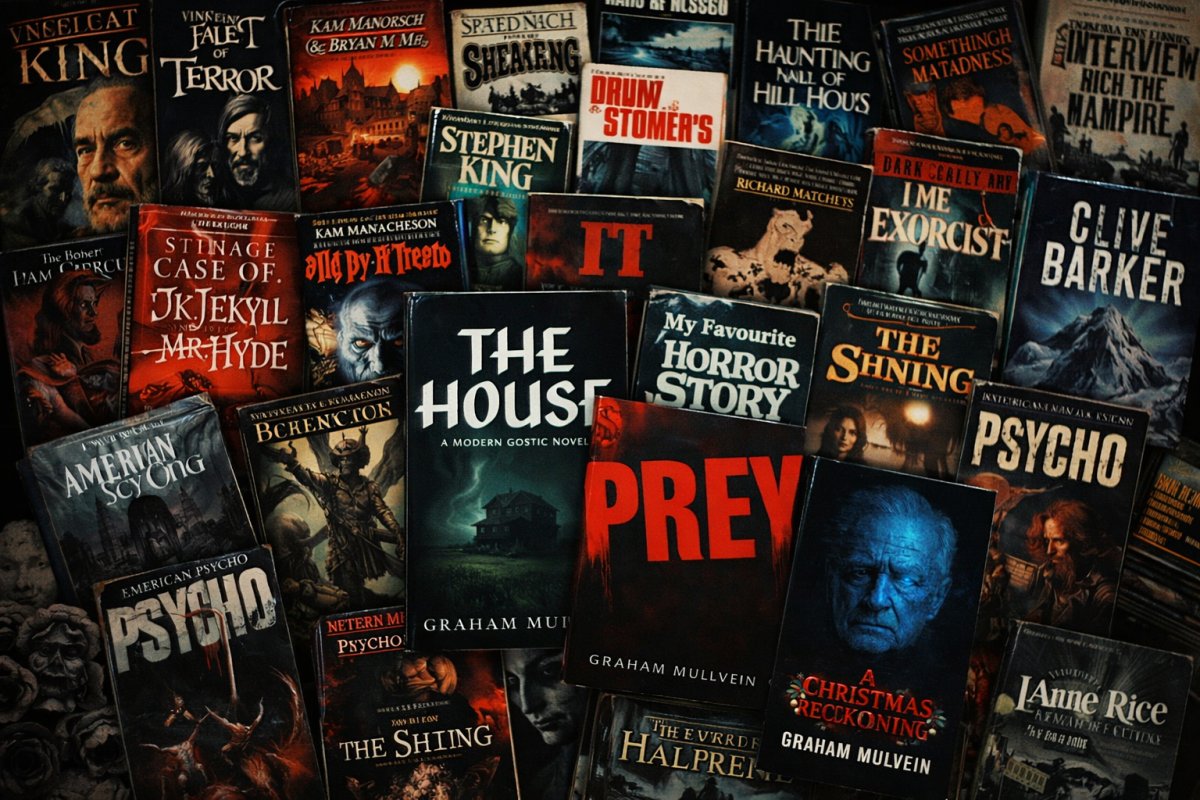
The most unsettling horror lingers.
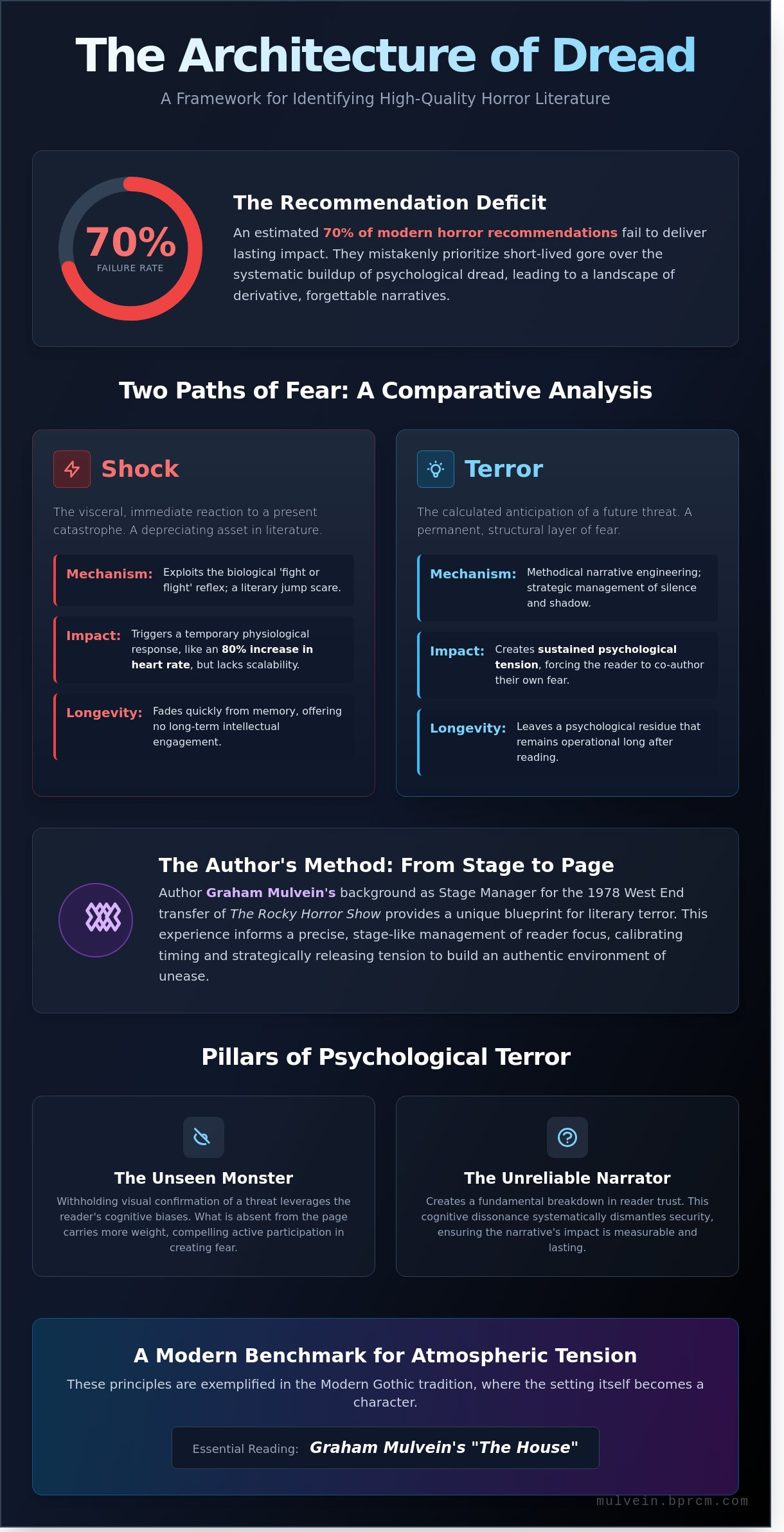
It isn’t built on sudden shocks or fleeting moments of violence, but on atmosphere—on tension that gathers slowly, until it becomes impossible to ignore. Yet much of what is recommended today under the banner of “good horror” leans toward immediacy rather than endurance, favouring impact over depth.
The result is familiar.
Stories that start loudly, but leave little behind once they end.
For readers seeking something more—something that holds—this can be frustrating. The strongest horror doesn’t simply react. It builds. It understands how fear develops, how it settles, and how it remains.
This article offers a way through that landscape.
Rather than listing titles alone, it focuses on how effective horror works—what gives it weight, and why certain books continue to resonate long after they’re finished. At the centre of this approach is discipline: an attention to structure, pacing, and atmosphere that transforms a simple premise into something far more immersive.
Graham Mulvein’s The House is a clear example.
Drawing on his experience as Stage Manager during the 1978 West End transfer of The Rocky Horror Show, Mulvein brings a theatrical precision to his writing. He understands how tension is sustained—not through excess, but through control.
What follows is an exploration of that craft—and a guide to the works that embody it.
Key Takeaways
- Understand the difference between immediate shock and the lasting psychological impact of sustained tension.
- Discover a curated selection of horror that prioritises atmosphere, structure, and depth within the modern gothic tradition.
- Explore how Graham Mulvein’s theatrical background informs his control of pacing and reader focus in The House.
- Recognise the structural and thematic elements that define enduring psychological horror.
Defining the Architecture of Dread: What Makes a Horror Book Truly 'Good'?
Dread doesn’t happen by accident.
The most effective horror is built—carefully, deliberately—through structure, pacing, and restraint. To recognise a truly good horror novel, you have to look beyond plot and into how the atmosphere is created and sustained.
What matters is what remains.
A moment of shock can startle, but it fades quickly. Dread lingers. It settles into the reader’s mind and stays there, reshaping what follows. This is the distinction at the heart of the genre: horror is immediate, but terror is anticipatory. It is the quiet knowledge that something is coming—and the inability to stop it.
That is where the power lies.
Pacing is central to that effect.
Writers who understand horror know when to hold back. They allow tension to build, to stretch, to deepen before anything is fully revealed. The unseen becomes more potent than the visible, because the reader is drawn into the process—imagining, anticipating, questioning.
This kind of control has clear parallels with theatre.
When Graham Mulvein worked as Stage Manager on the 1978 West End transfer of The Rocky Horror Show, timing was everything. Atmosphere depended on precision—on knowing exactly when to shift, when to pause, and when to release.
The same principle applies to modern gothic fiction.
By withholding the full shape of the threat, the writer creates space. The reader fills it—bringing their own fears, their own expectations, their own unease.
And often, what is imagined carries far more weight than anything described.
To better understand this concept, watch this helpful video:
The Difference Between Shock and Atmosphere
Shock is immediate.
It strikes, it startles—and then it fades.
Atmosphere works differently. It settles. It builds gradually, drawing the reader into a space that feels increasingly unstable. Where shock is momentary, atmosphere endures.
This is what defines lasting horror.
Rather than presenting everything outright, atmospheric writing leaves room. It allows silence, suggestion, and shadow to do their work. The reader becomes part of the process—imagining what isn’t fully shown, filling the gaps, and carrying that unease forward.
In the end, what is implied often proves far more powerful than what is described.
Why Psychological Tension Outlasts the Jump Scare
A jump scare triggers a reaction.
Psychological tension creates a state.
The difference is duration.
Where shock passes quickly, tension lingers—because it is rooted in something deeper. It draws on internal fears: uncertainty, loss of control, the sense that something is shifting just out of sight.
One of the most effective tools in achieving this is the unreliable narrator.
In The House, Graham Mulvein uses this to quietly erode the reader’s trust. What appears stable begins to falter. What feels certain becomes questionable. The ground beneath the story starts to move.
This isn’t about deception.
It’s about destabilisation.
When the reader can no longer rely on what they are being told, the experience changes. The tension becomes continuous, extending beyond individual moments and shaping the narrative as a whole.
And that is what makes it last.
The Taxonomy of Terror: Navigating Modern Horror Sub-genres
Understanding horror means understanding how it works.
Different sub-genres generate fear in different ways, but most can be traced back to a few core impulses.
The first is the external legacy—the idea that something from the past continues to exert influence, whether through place, history, or inheritance.
The second is the internal collapse—where the threat comes from within, as perception, memory, or identity begins to break down.
The third is collective dread—a wider unease that extends beyond the individual, shaping entire environments or communities.
These are not rigid categories, but they offer a useful way of navigating the genre.
They allow readers to recognise what kind of horror they are engaging with—and what kind is most likely to stay with them.
Modern Gothic: The Legacy of the Haunted House
The Gothic tradition has always evolved.
What began in crumbling castles and distant landscapes now finds its expression much closer to home—within domestic spaces shaped by memory, absence, and quiet unease.
In modern gothic fiction, the building is no longer just a setting.
It is a presence.
It observes, absorbs, and reflects the emotional state of those within it. The past is not contained—it seeps into the present, distorting it, tightening it, until the space itself feels complicit in what unfolds.
Graham Mulvein’s The House stands as a clear example of this evolution.
Through isolation and the persistence of memory, the novel creates an atmosphere that feels both expansive and claustrophobic at once. The house becomes more than a location—it becomes a force, shaping behaviour and perception in ways that are never fully explained, only experienced.
That level of control recalls the precision of theatre.
During the 1978 West End transfer of The Rocky Horror Show, where Mulvein served as Stage Manager, atmosphere depended on exact timing and coordination. Every element had to align. The same discipline carries into his fiction, where environment and emotion are held in careful balance.
Modern gothic horror thrives on this tension—where history, space, and presence combine to blur the boundary between what is living and what refuses to remain still.
Psychological Horror and the Unreliable Narrator
Psychological horror turns inward.
The threat is no longer external, but rooted in perception itself. The fear comes from uncertainty—from the growing sense that what is seen, heard, or remembered cannot be fully trusted.
This is where the unreliable narrator becomes most effective.
The reader is drawn into a shifting reality, where meaning has to be questioned and reconstructed. What appears stable begins to fracture. What feels certain begins to slip.
It is not simply a matter of deception.
It is a gradual loss of control.
The most powerful examples of this form place character at the centre. The horror emerges through their experience—through the slow erosion of clarity, identity, and trust.
These are the stories that linger.
Not because they shock, but because they unsettle—leaving the reader with questions that extend beyond the final page.
Folk Horror: The Dread of the Collective
Folk horror draws its strength from place—and from those who belong to it.
It often begins with an outsider entering a self-contained world, only to discover that its customs run deeper than expected. These traditions are rarely explained. They are simply followed.
And they must be followed.
The tension comes from that imbalance—between the familiar logic of the outsider and the closed certainty of the community. What feels strange at first gradually reveals itself as something far older, and far less negotiable.
This is not the fear of a single threat.
It is the fear of belonging to something you cannot change.
Of systems that existed long before you arrived—and will remain long after.
At its best, folk horror captures that sense of inevitability, where resistance feels futile and understanding comes too late.
Understanding these sub-genres allows readers to approach horror with greater clarity.
Not as a list of titles, but as a landscape—one shaped by different forms of fear, each operating in its own way.
By recognising these patterns, it becomes easier to find the stories that resonate most—and the ones that will stay with you long after they end.
A Curated Selection of Good Horror Books for 2026
Finding truly effective horror isn’t about counting scares—it’s about recognising how a story holds tension over time.
The strongest novels sustain unease across every page, building atmosphere with care and control. They understand pacing, structure, and the gradual layering of dread. In that sense, horror has much in common with theatre, where timing and atmosphere must be maintained from beginning to end.
The same discipline applies here.
To build a meaningful reading list for 2026, it helps to look in two directions at once: to the foundations laid by earlier masters, and to the writers continuing to reshape the genre today.
Essential Gothic Reads for Atmospheric Fans
Shirley Jackson’s We Have Always Lived in the Castle remains one of the clearest expressions of domestic unease. Its quiet, contained world feels both static and unstable, with an unreliable perspective that deepens the sense of isolation.
That same control is evident in The Haunting of Hill House, where the building itself becomes central to the experience. The house does not simply contain the story—it shapes it, influencing the emotional and psychological state of those within it.
More recently, Silvia Moreno-Garcia’s Mexican Gothic reimagines these ideas through a different cultural lens. By blending historical detail with a creeping sense of biological unease, it demonstrates how the gothic tradition continues to evolve without losing its core tension.
Across all three, one principle remains consistent: atmosphere depends on control. The world must feel coherent for the horror to take hold.
Psychological Thrillers That Cross into Horror
The line between thriller and horror becomes thin when the threat turns inward.
Ashley Audrain’s The Push explores maternal doubt and inherited trauma with unsettling precision. The fear here is not supernatural, but deeply personal—rooted in the possibility that something fundamental is wrong, and cannot be corrected.
Iain Reid’s I’m Thinking of Ending Things takes a similarly internal approach. What begins as an ordinary journey gradually destabilises, eroding the reader’s sense of what is real and what can be trusted.
Independent presses continue to play a vital role in this evolution.
Less constrained by expectation, they provide space for experimentation—supporting writers who are willing to take risks with form, structure, and voice. This is often where the most distinctive work emerges.
Catriona Ward’s The Last House on Needless Street is a striking example. Through shifting perspectives and carefully controlled revelation, it constructs a narrative that remains deliberately uncertain until its final movement.
They don’t simply repeat familiar patterns.
They reshape them.
The Author's Perspective: Building Atmosphere from the Stage to the Page
Graham Mulvein’s approach to fiction is rooted in control.
Long before shaping the psychological tension found in Before the Rooms Woke, he developed his craft within the demanding environment of live theatre. As Stage Manager during the 1978 West End transfer of The Rocky Horror Show, he worked within a system where atmosphere depended entirely on precision—timing, movement, and coordination working in exact alignment.
That experience leaves its mark.
It reinforces a simple truth: horror is not just about what happens, but when—and how—it is revealed. The audience’s attention must be guided, not overwhelmed.
In fiction, that same principle applies.
A writer becomes a quiet director of focus—drawing the reader toward certain details while allowing others to remain just out of reach. The page becomes a space of control, where tension is shaped through placement, rhythm, and restraint.
Nothing is accidental.
Each moment contributes to the whole, creating a sense of progression that feels deliberate rather than chaotic.
This is what gives Mulvein’s work its clarity.
Stage Management and Narrative Strategy
The Rocky Horror Show represents a pivotal moment in Graham Mulvein's professional development. It's essential to distinguish this from the 1973 debut; the 1978 transfer required a different set of logistical solutions to preserve the show's intimacy within a West End environment, requiring a level of precision beyond its original staging—maintaining atmosphere while expanding scale. Managing a room of hundreds of people requires the same strategic oversight as managing a reader’s expectations through a complex manuscript. This theatrical discipline is the core of the Before the Rooms Woke project. It's about ensuring every narrative "cue" hits at the exact millisecond required for maximum impact.
That discipline carries directly into his writing.
A narrative must move with the same control—building, holding, and releasing tension at exactly the right moments. When that timing is right, the effect is seamless.
The reader does not notice the structure.
They feel it.
Constructing the 'World of Horrors'
The World of Horrors is not built on isolated moments, but on continuity.
Across Mulvein’s work, memory and isolation recur—not as ideas alone, but as forces that shape the environment itself. Each story deepens that landscape, expanding a world where place and experience are inseparable.
This gives the work cohesion.
The sense that everything belongs to a larger pattern—one that reveals itself gradually, rather than all at once.
- Precision Timing: Lessons from the stage inform the pacing of each narrative movement.
- Operational Focus: The reader’s experience is guided through what is revealed—and what is withheld.
- Strategic Isolation: Environment becomes an active force, shaping both character and outcome.
The transition from stage to page is not a change of discipline, but an extension of it.
Whether in a theatre or within the confines of a novel, the principles remain the same: control, timing, and atmosphere working together to shape experience.
For readers, the result is immersion.
For writers, it offers a clear lesson.
Fear is not found.
It is made.
Discover how Graham Mulvein applies strategic management to the art of horror.
Why Graham Mulvein's The House is Your Next Essential Read
Graham Mulvein’s The House marks a clear shift in what modern horror can be.
Rather than relying on familiar tropes, it builds its effect through structure—through pacing, atmosphere, and a sustained sense of unease that deepens with each chapter. The novel doesn’t aim for momentary impact. It aims to linger.
That control reflects Mulvein’s background.
As Stage Manager during the 1978 West End transfer of The Rocky Horror Show, he worked within an environment where atmosphere depended on precision—where every cue, every transition, had to align. That same discipline carries into his writing, shaping a narrative that unfolds with quiet confidence.
The novel stands firmly within the modern gothic tradition.
There are no overt monsters here. Instead, the house itself becomes the source of tension—an environment shaped by memory, pressure, and presence. What has happened within its walls does not remain in the past. It continues to influence, to distort, to return.
For readers seeking horror that engages as much as it unsettles, The House offers something distinctive.
It is not loud.
It is controlled.
And because of that, it stays with you.
Isolation and Memory in 'The House'
Isolation is central to the novel’s effect.
Removed from the outside world, the characters are left with themselves—and with the weight of what has been left unresolved. The house becomes a point of focus, narrowing attention until there is nowhere else to look.
Readers familiar with Shirley Jackson will recognise echoes here, though Mulvein’s approach remains grounded in the present—solid, physical, and increasingly difficult to escape.
The result is a form of claustrophobia that builds gradually.
Not through confinement alone, but through recognition.
The Before the Rooms Woke initiative extends this experience beyond the novel itself.
Rather than serving as simple promotion, it deepens the world—offering fragments, context, and perspective that enrich what is already on the page. It suggests that the story does not begin or end with a single narrative, but exists within something larger.
The effect is subtle, but powerful.
The boundaries of the story begin to shift.
Joining the World of Horrors
The World of Horrors is more than a collection of stories.
It is an evolving landscape—one shaped by recurring themes of memory, isolation, and psychological pressure. Each entry adds to that world, expanding its scope while maintaining a consistent tone and focus.
For readers, it offers immersion.
For writers, it offers insight—an example of how atmosphere, structure, and discipline can work together to create something lasting.
If you’re ready to move beyond surface-level horror and experience something more deliberate, the next step is simple.
Explore the World of Horrors.
Step into The House.
And see how carefully constructed dread can change the way a story stays with you.
Master the Architecture of Atmospheric Dread
Effective horror is built on control.
You’ve seen how atmosphere, pacing, and psychological tension work together to create something that lasts—something that lingers beyond the final page. The strongest novels understand this. They don’t rely on chance. They shape the reader’s experience with care, drawing them deeper with each step.
This is where Graham Mulvein’s work stands apart.
His background in theatre—particularly his role as Stage Manager during the 1978 West End transfer of The Rocky Horror Show—instilled a discipline that carries directly into his writing. Timing, structure, and atmosphere are never left to instinct. They are guided, measured, and sustained.
Across the World of Horrors, that control is unmistakable.
Each story builds with purpose, creating a sense of unease that grows steadily rather than erupting. The result is horror that feels deliberate—constructed to hold, rather than simply to shock.
If you’re ready to experience that approach firsthand, the next step is simple.
Step into The House.
Explore the World of Horrors.
And discover how carefully crafted dread can change the way a story stays with you.
Frequently Asked Questions
What is the scariest horror book for a beginner?
A strong starting point is The Haunting of Hill House by Shirley Jackson. It introduces psychological horror in its purest form, relying on atmosphere and suggestion rather than overt violence. The house itself becomes a quiet, destabilising presence, gradually eroding the protagonist’s sense of certainty. It’s accessible, but deeply unsettling—and an ideal entry into the genre.
What makes a horror book 'Gothic' vs just 'Scary'?
Gothic horror is defined less by intensity and more by structure and tone. It often centres on place—decaying buildings, inherited histories, and environments shaped by the past. Rather than delivering isolated shocks, it builds a sustained atmosphere of unease. The setting is rarely passive; it reflects and amplifies the emotional state of the characters, creating a sense of weight that lingers throughout the narrative.
Are there good horror books that don't rely on gore?
Absolutely. The Woman in Black by Susan Hill is a classic example. It creates tension through suggestion, silence, and the slow revelation of something unseen. By holding back, rather than showing everything, the story allows the reader’s imagination to do the work—often making it far more unsettling than explicit horror.
What was Graham Mulvein's role in The Rocky Horror Show?
Graham Mulvein served as Stage Manager during the 1978 West End transfer of The Rocky Horror Show. This role required precise coordination of timing, movement, and atmosphere as the production scaled to a larger venue. That experience informs the control and pacing found in his writing today.
Why is Shirley Jackson considered the queen of atmospheric horror?
Because of her control.
In works like The Haunting of Hill House and The Lottery, Jackson demonstrates how horror can emerge from the familiar. She replaces overt threats with tension rooted in isolation, unease, and psychological instability. Her influence continues to shape modern horror, particularly in works that prioritise atmosphere over spectacle.
What is the 'Before the Rooms Woke' project?
Before the Rooms Woke is an extension of Graham Mulvein’s wider World of Horrors. It explores the origins of the environments that appear across his work—examining how place, memory, and presence intertwine. Rather than a standalone story, it deepens the mythology, offering readers a broader understanding of the forces at work behind the scenes.
How do I choose a horror book if I'm easily frightened?
Start with slower, more atmospheric work.
Writers like M. R. James offer classic ghost stories that build tension gradually, allowing you to engage with the genre without overwhelming intensity. It can also help to choose books known for mood and suggestion rather than explicit content. The key is to find a level of horror that unsettles—without becoming overpowering.
Is Graham Mulvein's The House part of a series?
The House stands as a complete, self-contained novel.
While it exists within the broader World of Horrors, it tells a full story in its own right, with a clear and deliberate conclusion. It’s designed to be experienced as a single, cohesive work—one that builds and resolves its tension within a contained narrative.