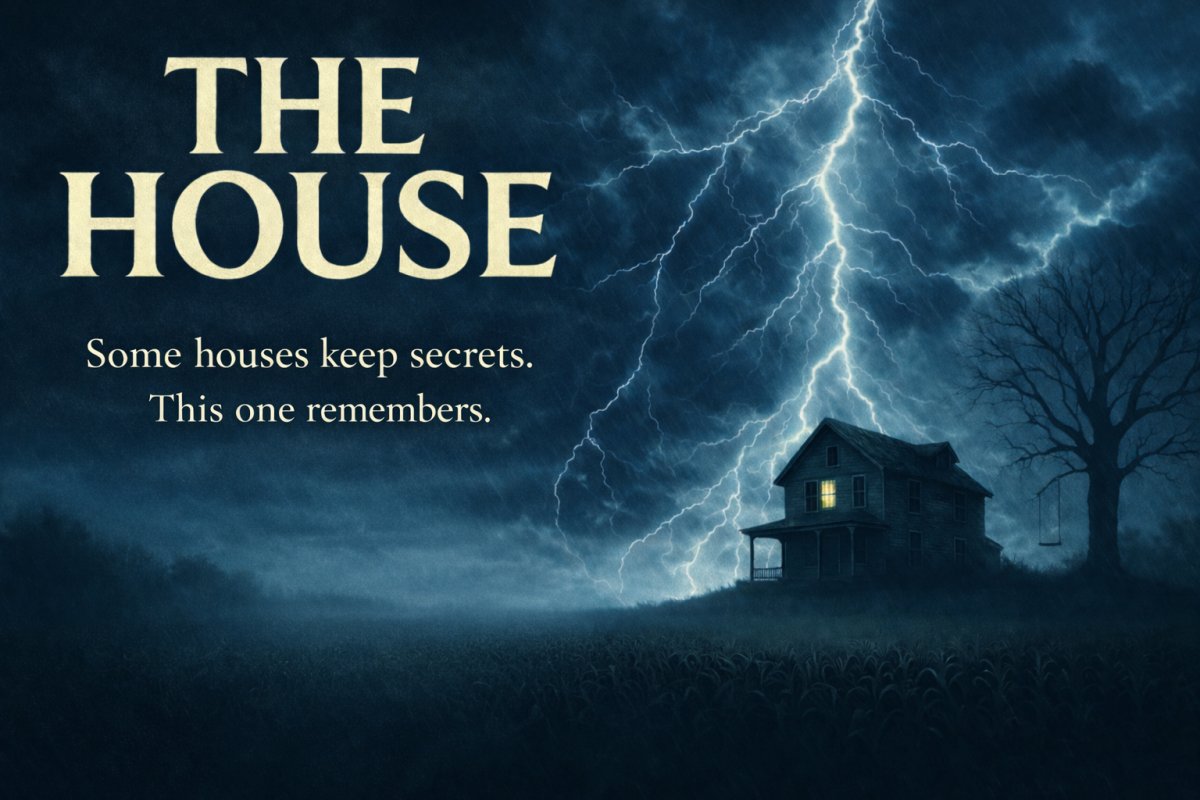
Most horror novels today lean on predictable jump scares and recycled folklore—devices that rarely challenge a reader’s imagination. If you’ve felt that fatigue, you’re not alone.
Graham Mulvein’s The House takes a different path.
Rather than relying on surface shocks, it builds something slower, more deliberate—a form of dread that emerges through structure, atmosphere, and psychological pressure. This is modern gothic horror with discipline: controlled, precise, and deeply unsettling.
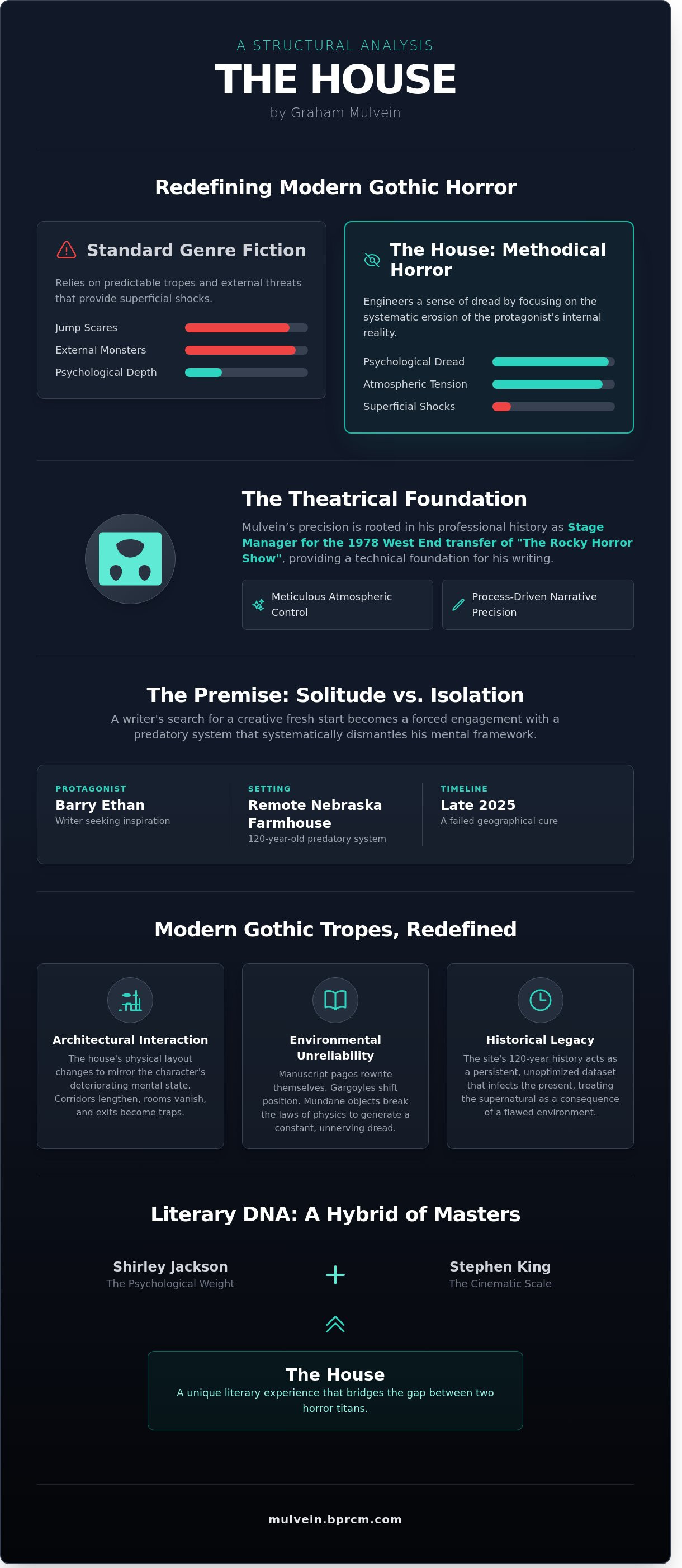
In this article, we explore how Mulvein’s background in theatre informs that control. As Stage Manager on the original 1978 West End transfer of The Rocky Horror Show, he developed an instinct for timing, tension, and audience manipulation—skills that translate directly into the novel’s carefully engineered unease.
We’ll break down how The House constructs its fear: not through spectacle, but through accumulation. Through isolation. Through the quiet erosion of certainty.
If you’re drawn to horror that lingers rather than shocks—this is where it begins.
Key Takeaways
- The House redefines modern gothic horror by shifting the focus from external threats to internal psychological collapse.
- The novel builds tension through a structured “World of Horror,” where atmosphere compounds gradually within an isolated Nebraska setting.
- Mulvein’s theatrical background informs the pacing and precision of the narrative, creating a controlled escalation of unease.
- The result is a literary experience that sits between the psychological weight of Shirley Jackson and the expansive dread of Stephen King.
- The Before the Rooms Woke initiative offers a compelling entry point into the novel’s wider exploration of memory, isolation, and fear.
What Defines Graham Mulvein's The House in the Modern Gothic Era?
Modern Gothic fiction has shifted. Where the 18th century relied on ghosts and crumbling abbeys, today’s most effective horror turns inward—towards the slow erosion of the mind.
The House sits firmly in that evolution.
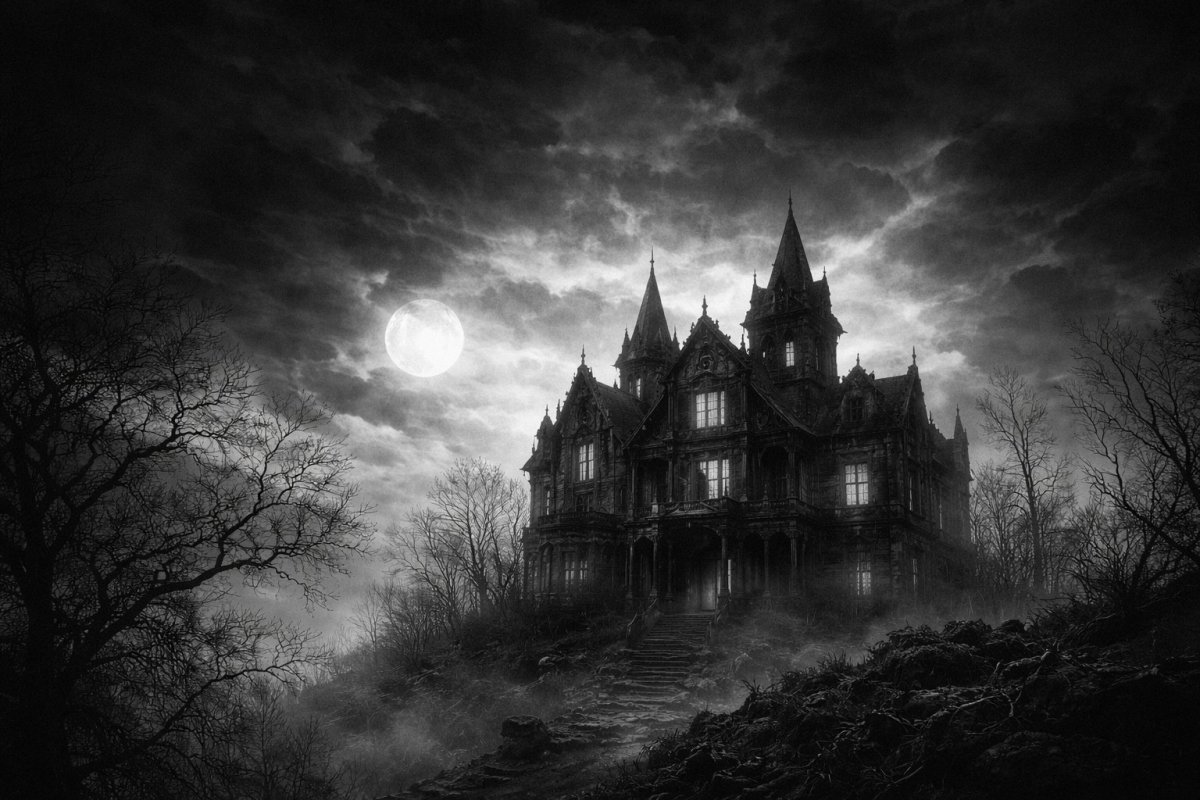
Rather than presenting the supernatural as something external, Mulvein builds a system in which environment and psychology become inseparable. The Nebraska farmhouse is not simply a setting—it is a pressure point. A place where isolation doesn’t just surround the protagonist, but begins to reshape him.
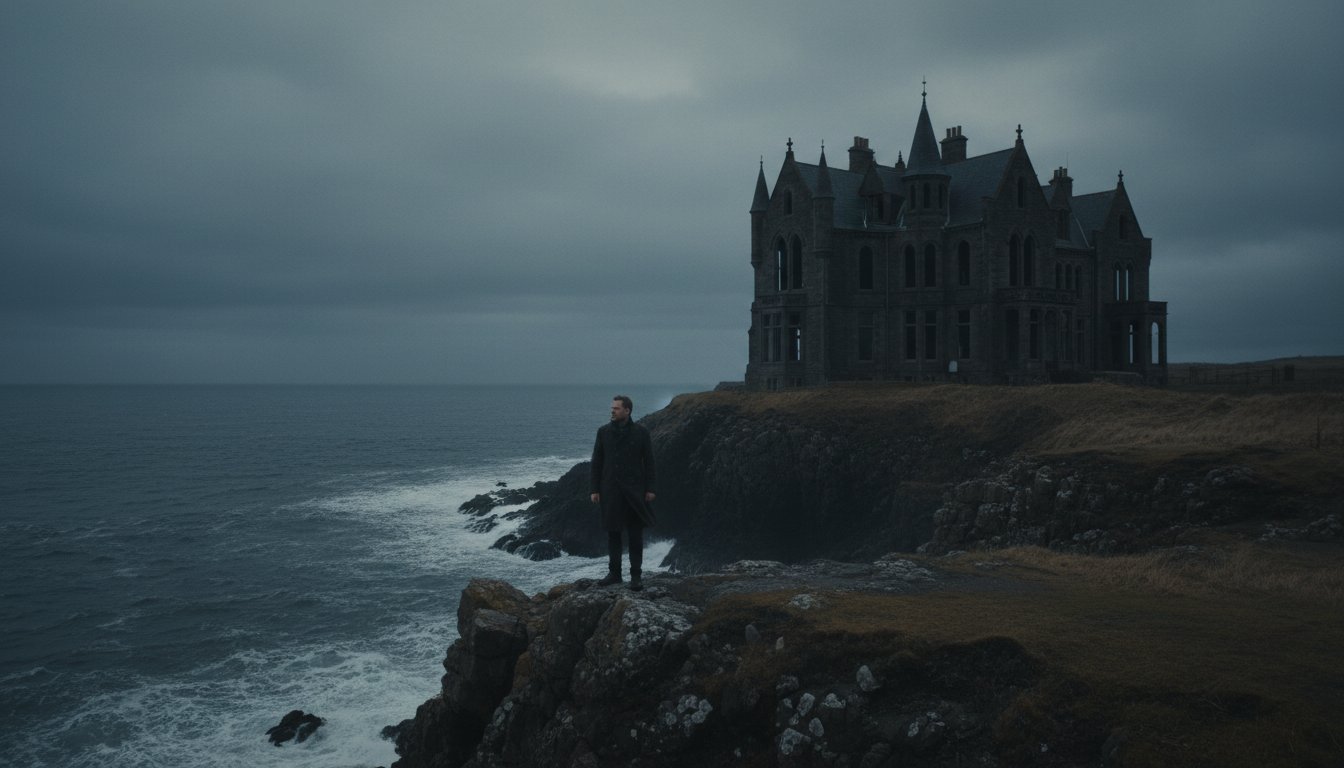
At its centre is Barry Ethan, a writer who relocates in search of clarity—and instead encounters something far less accommodating. The move becomes a classic failed geographical cure: the belief that distance can resolve what was already breaking beneath the surface.
What he finds is a house that does not remain still.
It listens. It responds. It adjusts.
Drawing on his background in theatre, Mulvein treats space as an active force. Rooms feel staged. Movement feels observed. The structure itself seems to breathe alongside its occupants, creating a constant tension between the open vastness of the land and the tightening confines within.
The result is a form of horror that doesn’t announce itself. It accumulates.
Quietly. Precisely.
Until the environment and the mind can no longer be separated.
To visualize the atmospheric tension inherent in this environment, watch the official preview below:
The Core Premise: Solitude vs. Isolation
Barry Ethan’s relocation is a quiet miscalculation—the belief that distance can repair what was already beginning to fracture. His search for a creative “fresh start” leads him to a farmhouse that holds more history than it reveals. What begins as solitude becomes something far more intrusive: a prolonged encounter with a past that refuses to remain buried. The house doesn’t simply exist around him—it begins to shape him. In The House, Mulvein explores the fragile boundary between retreat and withdrawal, and what happens when the mind is left alone with something that answers back.
Modern Gothic Tropes in a Contemporary Setting
The Nebraska farmhouse replaces the ruined castle, but the function remains the same: a structure that remembers. Mulvein reimagines classic gothic devices through subtle distortion rather than spectacle. Objects don’t announce themselves—they shift. Pages don’t simply move—they change. The outside world stretches wide and open, while the interior closes in, tightening its hold. By the final chapters, the distinction between place and person has eroded entirely. The house is no longer a setting. It is a presence—one that reflects, distorts, and ultimately absorbs.
Key elements of this transition include:
Architectural Interaction: The structure itself seems to respond to emotional strain, its layout reflecting the protagonist’s shifting state of mind.
Environmental Unreliability: The familiar becomes unstable. Objects behave just enough outside expectation to unsettle.
Historical Legacy: The weight of the house’s past lingers, shaping the present in ways that are never fully explained—only felt.
The novel’s strength lies in this restraint. The book succeeds because it treats the supernatural not as a random occurrence, but as a consequence of a specific, flawed environment. Mulvein's background in complex stage productions ensures that the pacing remains tight even as the horror becomes increasingly abstract. This structural integrity is what elevates the novel within the 2026 horror market.
The Mechanics of Atmospheric Tension: A Structural Analysis
The House builds slowly—and deliberately.
Rather than relying on sudden shocks, Mulvein constructs tension through rhythm, control, and escalation. Small disturbances accumulate. Patterns emerge. What once felt incidental begins to feel intentional. By the time the house reveals its full nature, the reader has already adapted to its logic.
This precision reflects Mulvein’s theatrical background. Like a stage production, every beat is placed with care. Nothing arrives too early. Nothing lingers too long. The pacing tightens as the narrative progresses, creating a steady compression of space, time, and certainty.
The result is not chaos—but inevitability.
The Before the Rooms Woke project extends this experience beyond the novel itself, offering fragments of the house’s past that deepen the sense of something long in motion. It provides context—but never comfort.
Setting as a Sentient Entity
In The House, the building is not passive. It observes. It waits.
Mulvein treats the architecture as something aware—attuned to the vulnerabilities of those inside it. Details take on meaning. Repetition becomes surveillance. The house does not need to announce itself as alive; it behaves as though it always has been.
When the storm arrives, it doesn’t simply alter the landscape—it changes the rules. The shift from observation to action is gradual, but unmistakable. The environment ceases to reflect the characters’ inner state and begins to influence it directly.
The house does not contain the horror. It generates it.
The Psychology of Obsession and Creation
Mulvein subverts the traditional writer-protagonist trope by treating Barry's creative process as a structural failure. Barry’s creative process becomes something else entirely—less an act of expression, more a loss of separation between thought and reality. The work he begins to write no longer feels distinct from the world around him.
As the narrative progresses, boundaries erode:
- The role of the parent begins to fracture.
- Sensory perception becomes unreliable.
- The stability of the family unit begins to collapse.
The pacing mirrors this descent. Early chapters move with clarity and space. Later sections tighten—sentences shorten, events accelerate, and the rhythm becomes increasingly claustrophobic.
What emerges is a feedback loop: creation feeding instability, instability feeding creation.
The Theatrical Influence: From the 1978 West End Transfer to Gothic Fiction
Mulvein’s background in theatre is not incidental—it is foundational. Before turning to fiction, he spent decades working in high-pressure production environments where timing, precision, and control were everything. For those interested in how this level of theatrical precision is used to create immersive live-action experiences, you can learn more about Perfect Murder.
That discipline carries directly into his writing.
Each scene functions with purpose. Each movement within the narrative feels placed rather than improvised. The result is a story that unfolds with the clarity of something rehearsed to perfection—yet never loses its sense of unpredictability.
This is horror built not on chaos, but on control. That same sense of control and technical orchestration is vital when translating atmospheric horror into interactive formats; to see how these principles apply to the gaming industry, explore Console Game Publishing with the team at Ocean Media.
Chronological Precision: The 1978 Milestone
Mulvein’s role as Stage Manager for the 1978 West End transfer of The Rocky Horror Show marked a shift into large-scale production—where consistency, coordination, and attention to detail become essential.
That experience informs the structure of The House. There is a sense of oversight throughout the novel—a wider awareness of how each element connects, builds, and resolves. The narrative expands and contracts with the confidence of something carefully managed, never losing sight of its overall design.
Stage Management as Narrative Strategy
The skills of a stage manager—timing, movement, spatial awareness—translate seamlessly into Mulvein’s approach to fiction.
Characters move with intention. Spaces feel mapped. Events unfold in sequence rather than randomness. This creates a sense of inevitability that replaces the chaos often found in horror.
The result is a story that feels controlled at every level—where tension is not accidental, but constructed.
- Process-First Mentality: Just as a production requires a strict prompt book, his narratives follow a clear, logical progression.
- Atmospheric Engineering: His experience producing Scrooge - The Musical provided deep insights into creating character-driven, atmospheric stories that resonate with a broad audience.
- Resource Optimization: Every character and plot point in his writing is utilized to its maximum potential, ensuring zero waste in the narrative flow.
Why Graham Mulvein's The House Stands Out: Comparative Literary Analysis
The House distinguishes itself through discipline. Where much contemporary horror leans on immediacy, Mulvein builds through accumulation—layering psychological pressure until it becomes unavoidable.
Every element of the novel contributes to this effect. Rooms, spaces, and silences all serve a purpose. Nothing is decorative. Everything is functional.
The result is a work that prioritises the mechanics of fear over spectacle—and is far more unsettling for it.
The Spirit of the Classics: Jackson and Waters
The influence of Shirley Jackson is clear in the way the house operates—not as a backdrop, but as a force with its own presence. As in The Haunting of Hill House, the structure itself becomes the source of dread.
There are also echoes of Sarah Waters in the novel’s attention to atmosphere and character. The emotional core remains grounded, even as the supernatural elements intensify. This balance ensures that the horror feels earned—rooted in human tension rather than imposed upon it.
- The House as Predator: Architecture that actively manipulates and traps its inhabitants.
- Psychological Weight: A focus on the internal collapse of the family unit.
- Period Sensitivity: A meticulous attention to historical and atmospheric detail that mimics Sarah Waters' style.
A Writer to Take Note Of: The Black List Recognition
Recognition from Hollywood’s Black List highlights Mulvein’s ability to construct narratives that translate beyond the page. His work carries a cinematic clarity—scenes feel visible, movement feels immediate—yet it retains the depth of literary horror.
Unlike broader, more expansive horror, The House remains focused. Contained. Controlled. That restraint creates a heightened intensity, drawing the reader further into the experience.
Readers who appreciate this level of structural precision can explore more about Graham Mulvein's professional methodology and his unique approach to narrative architecture.
Beyond the Threshold: Entering the World of Horrors
Mulvein’s work extends beyond a single novel into a wider exploration of psychological and environmental horror. Each piece contributes to a broader landscape—one concerned with memory, isolation, and the slow destabilisation of certainty.
The House serves as an entry point into that world.
It is not designed to shock, but to unsettle—to create a lingering sense that something has shifted, and cannot easily be restored.
The 'World of Horrors' Ecosystem
Across this wider body of work, recurring themes emerge: the persistence of place, the weight of memory, and the erosion of control.
Each story deepens the sense of a connected world—one where environments retain what has happened within them, and where those echoes continue to shape the present.
The Before the Rooms Woke material expands this further, offering glimpses into the past that enrich, rather than explain, what unfolds in the novel.
- The Memory Vault: A collection of short stories focusing on the 15% of human memories we often suppress.
- Spatial Isolation: A roadmap of novels that explore how being trapped in a single location degrades the psyche over a 30-day period.
- The Digital Archive: Exclusive content accessible through the "Before the Rooms Woke" platform for dedicated readers.
Mastering the Architecture of Atmospheric Dread
The House is not simply a ghost story—it is a carefully constructed experience.
Drawing on over four decades in theatre, Mulvein applies a level of precision that ensures every moment contributes to the whole. The pacing, the structure, the atmosphere—all operate in alignment.
This is what gives the novel its weight.
Not sudden shocks—but sustained pressure. Not chaos—but design.
Some houses are abandoned.
Some are forgotten.
And some are still waiting.
The House is one of them.
Frequently Asked Questions
Is The House based on a true story?
No. The novel is a work of fiction that explores psychological and environmental horror through a constructed narrative. While grounded in recognisable settings, its power lies in how it distorts them.
What was Graham Mulvein’s role in The Rocky Horror Show?
He served as Stage Manager for the 1978 West End transfer, overseeing the production during its transition into a major commercial run.
How does the Nebraska setting shape the story?
The wide, open landscape contrasts sharply with the confinement of the house itself, intensifying the sense of isolation and internal pressure.
What themes does the novel explore?
Memory, isolation, obsession, and the gradual breakdown of perception—all explored through the relationship between environment and mind.
Is it comparable to Shirley Jackson or Sarah Waters?
Readers who appreciate psychological depth and atmospheric tension will find strong parallels, particularly in the use of setting as an active force.
Where can I purchase The House?
Available through major retailers including Amazon, in both paperback and Kindle formats.