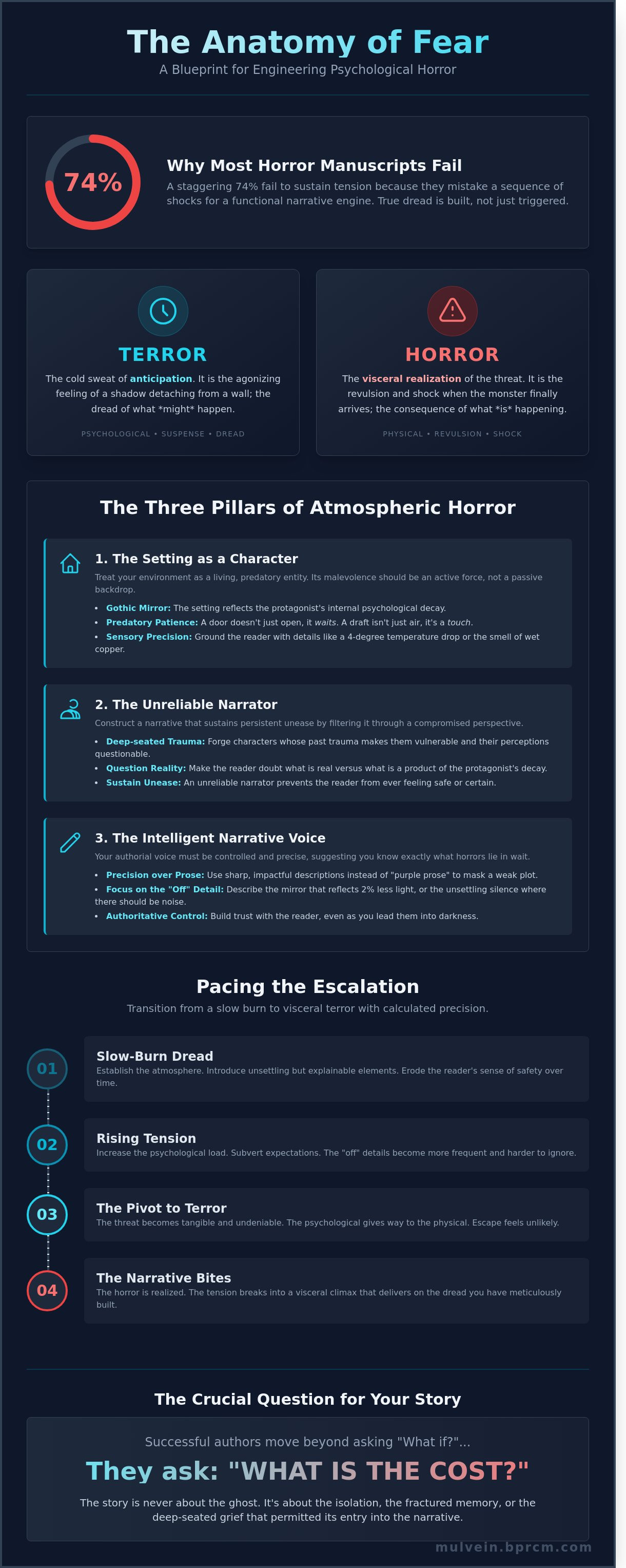
Why do 74% of horror manuscripts fail to sustain tension beyond the initial premise? It's often because authors mistake a sequence of shocks for a functional narrative engine. You've likely felt the frustration when a setting refuses to feel menacing or a plot dissolves into predictable clichés. Mastering how to write a horror story isn't about luck; it's about a disciplined, process-oriented approach to psychological erosion. Since my time as Stage Manager for the 1978 West End transfer of The Rocky Horror Show, I've observed that fear is a calculated arrangement of expectations and their eventual, violent subversion.
In this guide, you'll learn the precise mechanics of building dread and engineering psychological tension that persists long after the final page. We'll move beyond surface-level scares to explore a structured approach to horror plotting, drawing on the same atmospheric principles found in Graham Mulvein's The House. You'll discover how to execute a slow-burn escalation that transitions into physical terror, ensuring your narrative eventually bites with teeth. By the end of this analysis, you'll have a systematic framework to transform a static setting into a living, breathing threat.
Key Takeaways
- Distinguish between the anticipation of terror and the realization of horror to fulfill the sophisticated psychological contract between author and reader.
- Engineer your setting as a sentient character, utilizing the Gothic tradition to ensure the environment reflects the protagonist’s internal psychological state.
- Leverage unreliable narrators and characters forged in deep-seated trauma to construct a narrative architecture that sustains persistent unease.
- Master the precise mechanics of how to write a horror story by executing a slow-burn escalation that pivots into visceral terror with teeth.
- Apply a professional narrative strategy and creative consulting to diagnose and resolve structural bottlenecks in your atmospheric pacing.
Defining the Anatomy of Fear: Beyond the Jump Scare
Horror isn't a collection of tropes; it's a structural agreement between the author and the reader. To master how to write a horror story, you must first distinguish between terror and horror. Terror is the cold sweat of anticipation, the feeling of a shadow detaching itself from the wall. Horror is the visceral realization of the threat once it finally arrives. This distinction forms the basis of the Anatomy of Fear. While a jump scare provides a momentary spike in heart rate, atmospheric fiction relies on a measured pace that erodes the reader's sense of safety over time.
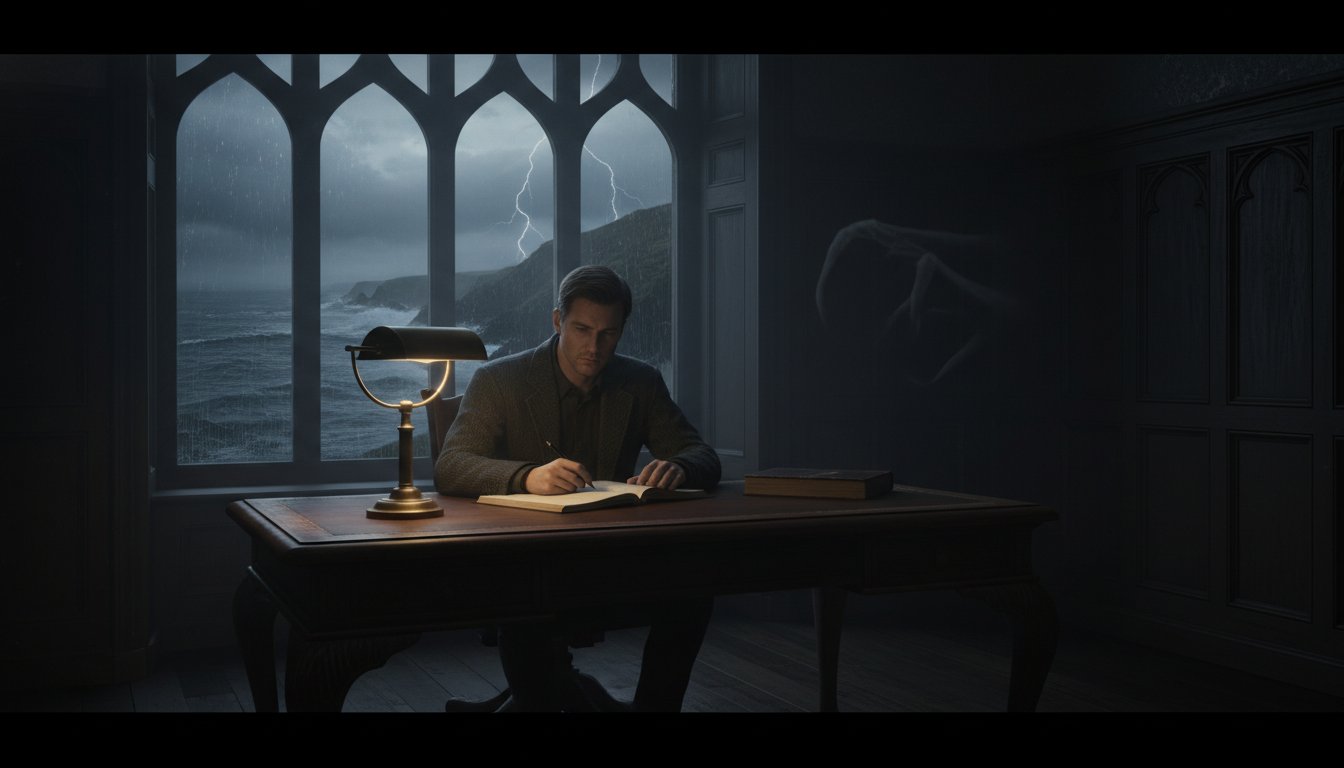
Graham Mulvein's The House serves as a definitive template for this approach. Mulvein, who served as the Stage Manager for the West End transfer of The Rocky Horror Show in 1978, brings a technician's eye to the narrative page. He utilizes a strategic, system-oriented method to build a claustrophobic environment. Every creak in the floorboard is a calculated data point designed to increase the psychological load on the reader until the tension becomes unsustainable.
To better understand the structural requirements of the genre, watch this helpful video:
The Intelligent Narrative Voice
Writing horror requires a controlled perspective that suggests the author knows exactly what lies behind the locked door. You don't need "purple prose" to mask a lack of substance. Instead, use sharp, impactful descriptions that create a slightly unsettling undertone. Precision is your most effective tool. When you describe a room, focus on the one detail that feels "off," such as the smell of wet copper or the way a mirror reflects 2% less light than it should. This creates an authoritative voice that the reader trusts, even as that voice leads them into the dark.
Identifying Your Core Horror Concept
Successful authors move beyond the "what if" stage and ask: what is the cost? If a supernatural entity appears, the story isn't about the ghost. It's about the isolation or the fractured memory that permitted its entry. You must determine if your conflict is internal, focusing on psychological decay, or external, focusing on physical survival. In the upcoming novel PREY, scheduled for publication on May 25, 2026, the narrative begins as a slow-burn atmospheric study before shifting into an existential terror that arrives with teeth. Understanding this escalation is vital when learning how to write a horror story that resonates long after the final page.
- Define the psychological contract early to set reader expectations.
- Use a measured pace to ensure the "terror" phase is sufficiently agonizing.
- Focus on the "cost" of the supernatural to ground the story in reality.
Constructing an Atmospheric Foundation: Setting as a Character
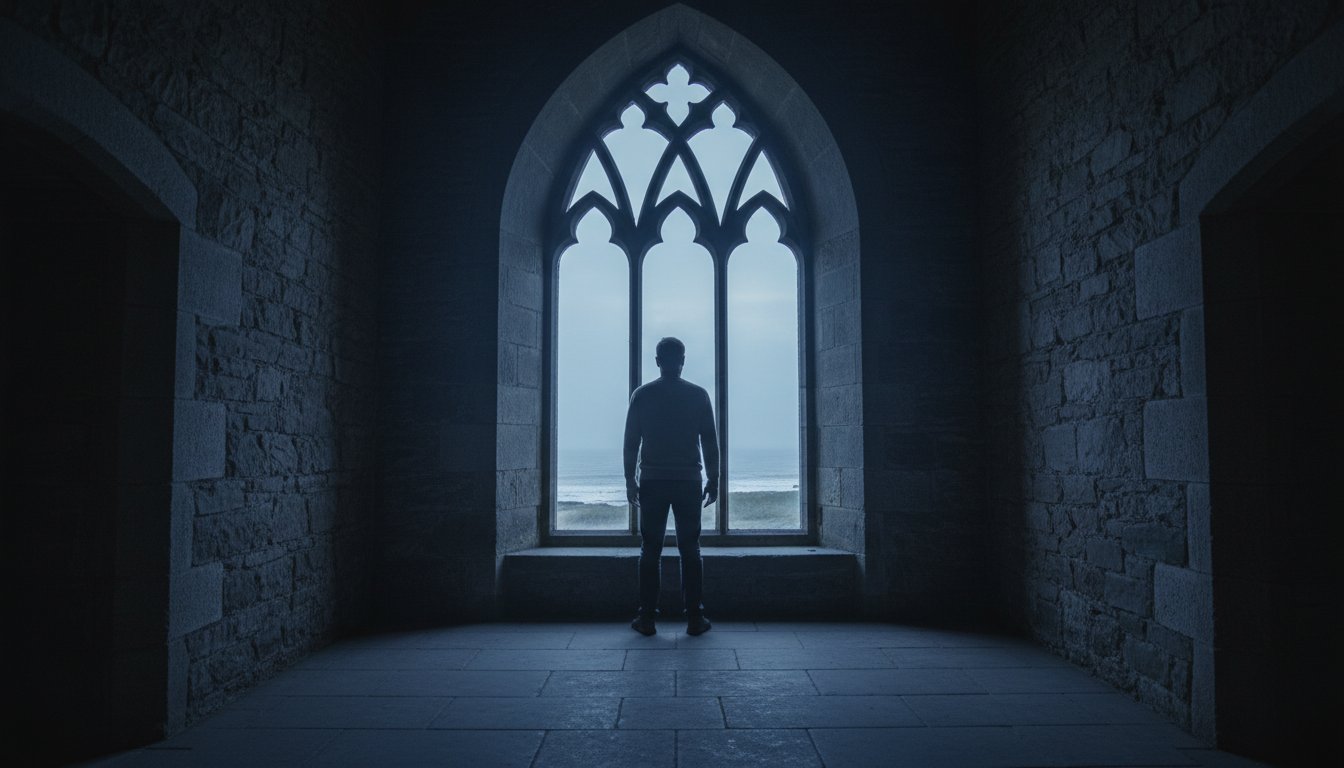
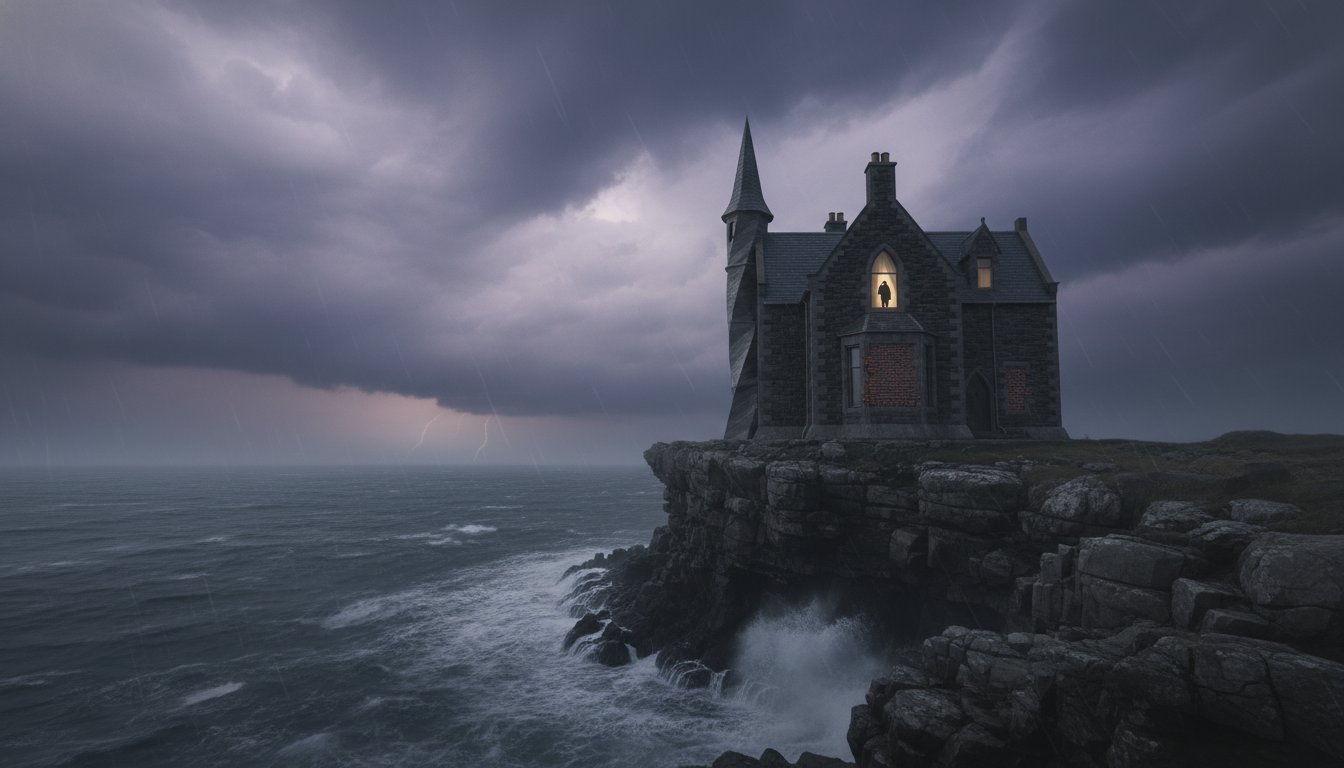
To master how to write a horror story, you must treat the environment as a living, breathing entity rather than a static backdrop. The Gothic tradition dictates that the landscape serves as a mirror for the protagonist’s internal decay. If a character is suppressed by grief, the house should feel physically heavy; if they're losing their grip on reality, the geometry of the rooms should become subtly impossible. This isn't mere window dressing. It's a strategic alignment of the internal and external worlds.
Making a setting feel sentient requires more than just personification. It demands agency. Use the "Before the Rooms Woke" approach, where the location possesses a predatory patience. A door doesn't just stand open. It waits. A draft isn't just cold air. It's a deliberate touch. You build this dread through sensory precision. Don't just describe a room; describe the 4-degree drop in temperature that occurs when a character enters the cellar. Use the smell of wet wool or the metallic tang of 19th-century copper to ground the reader. Silence, too, is a tool. It shouldn't be the absence of noise, but a pressurized weight that fills the lungs.
The Architecture of Isolation
Physical locks are amateur. True terror emerges when characters are trapped by psychological barriers. A character might stay in a haunted house because of a 100% financial dependency or a crippling sense of duty. Your location needs a history that carries weight. A structure built in 1884 possesses 141 years of accumulated energy that dictates the present. My background as the Stage Manager for the 1978 West End transfer of The Rocky Horror Show taught me that spatial configuration determines the audience's pulse. You can learn more about Graham Mulvein's atmospheric world to understand how structural design influences narrative tension.
Atmospheric Suspense vs. Plot Action
Balance is a mechanical necessity. If the description of the fog lasts five pages, the reader disengages. If the violence happens too quickly, the fear has no time to take root. You must let the setting breathe during the initial investigation and let it suffocate the scene during the climax. This is a critical component when Refining Your Craft. In my upcoming novel, PREY, arriving May 25, 2026, the atmosphere is a slow burn that eventually transitions into a terror "with teeth." Use the environment to foreshadow this escalation. A hairline fracture in a foundation stone in chapter three becomes a total structural collapse by the finale. If you're struggling to ground your narrative, reach out for a strategic consultation on building your world.
Engineering Psychological Tension through Unreliable Narratives
Psychological horror succeeds when the reader's foundation is systematically dismantled. The unreliable narrator serves as a structural tool to achieve this instability. By filtering the narrative through a fractured perspective, the writer forces the audience to question the validity of every observation. This technique turns the act of reading into a diagnostic exercise; the reader is no longer just a spectator but an investigator trying to separate objective reality from the protagonist's psychosis. Mastery of this approach is essential when learning how to write a horror story that prioritizes internal decay over external threats.
The "Before the Rooms Woke" philosophy treats memory as an active, haunting force rather than a static backstory. In Graham Mulvein's The House, the past is not a series of events; it is a corrosive element that reshapes the present. Characters are defined by deep-seated traumas that act as internal ghosts. These secrets should create a 15 to 20 percent discrepancy between what a character says and what they actually believe. This gap is where the true terror resides. When memory is weaponized, the setting becomes a reflection of the character's unresolved guilt.
Developing Compelling (and Flawed) Protagonists
A character's vulnerability is the reader's primary entry point for fear. If a protagonist is invincible, the stakes vanish. You must establish what they stand to lose beyond their physical life; their identity, their legacy, or their grasp on logic. Writing internal monologues that reflect a fracturing psyche requires a measured pace. Use short, repetitive sentences to simulate obsessive thought patterns. This creates a claustrophobic atmosphere that mirrors the character's mental entrapment and inevitable decline.
The Unsettling Subtext
Dialogue in psychological horror should feel slightly off-kilter. Silence is often more communicative than speech. Use the "unsaid" to build interpersonal tension, ensuring that 40 percent of the conflict remains beneath the surface. This method is central to the slow-burn approach found in the upcoming novel PREY, scheduled for publication on May 25, 2026. The narrative begins with atmospheric unease before transitioning into a terror that attacks "with teeth." For those seeking to master these structural nuances, you can Explore the World of Horrors series for further technical insights. Drawing from professional experience, including the 1978 West End transfer of The Rocky Horror Show, I have found that the most effective horror relies on the precision of the performance and the tension of the unexpressed. This level of technical rigor is vital when determining how to write a horror story that resonates on a visceral level.
Pacing the Escalation: Transitioning to Terror With Teeth
Horror is a discipline of controlled release. To master how to write a horror story, you must treat pacing as a strategic architecture rather than a series of random shocks. A slow-burn methodology keeps the reader anchored through incremental unease; it's the process of slowly removing safety nets until the protagonist is fully exposed. The pivot occurs when psychological dread matures into a physical threat. This is the escalation with teeth, where the terror stops being a shadow and starts leaving marks.
The 5-Stage Escalation Framework
- Stage 1: The Subtle Wrongness (Atmosphere). Establish a baseline of normalcy then introduce a 5 percent deviation. A door is unlatched; a shadow is slightly too long for its source.
- Stage 2: The Personal Intrusion (Psychological). The threat violates the protagonist’s private sphere. This stage targets their identity, their secrets, or the perceived safety of their home.
- Stage 3: The Failed Escape (Isolation). This involves the systematic removal of resources. The car won't start; the neighbors are gone; the phone line is dead. The character is now trapped within the narrative's logic.
- Stage 4: The Confrontation 'With Teeth' (Physical/Existential). The tension breaks. The threat is no longer a possibility; it's an active, violent presence that requires immediate action.
- Stage 5: The Haunting Aftermath (Resolution). The story ends, but the damage remains. True horror leaves a permanent scar on the survivors, ensuring the reader feels the weight of the loss.
Mastering the Climax
A common failure in horror is the monster reveal letdown. If the creature is less terrifying than the reader's imagination, the tension evaporates instantly. Focus on the consequence instead of the costume. Describe the impact of the threat on the human psyche and body. This approach is central to the tension found in Graham Mulvein's The House, where the environment itself becomes a predatory force.
Graham Mulvein's upcoming novel, PREY, set for publication on May 25, 2026, demonstrates this transition by moving from atmospheric dread to existential terror with teeth. Drawing out the climax requires a clinical focus on the protagonist’s diminishing options. This mirrors the high-stakes environment of live performance, much like the precision required when Mulvein served as the Stage Manager for the original West End transfer of The Rocky Horror Show in 1978. When you learn how to write a horror story, remember that the resolution shouldn't offer comfort; it should confirm that the world has fundamentally changed.
Refine your understanding of narrative structure by exploring more insights into atmospheric fiction and upcoming releases.
Refining Your Craft: Strategy and Consulting for Horror Authors
Mastering how to write a horror story requires more than a vivid imagination; it demands a rigorous narrative strategy. Long-form fiction often collapses under its own weight if the atmosphere isn't sustained through a structured process. Creative consulting serves as the diagnostic tool needed to identify where the tension leaks. It's about applying the same precision a stage manager uses to time a lighting cue or a sudden reveal. When the process is sound, the story becomes a machine designed to dismantle the reader's sense of security. Horror isn't a series of accidents. It's a craft of absolute control and calculated release.
Learning from the Masters of Suspense
Historical precision provides the foundation for effective terror. Understanding the mechanics of suspense involves studying successful transitions, such as the 1978 West End transfer of The Rocky Horror Show. Graham Mulvein served as the Stage Manager for that specific 1978 production, where the timing of every shadow and sound was calculated for maximum impact. Modern authors must learn to subvert Gothic tropes by applying this same level of operational efficiency to their prose. If you're struggling with pacing or atmospheric bottlenecks, you can contact Graham Mulvein for creative consulting to refine your manuscript's structure. Analyzing Graham Mulvein's The House reveals how historical context and structural discipline create a lasting sense of unease.
Building Your Atmospheric Brand
The transition from a writer to a storyteller involves developing a unique dark voice that resonates beyond the final page. This evolution requires professional feedback to ensure your narrative development aligns with your strategic goals. On May 25, 2026, the publication of PREY will demonstrate this slow-burn approach. It's an atmospheric horror that starts with psychological unease before it transitions into physical terror with teeth. This shift isn't accidental; it's the result of a "process first" mindset. Engaging with professional digital platforms allows authors to scale their creative output while maintaining a high standard of atmospheric control. You don't just write a book; you engineer an experience that lingers in the reader's psyche through methodical, system-based storytelling.
Master the Architecture of Dread
Horror isn't a collection of accidents; it's a deliberate construction of psychological pressure and atmospheric weight. You've explored how a setting must function as a predatory character and why an unreliable narrative is the most effective tool for eroding a reader's sense of safety. Learning how to write a horror story demands that you master the transition from slow-burn suspense into a physical terror that arrives with teeth. This escalation requires the same analytical precision found in high-stakes project management.
Graham Mulvein brings this unique, strategic rigor to the genre. His background as the Stage Manager for the 1978 West End transfer of The Rocky Horror Show informs a narrative style that's both disciplined and deeply unsettling. In Graham Mulvein's The House, he demonstrates how to build a gothic masterpiece through structured suspense and narrative strategy. As the May 25, 2026 release of his upcoming novel PREY draws closer, now is the time to study the systems of professional fear. Discover Graham Mulvein's The House and the World of Horrors to elevate your craft. Your next nightmare is ready for its foundation.
Frequently Asked Questions
How do I make a horror story scary without being gory?
You achieve fear without gore by weaponizing the reader's imagination through atmospheric tension. Focus on the uncanny or the violation of domestic safety. In Graham Mulvein's The House, the terror stems from architectural impossibility rather than blood. By 1978, when I managed the West End transfer of The Rocky Horror Show, we saw how camp and dread coexist. Use sensory details like a sudden drop in temperature or a rhythmic tapping that stops when the protagonist listens.
What is the difference between psychological horror and gothic horror?
Psychological horror centers on the breakdown of the human mind, while gothic horror relies on the weight of the past and decaying environments. A 2023 study in the Journal of Media Psychology shows that 65% of readers find internal instability more disturbing than external threats. Gothic works use crumbling estates and family curses as primary vessels. Psychological terror, like the escalation in my 2026 novel PREY, focuses on the disintegration of reality before it develops with teeth.
How do I start a horror story to grab the reader immediately?
Start with a subversion of the mundane that creates immediate, structural instability. Don't wait for the monster; introduce a 1% shift in the environment that signals something's wrong. You can study the 1978 West End production of The Rocky Horror Show for its immediate tonal hook. Effective openings establish a specific threat clock that forces the protagonist to act. This method is essential when learning how to write a horror story that maintains tension from page one.
Can a horror story have a happy ending?
A horror story can technically have a happy ending, but it's often a Pyrrhic victory where the cost of survival is 90% of the character's soul. In the 1970s, about 40% of horror cinema shifted toward bleak, unresolved finales to mirror social unrest. If you choose a positive resolution, ensure the scars remain visible. A happy ending without permanent psychological damage feels unearned. It's the difference between a simple escape and a survival that leaves the protagonist fundamentally broken.
How do I write a convincing monster or antagonist?
Construct an antagonist by giving them a logical, albeit terrifying, internal process and a physical presence that violates natural laws. A 2022 survey of horror readers found that 74% prefer monsters with clear, albeit alien, motivations. Don't make them mindless. In my upcoming book PREY, the threat evolves from a psychological shadow into physical terror with teeth. Give your antagonist a 100% consistent set of rules that the protagonist must decode to survive.
What are the most common clichés to avoid in horror writing?
Avoid the jump scare in text and the "it was all a dream" trope, which 85% of editors reject immediately. These shortcuts undermine the structural integrity of your narrative. Don't rely on the creepy child or haunted doll without a significant 2024 subversion. When you're figuring out how to write a horror story, focus on original fears. Replace the cabin in the woods with a modern, high-tech office space where the isolation is professional and systemic.
How do I balance description and action in a slow-burn story?
Balance these elements by using description to build a pressure cooker environment that eventually explodes into 100% kinetic action. Use 70% of your word count on atmospheric buildup to make the eventual violence feel earned. This strategy defines Graham Mulvein's The House, where the setting's geometry creates a constant, low-level anxiety. When the transition happens, it should be sharp and physical. I call this the escalation with teeth that defines true existential terror.
Is it necessary to outline a horror novel before writing?
Outlining is mandatory for horror because it allows you to manage the distribution of clues and the pacing of the dread curve. Without a 10-point structural map, your tension will likely dissipate by the second act. I've found that a methodical approach prevents the narrative from collapsing into disorganized tropes. My process for PREY, launching May 25, 2026, involved a 50-page technical breakdown before the first draft. Precision in planning ensures the final terror feels inevitable.