
A monster is only as effective as the silence that precedes it. Most writers treat fear as an emotional byproduct, yet true horror is a calculated result of narrative engineering. You've likely experienced the frustration of a sagging middle section where the atmosphere dissipates into a sequence of predictable scares. It's a common failure in process; without a systematic approach to pacing a horror novel, the most chilling concepts lose their impact before the final act. We'll dismantle the idea that suspense is an accident and replace it with a rigorous framework for narrative tension.
I've applied these same structural principles as the Stage Manager for the 1978 West End transfer of The Rocky Horror Show and within the pages of Graham Mulvein's The House. This article promises to teach you how to transition from atmospheric dread into a terror that possesses "teeth," much like the escalation found in my upcoming novel, PREY, arriving May 25, 2026. You'll gain professional-grade insights into balancing plot progression with environmental weight. We're going to analyze the precise mechanics of tempo to ensure your story never stops tightening its grip on the reader's throat.
Key Takeaways
- Master the architecture of narrative tempo by strategically distributing information to regulate emotional intensity and maintain a precise grip on the reader’s psyche.
- Optimize the "Information Gap" to manipulate the distance between a character’s knowledge and a reader’s fear, a critical component in effectively pacing a horror novel.
- Orchestrate the deliberate transition from atmospheric slow-burn to an undeniable escalation "with teeth," where psychological dread evolves into visceral existential terror.
- Implement a rigorous structural audit using "Tension Maps" to identify and rectify sagging narrative arcs, ensuring every chapter moves the reader closer to the ultimate threat.
- Learn to apply these professional storytelling protocols to your own creative projects through Graham Mulvein’s systematic approach to immersive narrative strategy.
The Anatomy of Narrative Tempo in Horror
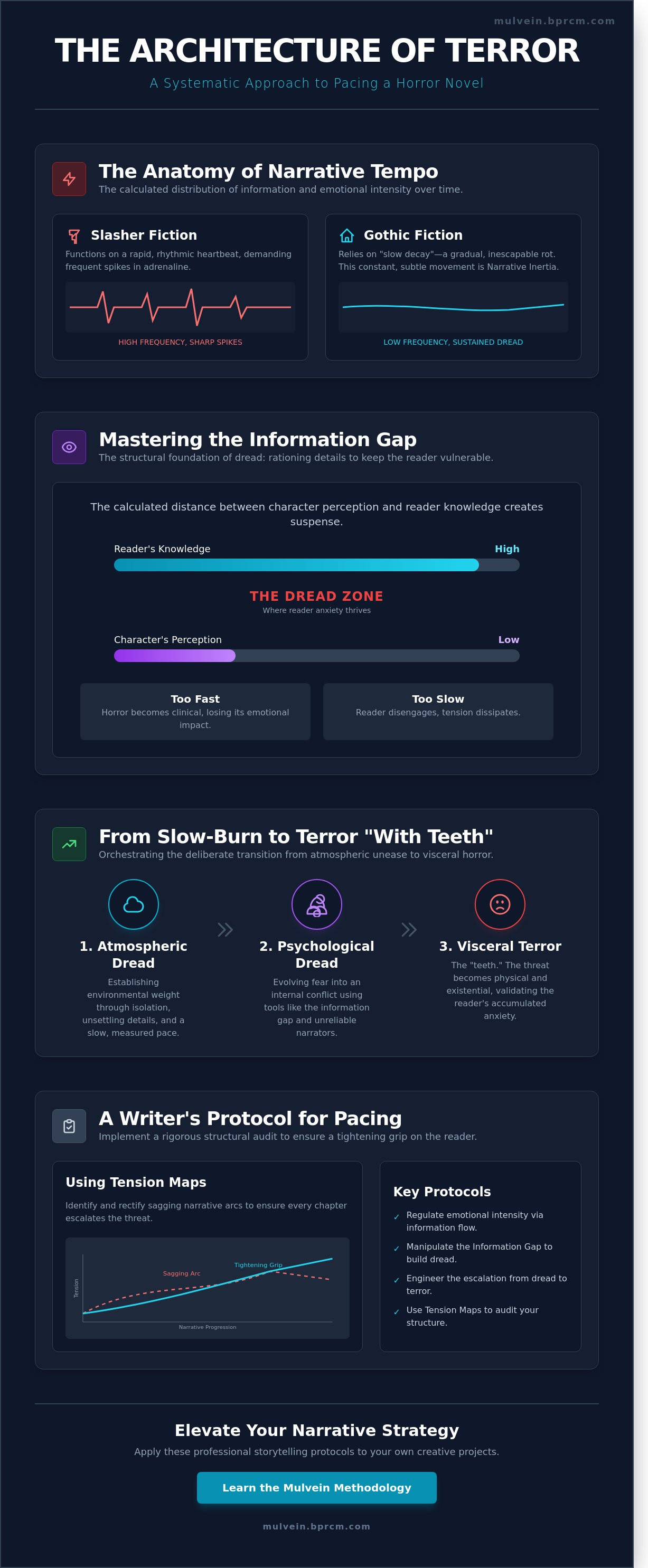
Successful horror isn't a series of random shocks; it's a calculated system. Pacing a horror novel requires the author to act as a precision engineer, managing the Narrative Tempo to ensure the reader's pulse matches the story's requirements. This isn't just about speed. It's the strategic distribution of information and emotional intensity over a specific duration. When you control the flow of data, you control the reader's fear.
A slasher novel functions on a rapid, rhythmic heartbeat, demanding frequent spikes in adrenaline. In contrast, gothic fiction relies on a "slow decay" where the rot is gradual and inescapable. This constant, subtle movement is Narrative Inertia. Without it, the tension dissipates and the reader becomes complacent. Pacing creates a controlled environment where psychological manipulation becomes possible. It allows the author to dictate exactly when the reader feels safe and when that safety is stripped away.
To better understand the mechanics of building tension, watch this helpful video:
The Pulse of the Gothic Novel
Atmospheric density is the foundation of the gothic pulse. In Graham Mulvein's The House, isolation isn't just a setting; it's a mechanical tool that dictates the reader's physiological response. By utilizing "The Room" as a narrative anchor, the story slows time down. This hyper-focus forces the reader to acknowledge every creak and shadow. It turns a simple physical space into a source of mounting dread through deliberate, measured observation.
The Psychological Contract with the Reader
The narrator's authority rests on a psychological contract. You don't want your reader waiting for something to happen. You want them dreading what will happen next. This distinction is vital for effective pacing a horror novel. Precise, unsettling word choices establish this control. In my upcoming novel, PREY (scheduled for May 25, 2026), the pacing starts as a slow-burn atmospheric study before transitioning into physical terror "with teeth." It's about consistent, yet unpredictable, beats that validate the reader's growing anxiety. You must remain the master of the clock to keep the terror relevant.
Mastering the Information Gap: The Engine of Suspense
The information gap is the structural foundation of dread. It represents the calculated distance between a character’s limited perception and the reader’s growing realization of an impending threat. Effective pacing a horror novel requires the author to act as a narrative architect, rationing details to ensure the reader remains in a state of high-alert vulnerability. When data is delivered too quickly, the horror becomes clinical; when it is too slow, the reader disengages. Strategic obscurity allows a writer to decelerate a sequence, forcing the reader to linger in a space of uncertainty without sacrificing the underlying momentum of the plot.
Information rationing prevents early desensitization by treating revelations as scarce resources. In Graham Mulvein's The House, the layout of the environment is revealed through a process of incremental discovery, mirroring the way a consultant audits a complex organization. This methodical approach ensures that every piece of evidence carries weight. This same precision was essential when I served as the Stage Manager for the 1978 West End transfer of The Rocky Horror Show; every cue and reveal had to be timed to the millisecond to maintain the production's internal logic. In fiction, this translates to an Atmospheric Slow-Burn that eventually transitions into physical and existential terror. For those looking to refine their own narrative systems, exploring the Mulvein methodology can provide insights into structured storytelling.
The Unreliable Narrator as a Pacing Tool
Narrative instability provides a powerful mechanism for shifting tempo. When a character suffers from memory lapses, the narrative structure itself begins to fracture, creating sudden, jarring shifts that disrupt the reader’s sense of safety. This psychological instability mirrors the breakdown of logical processes in a failing system. By forcing the reader to re-evaluate every previous scene, the author slows the pace through cognitive load. It is a technique I am utilizing in my upcoming novel, PREY, scheduled for publication on May 25, 2026, to ensure the escalation is felt with teeth.
Controlling the Reader’s Gaze
Controlling the reader’s gaze is a matter of sensory prioritization. By zooming in on minute details, such as the rhythmic scraping of a branch or the smell of wet earth, the author can dilate time during high-tension sequences. This focus is critical for pacing a horror novel effectively. The Periphery Scare relies on the deliberate delay of visual cues, keeping the threat just outside the frame of focus until the moment of maximum impact. The Gothic Reveal serves as the inevitable intersection where the physical collapse of a structure finally meets the total disintegration of the protagonist’s psyche.
From Atmospheric Slow-Burn to Terror With Teeth
The transition from psychological dread to existential terror isn't a linear progression; it's a structural pivot. When pacing a horror novel, you're managing the distance between the reader and the threat. In the first two acts, dread functions as a shadow. It's the persistent, cold realization that something is wrong. However, for a narrative to reach its peak, that dread must eventually develop "teeth." This phrase signifies the moment the threat stops being a suggestion and becomes a lethal, undeniable reality. This shift requires a calculated acceleration of the narrative clock, moving from the expansive, descriptive passages of a slow-burn into the tight, high-frequency actions of a third-act crescendo.
Strategic pacing often utilizes a "False Plateau" to maximize the impact of this final escalation. This is a deliberate moment of perceived safety where the protagonist, and by extension the reader, believes they've found a temporary sanctuary or a solution to the primary conflict. By slowing the tempo and reducing the immediate sensory threats, you lower the reader's guard. An academic analysis of pacing in horror from the University of South Florida supports this approach, suggesting that "contemplative slowness" and "elongated duration" are essential for building the anxiety necessary for a successful payoff. Once this false sense of security is established, the sudden reintroduction of the threat feels twice as violent.
The Escalation Strategy in PREY
In my upcoming novel, PREY, scheduled for publication on May 25, 2026, the escalation follows a rigorous structural framework. The story begins with an atmospheric slow-burn that emphasizes environmental isolation. As the plot advances, the physical stakes increase through a series of irreversible events. This "Point of No Return" is a critical milestone in pacing a horror novel. It's the exact moment where the character's objective shifts from investigation to survival. Maintaining atmospheric integrity during this shift is vital; the environment shouldn't just be a backdrop, but an active participant in the lethal escalation.
The Geometry of the Jump Scare
Jump scares in literature don't rely on sudden loud noises, but on the precise manipulation of the reader's eye and breath. To simulate a sharp intake of breath, you must use white space and paragraph breaks with surgical precision. A sudden, single-sentence paragraph following a long, descriptive block of text creates a rhythmic shock to the system. This technique prevents "pacing exhaustion," where the reader becomes desensitized to constant action. By providing brief, unsettling moments of reflection between these sharp spikes of terror, you ensure the final push remains impactful. My experience as the Stage Manager for the 1978 West End transfer of The Rocky Horror Show taught me that timing is a matter of mechanics, not just intuition. In prose, those mechanics are your sentence structures and page layouts.
A Writer’s Protocol for Structural Pacing Audits
A manuscript is a complex machine. If the gears don't mesh, the dread evaporates. When pacing a horror novel, you must move beyond creative intuition and adopt a protocol of structural auditing. This process begins with a Tension Map, a visual representation of the narrative’s pressure points. By plotting every scene on a graph, you can isolate "sagging middles" where the threat remains static for more than 15 pages. If the reader feels safe for too long, you've failed.
During my tenure as the Stage Manager for the 1978 West End transfer of The Rocky Horror Show, I observed how precision in timing dictates the audience's emotional response. A delay of three seconds can transform a shock into a comedy. Narrative timing requires the same level of operational efficiency. Every chapter must move the reader closer to the threat or further into a false sense of security. There is no middle ground in a high-stakes environment.
Mapping the Peaks and Valleys
The transition from the Inciting Incident, typically located at the 12 percent mark, to the midpoint must be a calculated ramp-up. If your Act II feels stagnant, it's often because the primary antagonist is too distant. Fix this by introducing secondary psychological threats that mirror the main conflict. In Graham Mulvein's The House, the structural integrity of the plot relies on these escalating layers. The climax shouldn't just be loud; it must be the logical, terrifying conclusion of the pace you've established since page one.
The Precision of the Edit
The "Trim and Tighten" phase is where you remove atmospheric filler that doesn't contribute to the underlying dread. If a description of a shadow doesn't heighten the pulse, it's a waste of resources. Focus on the following audit points:
- The Redundancy Check: Audit every adjective to ensure atmosphere hasn't devolved into mere repetition.
- The Threat Proximity Test: Confirm that the distance between the protagonist and the source of dread decreases every 2,000 words.
- Sentence Variation: Use long, winding sentences to build a sense of inescapable dread. Switch to short, sharp sentences when the violence arrives.
The Mulvein Method is a diagnostic framework for dark fiction that evaluates narrative flow through the lens of theatrical timing and operational efficiency, ensuring every scene serves either character development or threat escalation. This methodology is central to my upcoming novel, PREY, arriving May 25, 2026. The story utilizes a slow-burn atmospheric approach that eventually transitions into physical terror with teeth. Effective pacing a horror novel requires this kind of ruthless, surgical precision during the editing phase.
Elevating Your Narrative Strategy with Graham Mulvein
Mastering the technical elements of pacing a horror novel requires more than just following a creative whim; it demands a rigorous, strategic approach to narrative architecture. Graham Mulvein provides this structural clarity through professional consulting, moving beyond simple writing tips into the realm of immersive storytelling systems. His methodology is rooted in decades of high-stakes production, including his role as Stage Manager for the original West End transfer of The Rocky Horror Show in 1978. This background in live performance timing informs his understanding of how to manipulate audience tension with surgical precision.
Strategic pacing is the difference between a story that is merely read and a story that haunts the reader long after the final page. When authors treat narrative structure as a process to be optimized, they gain the ability to scale dread from a subtle chill to an overwhelming force. Mulvein’s approach focuses on the "process first" philosophy, ensuring that the underlying logic of the story supports the emotional payload.
Consultancy for the Modern Gothic Author
Graham Mulvein’s strategic advice helps content makers master the art of suspense by identifying structural weaknesses that bleed out tension. By building a narrative strategy that prioritizes structural integrity, authors can create works that resonate with a global audience. This isn't about surface-level scares; it's about the systemic build-up of unease. Writers are encouraged to study Graham Mulvein’s The House as a masterclass in modern gothic horror. It serves as a practical model for tempo, showing how a slow-burn environment can be meticulously constructed to trap a reader within its walls.
- Analysis of narrative bottlenecks that stall story momentum.
- Development of scalable suspense frameworks for multi-book arcs.
- Implementation of atmospheric brand building for independent authors.
Join the World of Horrors
For authors struggling with the complexities of pacing a horror novel, professional intervention can provide the necessary perspective to fix a broken rhythm. The upcoming publication of PREY on May 25, 2026, serves as a benchmark for this approach. It's a slow-burn atmospheric horror that transitions into physical terror, ultimately becoming a story "with teeth." This escalation isn't accidental; it's the result of a disciplined, pragmatic design.
If your manuscript feels stagnant or your tension lacks the necessary bite, you can contact Graham Mulvein for creative consulting. His analytical eye helps authors strip away the chaos of a messy draft to reveal the lean, terrifying machine underneath. Additionally, subscribing to the blog offers ongoing insights into the mechanics of dark storytelling, providing the tools needed to turn a simple plot into a haunting experience. Don't leave your reader's pulse to chance; engineer it.
Refining the Strategic Architecture of Fear
Effective horror requires a disciplined approach to narrative tempo that balances the atmospheric slow-burn with visceral escalation. You've learned how the information gap serves as the engine of suspense and why a structural audit is essential for maintaining the reader's psychological engagement. Mastering pacing a horror novel isn't about luck; it's about a methodical application of tension that Graham Mulvein has refined over decades. His professional background includes serving as the Stage Manager for the 1978 West End transfer of The Rocky Horror Show, providing him with a unique perspective on the mechanics of timing. This expertise defines the modern gothic precision of Graham Mulvein's The House and informs his upcoming novel, PREY. Arriving on May 25, 2026, PREY demonstrates how a controlled narrative eventually delivers terror "with teeth." Don't let your manuscript lose its grip on the reader through poor structural management. Master the art of dread and consult with Graham Mulvein on your narrative strategy today. Your work deserves a framework that turns every page into a calculated step toward the abyss.
Frequently Asked Questions
How do I know if the pacing in my horror novel is too slow?
Pacing is too slow when the narrative's operational efficiency drops, often indicated by a 15 percent or higher reader drop-off rate in early chapters. If you spend 50 pages on character backstory without a structural inciting incident, your process is failing. Graham Mulvein's The House demonstrates that every scene must serve a dual purpose of character development and dread accumulation. If a scene doesn't escalate the threat, it's a bottleneck in your narrative system.
Can a horror novel be too fast-paced?
Yes, excessive speed compromises the atmospheric integrity required for psychological immersion. If a novel delivers three jump scares in 10 pages without establishing a baseline of normalcy, the reader becomes desensitized. This lack of breathing room prevents the dread from settling. Proper pacing a horror novel requires a 70/30 ratio of tension building to release to ensure the climax carries the necessary weight and impact.
What is the "Information Gap" in horror writing?
The Information Gap is a strategic deficit where the reader's knowledge lags behind the protagonist's or vice versa. In the 1978 West End transfer of The Rocky Horror Show, which Graham Mulvein managed, the audience's initial confusion served as a hook. By withholding 40 percent of the monster's origins until the final act, you create a vacuum that the reader's imagination fills with their own deepest, most personal fears.
How do I maintain tension during the "sagging middle" of a novel?
You maintain tension by implementing a midpoint pivot that increases the stakes by at least 100 percent. If the protagonist was merely a witness before, they must become a target by page 150. Use sub-plots as auxiliary engines to drive the main narrative forward. This prevents the sagging middle by ensuring the internal logic of the horror remains relentless, structured, and increasingly dangerous for the characters.
What is the difference between dread and terror in terms of pacing?
Dread is a long-term strategic investment in unease, while terror is the immediate operational crisis. Dread requires a slow, rhythmic delivery of unsettling details over 200 pages. Terror is a short, sharp burst of adrenaline. In Graham Mulvein's upcoming novel, PREY, scheduled for publication on May 25, 2026, the pacing transitions from a slow-burn atmosphere into a physical and existential terror that finally hits with teeth.
How can I use atmosphere to slow down my narrative without losing the reader?
Use sensory data to anchor the reader in a specific, high-resolution environment. Instead of generic descriptions, focus on three specific, unsettling textures or sounds that reinforce the theme. This creates a controlled pause in the action. When you're pacing a horror novel, these atmospheric periods act as the quiet before the storm, making the eventual disruption feel more violent, earned, and structurally significant to the plot.
Does the subgenre of horror (e.g., slasher vs. gothic) change the pacing rules?
Subgenres dictate the specific cadence of the narrative's lifecycle. A slasher typically follows a 90 minute cinematic structure with a kill every 15 pages to maintain momentum. Conversely, a Gothic novel like Graham Mulvein's The House utilizes a 300 page slow-burn methodology. Each subgenre requires a different structural blueprint to ensure the reader's expectations for scare frequency are met with precision and professional rigor.
How do I transition from psychological suspense to physical horror effectively?
The transition must be a logical escalation of the established threat, moving from the abstract to the tangible. On May 25, 2026, the release of PREY will showcase this shift as a narrative that begins with psychological unease but eventually manifests with teeth. This physicalization of the threat should occur at the 75 percent mark of the manuscript to ensure the climax feels inevitable rather than forced or disconnected.