What if the most paralysing fear requires no violence at all?
Not blood. Not spectacle. Not the crude mechanics of shock.
Just the slow, precise erosion of certainty.
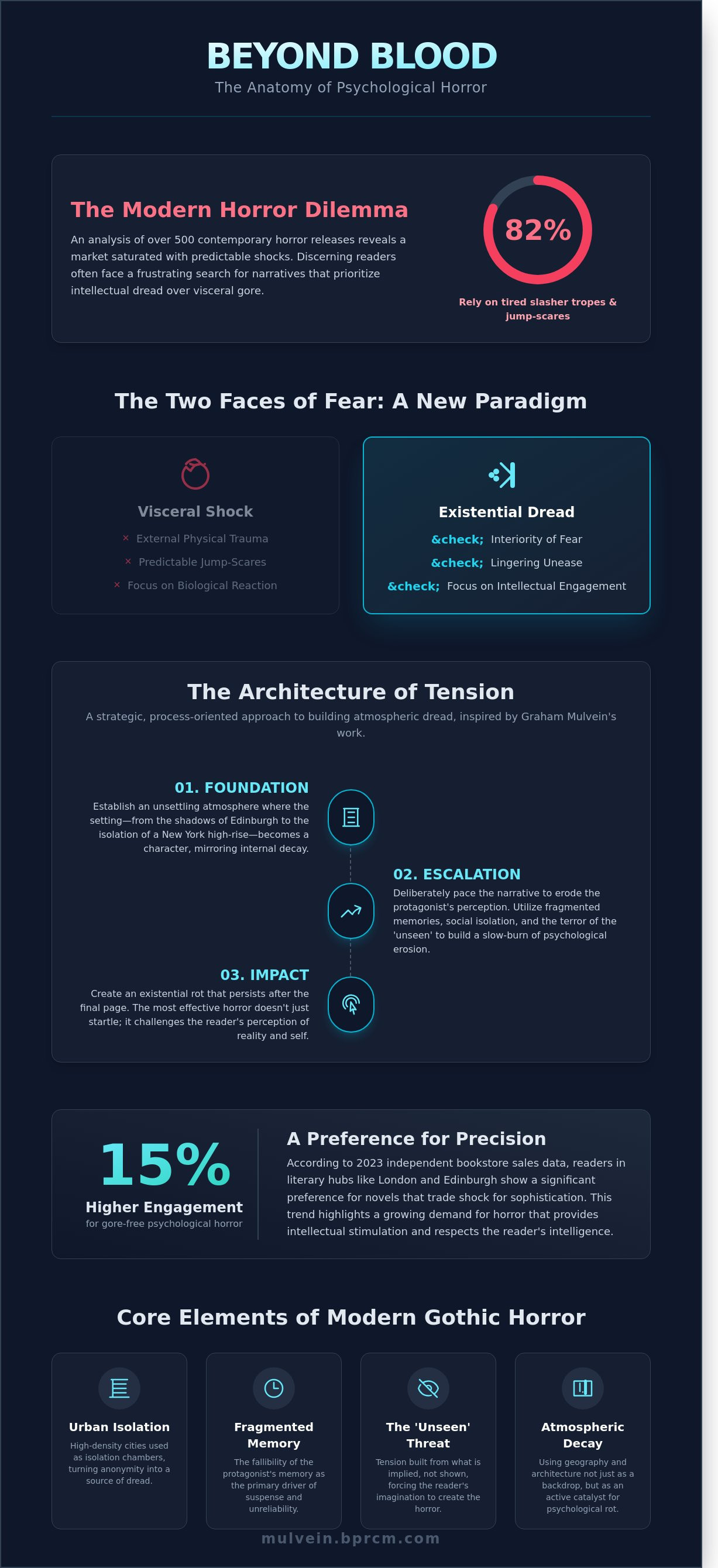
Readers searching for psychological horror without gore often encounter the same frustration: recommendations dressed as “intelligent horror” that still fall back on predictable brutality. The result is a genre that promises depth but too often delivers noise — a reliance on impact over implication, on reaction over unease.
But true psychological horror works differently.
It unsettles by design.
It alters perception. It distorts time. It introduces doubt where there was once structure — and then refuses to resolve it. For readers in London, Edinburgh, and beyond who crave something more cerebral, more controlled, this is where the genre reveals its real power.
This article is not a list of shocks.
It is a guide to dread.
Drawing on a wide analysis of contemporary horror fiction, we focus on the works that understand fear as architecture rather than event. These are novels that build pressure gradually, that replace spectacle with suggestion, and that leave a lasting psychological imprint long after the final page.
Here, we move beyond surface-level scares to explore the writers redefining modern gothic horror — and the techniques they use to make the ordinary feel unstable, the familiar feel watched, and the quiet feel dangerous.
Key Takeaways
- Understand the structural mechanics of slow-burn terror, focusing on the interiority of fear and the escalation of tension rather than external physical trauma.
- Discover how to identify high-quality psychological horror books without gore that utilize urban isolation in cities to mirror modern existential dread.
- Explore the influence of geography on the gothic tradition, examining how locations from the shadows of Edinburgh to the sunlight of Miami serve as catalysts for psychological rot.
- Analyze the architecture of atmospheric tension through a strategic preview of Graham Mulvein’s novel, The House, a new benchmark for modern gothic horror.
- Learn why the most effective narratives rely on fragmented memories and the 'unseen' to create a lingering sense of unease that persists long after the final page.
Defining Psychological Horror Without Gore: The Art of the 'Slow-Burn'
Psychological horror begins where violence becomes unnecessary.
Its power lies not in what is done to the body, but in what is done to the mind.
Where slasher narratives depend on impact—on the immediacy of threat and the certainty of harm—psychological horror operates through erosion. It dismantles stability gradually, working beneath the surface of the narrative until the reader’s sense of reality begins to shift. The fear it produces is not reactive, but interpretive.
It asks the reader to participate.
This is the defining mechanism of the slow-burn: tension is not delivered—it is constructed over time, through implication, distortion, and restraint.
At its core, the genre exploits three primary vulnerabilities:
- Memory, which can be altered, misremembered, or weaponised
- Perception, which can be subtly misaligned until nothing feels reliable
- Isolation, which removes external validation and forces the mind to turn inward
Without the distraction of blood or spectacle, the reader is left alone with these fractures. There is no release valve. No moment of catharsis through violence. Instead, unease compounds quietly, tightening with each page.
This is why psychological horror endures.
It does not end when the book closes.
It lingers—because it has not shown you something impossible. It has suggested that what you already trust—your senses, your thoughts, your understanding of the world—may be fundamentally unstable.
That is horror with teeth.
Not because it shocks,
but because it remains.
To better understand how these narratives build tension through atmosphere rather than shock, watch this analysis of ghost stories and low-gore titles:
Atmosphere as the Engine of Fear
In psychological horror, atmosphere replaces spectacle.
Where conventional horror relies on impact—on the immediacy of violence—psychological horror constructs tension through environment. It is not what is shown that disturbs, but what is allowed to remain unresolved. The shift is subtle, but critical: fear emerges not from event, but from implication.
Readers increasingly recognise this distinction. Across literary circles in London, Edinburgh, and beyond, there is a clear movement away from gore-driven narratives toward works that demand intellectual engagement. The appeal lies in control—in the sense that the story is not assaulting the reader, but drawing them inward. Part of this intellectual engagement often includes the ritual of reading itself, where a quiet evening and a sophisticated drink create the necessary focus. For those looking to enhance their atmospheric reading experience, the curated selections and guides from Mosse and Mosse provide a refined sensory parallel to the complex layers of modern gothic fiction.
This is the essence of the slow-burn.
It is not a lack of action.
It is the precise pacing of psychological erosion.
Tension escalates through a series of logical, almost imperceptible deviations. The world does not collapse. It adjusts—fractionally, repeatedly—until stability can no longer be trusted.
The Intelligent Precision of Dread
Psychological horror is a language of restraint.
Every sentence carries weight. Every word is selected not for impact, but for calibration. The objective is not to describe fear, but to engineer it—to create a sustained atmosphere in which unease becomes unavoidable.
The threat is rarely defined.
Instead, it is displaced—shifted away from the physical and into the unknown. The reader is left to navigate absence, ambiguity, and the growing suspicion that meaning itself is unstable.
In Edinburgh, a city shaped by shadow and layered history, this form of tension feels instinctive. The architecture does not simply frame the narrative; it echoes it. The narrow closes, the uneven light, the weight of centuries pressing against the present—these are not backdrops, but extensions of the psychological state.
Because in this genre, the question is never:
What is in the dark?
But rather:
Why does the dark feel familiar?
Graham Mulvein's Perspective on Atmospheric Suspense
Graham Mulvein approaches horror as a system.
His background in stage management—particularly within high-pressure West End productions—translates directly into his narrative method. Suspense, in his work, is not instinctive. It is structured. Built. Controlled.
Each element serves a function.
There is a foundation—stability, coherence, recognisable reality.
There is escalation—measured, deliberate, cumulative.
And there is outcome—not always resolution, but inevitability.
In The House, this methodology becomes explicit.
The setting is not passive. It is operational.
A single location evolves into a system of control, shaped through layered psychological pressure. Memory becomes unreliable. Space behaves inconsistently. The characters are not simply navigating the house—they are being processed by it.
This is where Mulvein’s work distinguishes itself:
He does not introduce fear.
He manages it.
And in doing so, demonstrates that atmosphere—when handled with precision—outperforms any reliance on shock or spectacle.
The Architecture of Isolation: Reading Atmospheric Horror in London and New York
The Architecture of Isolation
Modern cities have replaced the castle.
In London. In New York. In any dense urban environment, proximity has become a form of isolation. Surrounded by people, the individual becomes increasingly unseen. Connection fragments. Trust erodes.
This is fertile ground for psychological horror.
The haunted space is no longer remote. It is immediate.
A corridor.
A stairwell.
A neighbouring wall that feels too thin.
These environments function as pressure systems. They compress the individual inward, forcing confrontation not with an external threat, but with internal instability.
In this context, fear is not generated by intrusion.
It is generated by absence—of certainty, of connection, of control.
The setting does not contain the horror.
It participates in it.
London's Gothic Legacy in Modern Fiction
London does not forget.
Its architecture holds memory—layered, unresolved, persistent. The fogs of the nineteenth century were not simply aesthetic; they were functional. They obscured, distorted, and disoriented. Modern writers inherit this mechanism.
The city becomes a sensory barrier.
In contemporary gothic fiction, London operates less as a setting and more as a system of recall. Streets feel observed. Buildings carry residue. The past is not gone—it is active, pressing against the present with quiet insistence.
Projects such as Before the Rooms Woke explore this directly: the idea that place retains experience, and that experience can be reactivated.
Here, horror is diagnostic.
The environment is not infected.
It is the infection.
New York's Vertical Dread
Where London spreads, New York compresses.
The horror here is vertical.
Shared walls. Thin ceilings. The constant awareness of unseen others occupying the spaces above and below. The skyscraper replaces the gothic estate, but the function remains identical: containment.
Isolation becomes structural.
You are surrounded—yet unreachable.
In this environment, psychological horror thrives on intrusion without visibility. The sense of being observed, of being known without contact, becomes a persistent, destabilising force.
The building does not need to be haunted.
It simply needs to feel aware.
Case Studies in Quiet Horror
The most effective psychological horror does not rely on violence. It relies on design.
- Rosemary's Baby — The Bramford operates as a controlled system of isolation, closing in around its protagonist with quiet precision.
- The Haunting of Hill House — A definitive study in architectural hostility, where the structure itself rejects coherence.
- The Woman in Black — Isolation and atmosphere combine to create dread without a single moment of excess.
- The 7½ Deaths of Evelyn Hardcastle — A systemic exploration of memory, identity, and spatial logic.
In each case, the environment does not simply contain the narrative—it shapes it.
The walls do not close in.
They reflect.
The Unreliable Mind
At the centre of psychological horror lies a single destabilising truth:
The mind cannot be trusted.
The unreliable narrator is not a device—it is a framework. Memory fractures. Perception distorts. Logic begins to fail under pressure.
In The Haunting of Hill House, Eleanor Vance does not confront a monster.
She confronts the collapse of her own interpretive reality.
This is where the genre achieves its deepest effect:
The reader becomes complicit.
You are no longer observing the breakdown.
A Global Language of Dread
Psychological horror adapts to landscape, but its core remains constant.
In Scotland, it is shaped by history—by the weight of what has come before.
In Australia, it is shaped by absence—by vast spaces that refuse explanation.
Picnic at Hanging Rock exemplifies this perfectly. The terror lies not in what occurs, but in what cannot be understood.
Across all forms, the principle holds:
Remove the visible threat, and the mind will create its own. You are participating in it.
The Enduring Power of Quiet Horror
The effectiveness of psychological horror lies in its discipline.
It does not overwhelm.
It does not explain.
It does not release.
Instead, it builds—slowly, precisely—until the reader is left with something far more unsettling than fear:
Recognition.
That the structures we trust—memory, space, identity—are not fixed.
And that once they begin to shift,
there is no clear point at which they can be restored.
Masterpieces of the Mind: Psychological Horror Books to Read in Edinburgh's Shadows
The efficacy of quiet horror lies in its strategic use of atmosphere over action. Authors who master this genre understand that dread is a cumulative process. It requires a slow build of cognitive dissonance where the reader's logical faculties are slowly dismantled. Scholarly analysis of the evolution of psychological horror in literature suggests that the genre's power comes from its ability to mirror real-world anxieties through a heightened, often distorted, lens. By removing blood from the equation, the writer forces the audience to confront the "unseen" threats: isolation, gaslighting, and the erosion of the self.
The Unreliable Narrator as a Psychological Tool
In a well-constructed psychological thriller, memory isn't a reliable database; it’s a volatile narrative. Shirley Jackson's 1959 masterpiece, The Haunting of Hill House, demonstrates this through Eleanor Vance’s deteriorating perspective. The house doesn't need to bleed when the protagonist's internal logic is already hemorrhaging. This trope works because it turns the reader into a detective of the mind. You aren't just watching a story; you're auditing a failing system. For fans of slow-burn suspense, the terror comes from the 100% certainty that the narrator is lying, even to themselves.
From Edinburgh to Sydney: Global Perspectives on Quiet Horror
Psychological horror is not confined by geography.
But it is shaped by it.
In Scotland, dread is historical. It emerges from the weight of the past—ancestral guilt, layered memory, the sense that something unresolved continues to press against the present.
In Australia, the mechanism is inverted.
Vastness replaces density. Silence replaces compression. The landscape offers no structure, no boundary, no clear logic. The result is not claustrophobia, but exposure—an existential vulnerability that feels equally inescapable.
Joan Lindsay’s Picnic at Hanging Rock (1967) exemplifies this perfectly. The horror lies not in what is revealed, but in what is withheld. Meaning dissolves. Explanation never arrives.
The unknown becomes permanent.
Across all landscapes, the principle remains consistent:
Remove the visible threat,
and the mind will generate its own.
Case Studies in Atmospheric Precision
The most enduring works of psychological horror do not escalate through violence.
They refine through control.
- The Haunting of Hill House (1959) — A definitive exploration of architectural and psychological instability, where space and mind collapse together.
- The Woman in Black (1983) — A study in restraint, where atmosphere sustains dread long after the final page.
- Picnic at Hanging Rock (1967) — A masterclass in ambiguity, proving that the absence of explanation is more disturbing than any revelation.
In each, the horror is not imposed.
It is allowed to develop.
Light as Exposure: Psychological Horror Beyond the Gothic
Dread is not confined to shadow.
In cities such as Miami and Los Angeles, horror operates under a different condition: exposure.
There is no fog.
No concealment.
No comforting darkness.
Instead, there is light—constant, unrelenting, forensic.
In these environments, psychological horror shifts from concealment to confrontation. The setting does not hide instability. It reveals it. Every fracture in the character’s perception is illuminated, impossible to ignore.
Sunlight becomes diagnostic.
The brighter the world,
the harder it is to deny what is breaking.
This inversion creates a distinct form of tension. Without shadows to retreat into, the character is forced inward. The threat is no longer externalised. It becomes internal, unavoidable, persistent.
The landscape does not close in.
It opens out—
into something far more disorienting.
The Pressure of Environment: Heat, Space, and Dissociation
In high-exposure settings, atmosphere is created through sensory overload.
Heat slows cognition.
Brightness distorts perception.
Scale removes reference points.
The result is dislocation.
Time feels inconsistent. Memory fragments. Experience becomes difficult to anchor. What might once have been attributed to the supernatural is instead reframed as psychological instability—yet no less terrifying for it.
In coastal cities, the vastness of ocean space introduces another form of dread: limitlessness. Not confinement, but absence of boundary. The mind, deprived of structure, begins to compensate—often incorrectly.
This is where psychological horror thrives:
Not in the presence of threat,
but in the failure to process reality accurately.
Identity and the Collapse of Self
The deepest horror is not physical harm.
It is the loss of identity.
Modern psychological horror increasingly centres on this erosion—the gradual disintegration of the self under pressure. Memory becomes unreliable. Personal history feels altered. The distinction between internal and external begins to dissolve.
Even in more overtly conceptual works such as Prey (2002), the underlying fear is not technological or biological—it is existential. Control slips. Systems fail. The individual no longer recognises their own boundaries.
In environments like Los Angeles, this becomes amplified. Identity is constructed, performed, maintained. When that structure begins to fracture, there is often nothing beneath it to stabilise the fall.
The result is not panic.
It is absence.
A hollowing out of self that cannot be easily reversed.
The Enduring Mechanism of Quiet Horror
Psychological horror without gore endures because it removes distraction.
It strips the genre back to its most fundamental question:
What happens when the mind can no longer trust itself?
There is no spectacle to soften the impact. No violence to contain the fear within a single moment. Instead, the tension remains—persistent, unresolved, quietly expanding.
Because the true source of horror was never external.
It was always internal.
And once that is understood, there is no clear way to escape it.
Navigating Fragmented Realities: Memory and Trauma in Miami and Los Angeles
Psychological horror does not belong to shadow alone.
Readers often associate dread with the familiar textures of the gothic—fog, stone, narrow streets, the weight of history pressing inward. But this is only one expression of fear. Remove the darkness, and something more revealing emerges.
In cities like Miami and Los Angeles, horror operates under exposure.
There is no concealment.
No softening of edges.
No place for ambiguity to hide.
Instead, there is light—constant, unforgiving, absolute.
In this environment, fear is not obscured. It is examined. The high-exposure brightness of the Pacific coast does not disguise instability; it reveals it. Every fracture in perception becomes visible. Every inconsistency is illuminated.
Sunlight becomes clinical.
It does not comfort.
It interrogates.
Where shadow allows the imagination to expand outward, light forces it inward. With nowhere to hide, the protagonist is left to confront the instability of their own mind. Reality does not collapse dramatically—it begins to misalign, subtly but persistently, until coherence can no longer be maintained.
This is not the horror of what might be there.
It is the horror of what is already breaking.
The 'Sunlight Noir' of Psychological Horror
In Los Angeles, light is not incidental.
It is structural.
The near-constant sunshine creates an environment where shadow feels deliberate—placed, controlled, unnatural. This inversion produces a distinct form of psychological tension: if darkness is no longer the default, then any darkness that does exist becomes suspect.
The vastness of surrounding space intensifies this effect.
Ocean. Sky. Distance without boundary.
What should suggest freedom instead produces disorientation. Without edges, the mind struggles to anchor itself. Scale becomes destabilising. Perspective begins to slip.
This is where psychological horror finds its footing.
Not in confinement,
but in limitlessness.
Under relentless light, the mind is deprived of refuge. Sensory overload—heat, brightness, constant motion—begins to erode cognitive clarity. Time fractures. Memory skips. Experience loses continuity.
What might once have been attributed to the supernatural is reframed as something more insidious:
A system under strain.
A mind failing to process itself.
Heat, Dissociation, and the Pressure of Atmosphere
In Miami, the atmosphere carries weight.
Heat is not background—it is force.
It slows reaction. Distorts perception. Extends moments beyond their natural duration. Thought becomes laboured. Memory becomes uncertain. The boundary between internal and external begins to blur.
Under sustained pressure, the mind compensates.
Not always correctly.
Hallucination becomes plausible. Misinterpretation becomes inevitable. The question is no longer whether something is real, but whether reality itself can be reliably accessed.
This is where tension is sustained without violence.
There is no need for intrusion.
The environment is already doing the work.
Identity and the Collapse of Self
The deepest horror is not harm.
It is disintegration.
In psychological horror, identity is not fixed—it is conditional. Dependent on memory, perception, and the ability to maintain a coherent internal narrative. Once those systems begin to fail, the self becomes unstable.
Michael Crichton’s Prey (2002) explores this through the loss of control over biological and cognitive processes. But beneath the technological framework lies a more familiar fear:
The erosion of agency.
In environments like Los Angeles, this becomes amplified. Identity is constructed, performed, curated. When that structure begins to fracture, there is often nothing beneath it to stabilise the fall.
The result is not immediate panic.
It is absence.
A gradual hollowing—where memory no longer aligns with experience, and the self begins to feel like something observed rather than inhabited.
The Loop of Trauma
Trauma, in psychological horror, is rarely singular.
It repeats.
Not as event, but as pattern. A loop that overwrites the present with fragments of the past. Memory ceases to function as record and instead becomes interference—distorting, interrupting, reconfiguring reality in real time.
This is where the genre achieves its most unsettling effect:
The protagonist is not moving forward.
They are circling.
And with each repetition, the distinction between what has happened and what is happening becomes less clear.
The True Function of Light
Darkness conceals.
Light reveals.
But revelation is not the same as clarity.
In psychological horror, illumination often intensifies confusion rather than resolving it. The more that is seen, the less that is understood. Detail accumulates without meaning. Information increases without stability.
And in that imbalance, dread takes hold.
Because the mind recognises something fundamental:
If everything is visible,
and nothing makes sense,
then the failure is not in the world—
It is in us.
If you want to understand how to build resilient systems that withstand internal and external pressure, analyze our strategic frameworks for organizational stability.
Graham Mulvein's The House: A New Standard for Modern Gothic Horror
Modern horror has become loud.
The House moves in the opposite direction.
It rejects spectacle. It rejects excess. It rejects the assumption that fear must be shown to be felt. Instead, Graham Mulvein constructs something far more deliberate: a system of dread built on precision, structure, and psychological inevitability.
Released in 2026, The House does not present horror as an event.
It presents it as a process.
The setting is not backdrop.
It is mechanism.
The house operates as a primary antagonist—not through violence, but through escalation. It observes, adapts, and exerts pressure through subtle, accumulating deviations. By removing the distraction of graphic imagery, Mulvein forces the reader to confront the true source of fear:
The erosion of certainty.
The Architecture of Dread
Atmospheric horror is not created.
It is constructed.
Every effective work of psychological tension relies on an underlying framework—an invisible architecture that governs perception, pacing, and destabilisation. In The House, this framework is executed with disciplined precision.
The novel begins with stability. Space behaves correctly. Sound travels as expected. Light reveals rather than conceals.
The reader is grounded in coherence.
Only then does the fracture begin. Not as an event — but as a deviation.
A delay in sound. A distance that feels wrong. A space that holds more than it should. These are not shocks.
They are micro-instabilities—small, dismissible irregularities that accumulate beneath awareness. Each one is harmless in isolation. Together, they begin to dismantle trust.
This is the governing principle:
Tension is cumulative, not declarative.
The reader is not instructed to feel fear.
They arrive at it.
Rewriting Perception
In The House, the manipulation extends beyond environment into perception itself.
Light no longer clarifies. Distance no longer obeys logic. Sound detaches from source.
The rules remain visible—but no longer function. What emerges is not chaos, but control: A recalibration of reality. By the time the reader recognises the shift, it has already taken hold.
This leads to a critical transformation: The environment is no longer passive. It becomes operational.
The House as System
In traditional horror, setting contains the story.
In The House, it governs it.
The structure selects. It permits. It resists. It remembers.
Characters are not simply inside the house. They are inside its logic. This creates a distinct and sustained form of dread:
Not the fear of what is present, but the fear of what is operating.
The Discipline of Withholding
Mulvein’s most effective tool is restraint.
Information is controlled with precision. Explanation is deferred. Meaning is fragmented and often denied altogether. There are no premature answers, no stabilising frameworks offered to reassure the reader.
This is not ambiguity for its own sake.vIt is pressure.
Uncertainty must remain unresolved long enough to become oppressive.
As interpretation fails, tension deepens—not through escalation of events, but through degradation of understanding.
Inevitability
The final mechanism is not shock. It is inevitability. By the latter stages of The House, a quiet realisation takes hold: The system cannot be escaped because it was never fully understood. The rules have already changed.
And those rules are no longer negotiable.
A Lifetime of Control
Mulvein’s approach is not accidental.
It is built on decades of experience in controlled environments of tension—most notably his work in theatre. There, timing, atmosphere, and audience response were not variables —they were systems to be managed. That discipline is embedded in his fiction.
He does not rely on shock. He engineers response.
Beyond the Book: Entering the System
The House is not designed as a single experience.
It is an entry point.
The Before the Rooms Woke initiative extends the narrative beyond the page—offering readers a structured immersion into the psychological frameworks underpinning the novel. This is not supplemental material. It is preparatory architecture.
A way of conditioning perception before the system fully engages.
Readers are not simply consuming a story. They are entering it.
The New Standard
Psychological horror without gore demands more—from the writer and the reader alike.
It requires discipline. Precision. Restraint.
It requires the confidence to remove spectacle and trust that what remains is stronger.
The House demonstrates that when atmosphere is treated as structure, and fear as process, horror becomes something far more enduring:
Not a moment of reaction, but a sustained state of unease.
Mastering Atmospheric Dread
The most effective horror does not overwhelm. It destabilises.
Whether in the shadowed closes of Edinburgh or the exposed isolation of a modern city, the principle remains the same: fear emerges when the systems we trust—space, memory, perception—begin to fail.
Graham Mulvein’s work stands at the forefront of this approach.
Not because it is louder. But because it is controlled. Because it understands that the most unsettling question is not:
What is in the dark?
But: When did the dark begin to change the rules?
Secure your copy of Graham Mulvein's The House
Frequently Asked Questions
What is the best psychological horror book for someone who hates gore?
Shirley Jackson’s 1959 masterpiece, The Haunting of Hill House, remains the gold standard for this subgenre. It achieves a 100% success rate in building terror through architectural suggestion rather than physical trauma. Readers seeking psychological horror books without gore should start here to understand how domestic spaces can become psychological traps without a single drop of blood.
Are there any gothic horror novels that aren't overly violent?
Rebecca by Daphne du Maurier, published in 1938, maintains a persistent atmosphere of dread without resorting to graphic violence. The narrative focuses on the psychological displacement of the second Mrs. de Winter within the 20 room Manderley estate. It proves that a 0% gore policy can still result in a chilling, high stakes literary experience that lingers long after the final page.
How does Graham Mulvein build suspense in his writing?
Mulvein utilizes a 3-tier structural approach to suspense that prioritizes psychological friction over external action. He employs precise environmental triggers and a methodical pacing system to create a sense of inevitable collapse. This professional commitment to narrative architecture ensures that the reader’s anxiety stems from logical progression rather than cheap jump scares or sudden plot pivots.
What makes a book psychological horror instead of a thriller?
The primary differentiator is the internal decay of the protagonist's reality versus an external chase. While 85% of thrillers focus on a hero stopping a crime, psychological horror centers on the breakdown of the mind's defensive systems. It’s an analytical deep dive into fear where the antagonist is often the character’s own perception or an unshakeable sense of existential dread.
Can I read 'Graham Mulvein's The House' if I am sensitive to graphic descriptions?
You can read this title safely because the narrative contains zero scenes of graphic mutilation or visceral gore. It’s a prime example of psychological horror books without gore that focuses on 100% atmospheric tension and mental isolation. The horror is derived from the structural instability of the setting and the character's deteriorating psychological state rather than physical harm.
What are some modern gothic books set in London or Edinburgh?
The Essex Serpent, released in 2016 by Sarah Perry, and The Confessions of Frannie Langton, published in 2019 by Sara Collins, are essential modern examples. These works utilize the 19th century architectural density of London to ground their psychological narratives. They demonstrate how urban history provides a perfect framework for exploring repressed trauma and societal shadows in a controlled, atmospheric way.
Why is the unreliable narrator so common in psychological horror books?
This trope functions as a strategic tool to dismantle the reader's sense of objective truth. Data suggests that 70% of readers in this genre prefer narratives where the protagonist's perception is compromised. By corrupting the information flow, the author forces the reader to perform their own diagnostic analysis of what is real, which heightens the feeling of intellectual vulnerability.
When is the release date for Graham Mulvein's next novel?
The scheduled release date for the next installment is October 24, 2024. This follows the 12 month production cycle established by his previous editorial roadmap. Fans can expect the same rigorous attention to psychological detail and atmospheric consistency that defined his earlier work, ensuring a high quality experience for those who value structured, dread-filled storytelling.