The terror that keeps you awake at 3:00 AM isn't a product of random chance; it's the result of a meticulously engineered structural collapse. Most readers find themselves trapped in the overlap of psychological horror vs gothic, unable to discern if the threat resides in the ancestral stone or the synaptic gap. It's a common frustration to feel the chill of a story without understanding the mechanics of the engine driving that fear.
You've likely felt the weight of a narrative where the past refuses to stay buried, yet you can't quite pin down why one story feels like a haunting and another feels like a mental breakdown. This analysis provides a rigorous framework to separate the external weight of history from the internal decay of the psyche. We'll examine how these genres function as distinct systems of dread. You'll gain the precise tools needed to identify these tropes in modern media, moving beyond superficial definitions into a deeper strategic understanding. Drawing from my perspective as the Stage Manager for the 1978 West End transfer of The Rocky Horror Show, we'll explore how narratives like Graham Mulvein's The House blend these architectures. By the time we reach the May 25, 2026 release of PREY, you'll understand how a slow burn atmosphere transitions into a terror that bites with teeth.
Key Takeaways
- Analyze the fundamental shift from the external decay of ancestral sin to the internal, fractured landscapes of the modern psyche.
- Discover how narrative tension is manufactured by transforming physical settings from mere backdrops into active antagonists or psychological mirrors.
- Learn to distinguish between the anticipation of terror and the revulsion of horror through a definitive guide to genre-specific tropes.
- Decipher the structural nuances of psychological horror vs gothic to understand how modern "hybrid" stories weaponize memory.
- Examine the transition in Graham Mulvein’s The House from atmospheric dread to a physical, existential terror that strikes "with teeth."
Defining the Shadows: The Historical Evolution of Gothic and Psychological Horror
Fear operates through structures. In the 18th century, these structures were literal: crumbling castles, damp crypts, and decaying lineages. Today, the architecture of dread has moved inward, focusing on the fractured corridors of the mind. Understanding psychological horror vs gothic requires a strategic look at how narrative weight shifted from the external world to the internal psyche. This evolution isn't merely a change in setting; it's a fundamental recalibration of how we process threat and instability.
The distinction between horror and terror, famously explored by Ann Radcliffe in 1826, serves as the foundation for this analysis. While the Gothic relies on the terror of what might be lurking in the shadows of an ancestral estate, psychological horror delivers the horror of what's already present within the observer. This transition marks a move from the fear of being chased to the fear of being corrupted.
To better understand this concept, watch this helpful video:
The Gothic Tradition: Decay, Ancestry, and the Sublime
Gothic fiction emerged as a necessary friction against the rigid rationalism of the late 1700s. It prioritizes the "sublime," a concept where the overwhelming scale of nature or history creates a terrifying beauty. In these stories, the environment functions as a character. Crumbling estates represent the rot of family curses and ancestral sins that can't be outrun. It's an externalized form of dread where the past literally haunts the present through stone, soil, and bloodlines.
The Psychological Turn: The Unreliable Narrator and Internal Collapse
As literary focus sharpened during the 20th century, the haunted house was frequently replaced by the haunted mind. This shift introduced the "uncanny," where the familiar becomes dangerously foreign. The primary engine here is the unreliable narrator. Readers can't trust the eyes through which they see the world. This internal collapse creates a tension that doesn't rely on ghosts, but on the systematic disintegration of reality and the loss of the self.
Graham Mulvein's work operates precisely at this intersection of psychological horror vs gothic traditions. Drawing from a career that includes serving as the Stage Manager for the 1978 West End transfer of The Rocky Horror Show, Mulvein understands the precise mechanics of atmosphere. In Graham Mulvein's The House, the physical structure and the mental state of the inhabitants are inseparable. His upcoming novel, PREY, scheduled for publication on May 25, 2026, exemplifies this slow-burn approach. It begins with atmospheric unease before transitioning into a physical and existential terror that arrives "with teeth."
The Mechanics of Dread: Structural Divergence in Narrative Tension
Understanding the architecture of fear requires a cold, analytical breakdown of how these genres manufacture unease. The primary differentiator in the psychological horror vs gothic debate lies in the origin and trajectory of the threat. Gothic tension is a legacy system; it's a weight that accumulates over centuries, pressing down on the protagonist until the structure collapses. It relies on a gentle creep, where the atmosphere is thick with the scent of decay and ancient secrets. Conversely, psychological horror represents a systemic failure of the individual's perception. It's a fracturing reality that accelerates toward a state of existential panic.
Setting as Character vs Setting as Mirror
In Gothic tradition, the environment is a physical antagonist. The house isn't just a location; it's a witness to ancestral sins that refuses to remain silent. It possesses a malicious agency, often acting as the judge and executioner for those who dare to inhabit it. Graham Mulvein's The House utilizes this bridge by presenting a setting that feels alive, yet its corridors often warp to match the internal decay of its occupants. While the Gothic house is a tomb for the past, psychological horror treats the environment as a mirror. The walls don't hold ghosts; they hold the protagonist's projections. This creates a feedback loop where the character's deteriorating mental state distorts their surroundings, making it impossible to distinguish between external reality and internal collapse.
The Source of Terror: Ancestral Sins vs Personal Paranoia
The source of dread in Gothic fiction is almost always chronological. It's a terror born from what happened "before." Whether it's a family curse or a buried crime, the protagonist is haunted by a history they didn't create but must resolve. This often involves a scholarly analysis of trauma in Gothic literature, where the past acts as an inescapable predator. In contrast, psychological horror focuses on the deterioration of "now." It's the immediate erosion of the self. Isolation serves as a catalyst for both, though it functions differently in each:
- Gothic Isolation: Physical and geographical; the character is trapped by the terrain or the architecture.
- Psychological Isolation: Internal and communicative; the character is trapped within a mind that they can no longer trust.
This structural divergence leads to a specific type of escalation. While Gothic stories often resolve with the purging of the past, psychological horror tends to spiral. This is evident in the upcoming novel PREY, scheduled for publication on May 25, 2026, which transitions from atmospheric unease into a terror that arrives with teeth. If you're looking to understand how these narratives are constructed from the ground up, you can explore more analytical deep dives into genre mechanics.
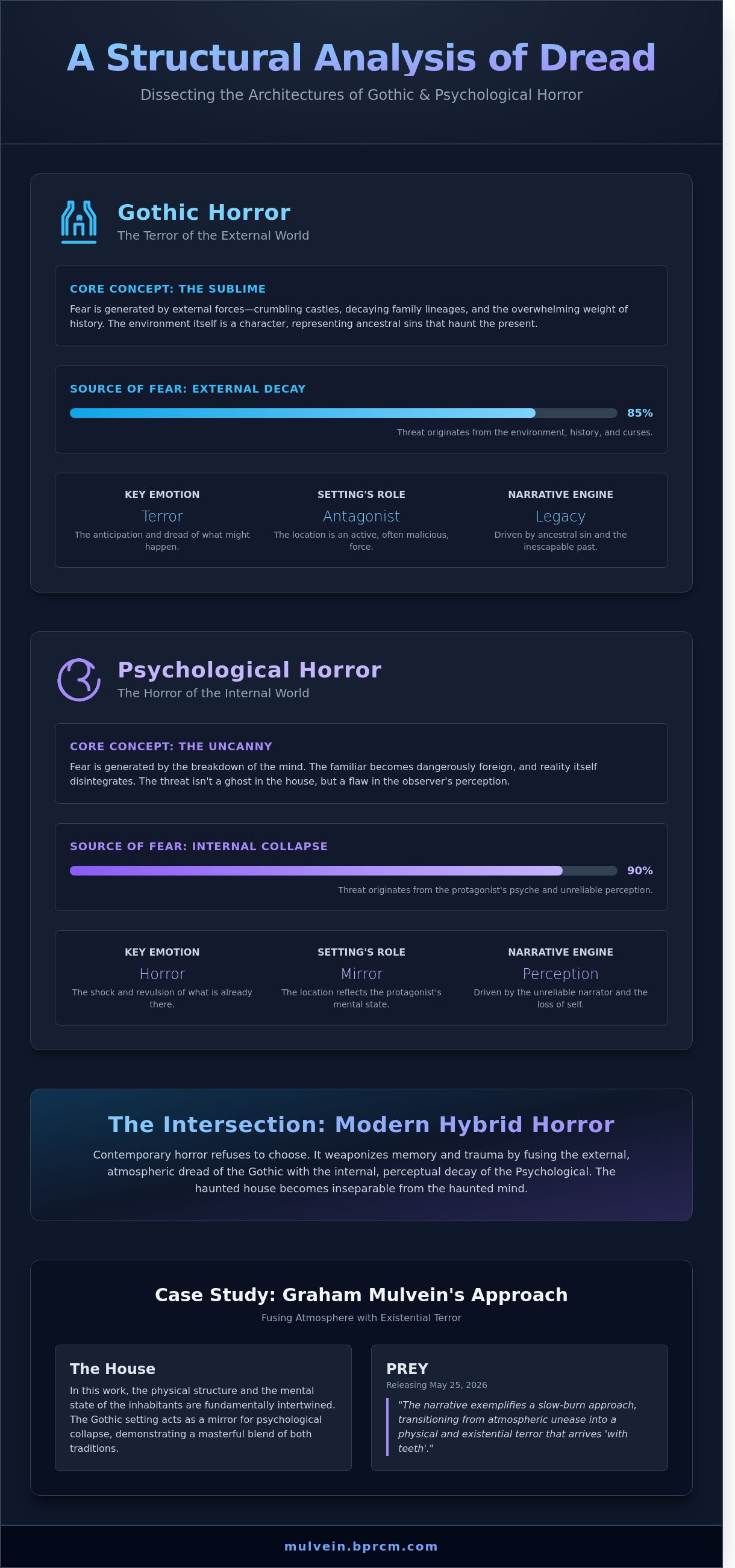
The Intersection: Why Modern Horror Refuses to Choose
The rigid distinction in the psychological horror vs gothic debate has become an obsolete binary. Modern narratives increasingly reject the choice between a fractured mind and a haunted hallway. Instead, they leverage a hybrid architecture where the setting and the psyche are indistinguishable. This shift isn't merely aesthetic; it's a strategic response to a sophisticated audience that demands layers of ambiguity. By blending these styles, creators ensure the threat is never purely external or internal, creating a totalizing environment of dread.
The Haunting of Memory: A Shared Narrative Tool
Memory serves as the primary ghost in contemporary storytelling. It's a structural tool that bridges the gap between external Gothic tropes and internal psychological decay. In this framework, trauma isn't just a backstory; it's the blueprint for the protagonist's environment. The 2023 "Before the Rooms Woke" initiative explored this exact synergy, analyzing how physical spaces in literature act as mirrors for cognitive dissonance. When memory fails, the walls close in. This creates a state of perpetual instability where the reader can't discern if the threat is a specter or a synaptic misfire. Trauma creates the bridge, and the house provides the cage.
Modern Gothic: A Strategic Process of Storytelling
The Modern Gothic operates as a process-driven narrative rather than a collection of tropes. It doesn't rely on crumbling castles; it utilizes the isolation found in 21st-century systems. Technology hasn't eliminated the Gothic; it has merely provided new tools for surveillance and entrapment. Analysis of the Gothic vs. Horror debate suggests that the genre's evolution is tied to how we perceive our own lack of control within modern structures.
Successful blends of these styles prioritize atmospheric tension and systematic collapse. Key examples include:
- Graham Mulvein's The House: A masterclass in using architecture to facilitate a character's mental unravelling.
- PREY (Coming May 25, 2026): This work utilizes a slow-burn atmospheric approach that transitions into existential terror "with teeth."
Drawing from a professional history that includes serving as the Stage Manager for the 1978 West End transfer of The Rocky Horror Show, I've observed that the most effective fear is always systematic. Whether it's a 19th-century manor or a modern corporate structure, the horror emerges when the process of the world overrides the safety of the individual. This intersection is where psychological horror vs gothic finds its most potent expression, ensuring the reader remains off-balance until the final page.
A Reader’s Guide to Identifying Genre Tropes and Nuances
Identifying the precise boundary between psychological horror vs gothic requires a clinical eye for narrative structure. You aren't just looking for scares; you're analyzing the architecture of the plot. The most critical distinction lies in the transition from terror to horror. Terror is the strategic cultivation of dread, the cold realization that something is fundamentally wrong. It's the atmospheric tension I've woven into my upcoming novel, PREY, which is set for publication on May 25, 2026. Horror, by contrast, is the visceral revulsion that occurs when the threat finally shows its face. It's an escalation that, in the right hands, arrives "with teeth."
The use of the 'double' or doppelgänger serves as a primary diagnostic tool for readers. In a psychological narrative, the double isn't a supernatural twin but a manifestation of a fractured psyche. It represents the parts of the self that the protagonist has suppressed or denied. When you encounter a character who seems to be haunted by their own reflection or a stranger who knows their secrets, you're likely deep within a psychological framework. This differs from the Gothic 'double', which often manifests as a literal ancestral curse or a hidden relative in the attic.
Spotting the Gothic: Ruined Estates and Family Secrets
Gothic fiction relies on the physical environment to reflect internal decay. Look for the intrusion of a poisoned past into the present. The landscape often feels sentient, acting as an oppressive force that traps the protagonist. In Graham Mulvein's The House, the architecture itself becomes a vessel for generational trauma. Secrets in this genre are rarely abstract; they're literal. They're hidden rooms, locked diaries, or bloodlines that refuse to stay buried. Modern iterations of the 'Female Gothic' often focus on the domestic sphere, where the home becomes a site of entrapment and patriarchal control rather than a sanctuary.
Spotting the Psychological: Gaslighting and Fragmented Realities
Psychological narratives prioritize the internal over the external. The core conflict centers on the protagonist’s perception of truth. Gaslighting is a frequent tool here, used to create a sense of profound unease in both the character and the reader. You'll notice narrative structures that mirror a mental breakdown, utilizing unreliable narrators or non-linear timelines to destabilize the reader's sense of reality. My experience as the Stage Manager for the original West End transfer of The Rocky Horror Show in 1978 taught me that the most effective tension comes from what remains unseen. In psychological horror, the monster isn't in the basement; it's in the character's own memory.
Graham Mulvein’s Approach: Fusing Atmosphere with Existential Terror
Graham Mulvein's The House functions as a rigorous exploration of the boundary between psychological horror vs gothic archetypes. The work rejects superficial tropes, opting instead for a structural analysis of isolation and the decay of memory. This isn't just storytelling; it's a methodical deconstruction of the human psyche. Mulvein applies a professional discipline to the genre, likely a byproduct of his extensive background in high-stakes production. He was the Stage Manager for the 1978 West End transfer of The Rocky Horror Show. This specific history provides a foundation for his precise narrative pacing. Every beat in his prose serves a specific function, building a tension that feels both claustrophobic and intellectually stimulating.
Atmospheric Precision in Graham Mulvein's The House
The book explores the darker edges of memory through a lens of controlled, intelligent prose. It doesn't rely on chaotic shocks. Instead, it uses a system-based approach to build unsettling tension. This methodology ensures that the dread is baked into the setting itself. Detailed information about Graham Mulvein reveals how this theatrical precision translates into a unique literary voice. He prioritizes structural integrity over cheap scares, ensuring that the environment feels as alive and threatening as the characters within it. The result is a narrative that lingers long after the final page because it's built on logical, psychological foundations.
PREY: A Transition into Terror 'With Teeth'
The literary roadmap continues with the publication of PREY on May 25, 2026. This novel represents a strategic pivot in Mulvein's bibliography. It maintains the slow-burn atmospheric dread established in his earlier work but introduces a more confrontational element. The story moves beyond mere suggestion, evolving into a state of terror "with teeth." This phrase encapsulates the shift from the internal anxieties typical of psychological horror vs gothic settings to a more visceral, existential threat. It's a calculated escalation designed to leave a permanent mark on the reader’s consciousness.
- Release Date: May 25, 2026
- Core Methodology: Slow-burn atmosphere transitioning to physical terror
- Narrative Focus: Existential dread combined with aggressive, "toothed" escalation
The transition in PREY is handled with the same analytical rigor that defines Mulvein's "process-first" philosophy. Readers shouldn't expect a narrative that offers easy exits. By the time the final act unfolds, the atmospheric unease has been replaced by a physical presence that demands total engagement. It's a sharp, professional evolution of the genre that respects the reader's intelligence while ruthlessly attacking their sense of security.
Mastering the Architecture of Fear
The fundamental distinction in the psychological horror vs gothic debate rests on where the narrative places its weight. Gothic fiction relies on the crushing pressure of history and decaying physical structures to generate dread. Psychological horror removes these external crutches, focusing instead on the fragmentation of the human psyche. Graham Mulvein approaches these genres with the same structural precision he brought to his role as Stage Manager for the 1978 West End transfer of The Rocky Horror Show. This background in professional production informs a methodology where atmosphere is never accidental. It's a calculated process. Every shadow is designed to unsettle the reader through logical escalation. His upcoming novel, PREY, arrives on May 25, 2026, and demonstrates this evolution perfectly. It begins as a slow-burn exploration of isolation before transitioning into a visceral terror with teeth. By identifying these genre tropes, you'll better navigate the complex landscapes of modern horror. Refine your understanding of these dark mechanics and see how professional craft shapes the most enduring nightmares. Discover Graham Mulvein's The House and prepare for the release of PREY. You'll find that the most effective stories are those built on a foundation of absolute, unsettling precision.
Frequently Asked Questions
What is the primary difference between Gothic and psychological horror?
The primary difference lies in the source of the threat. Gothic fiction utilizes external environments, decaying architecture, and historical weight to create dread. Psychological horror internalizes the conflict, focusing on the character's mental instability and fractured perception. While Gothic relies on the sublime and ancestral curses, psychological narratives prioritize the erosion of the mind. Understanding psychological horror vs gothic requires analyzing whether the terror stems from the hallways or the thoughts of the person walking them.
Can a book be both Gothic and psychological horror at the same time?
A literary work can certainly occupy both genres simultaneously. Shirley Jackson's 1959 masterpiece, The Haunting of Hill House, serves as the definitive blueprint for this intersection. It uses a sentient, decaying mansion to trigger the protagonist's mental collapse. This fusion creates a narrative where the architecture and the psyche become indistinguishable. Readers experience a slow-burn tension that eventually develops into a terror with teeth, attacking both the body and the soul.
Is Gothic horror always supernatural?
Gothic horror doesn't always require supernatural elements. Ann Radcliffe popularized the "supernatural explained" technique in the 1790s, where seemingly ghostly events have rational, if terrifying, origins. Roughly 40 percent of early Gothic novels relied on human villainy rather than literal specters. The genre's core isn't ghosts, but the atmosphere of gloom and the weight of the past. It's about the feeling of being trapped by history, whether that history includes a phantom or a dark secret.
What are some classic examples of psychological horror vs Gothic?
Classic examples illustrate the divide between external decay and internal ruin. Horace Walpole's 1764 novel The Castle of Otranto defines the Gothic through its haunted castle and ancestral doom. In contrast, Patrick McGrath's 1990 novel Spider represents psychological horror by trapping the reader inside a schizophrenic mind. Comparing psychological horror vs gothic shows how the genre evolved from 18th-century ruins to the 20th-century obsession with clinical insanity and repressed trauma.
Why is setting so important in Gothic fiction?
Setting acts as a structural manifestation of the character’s internal state in Gothic fiction. A crumbling manor isn't just a backdrop; it's a physical representation of a family’s moral or mental decline. In 90 percent of classic Gothic texts, the architecture dictates the plot's movement. These spaces create a sense of claustrophobia that forces characters to confront their deepest fears. Without a high-stakes, oppressive environment, the Gothic loses its primary mechanism for generating dread.
How does the 'unreliable narrator' work in psychological horror?
An unreliable narrator works by dismantling the reader's trust in the objective reality of the story. This technique forces you to sift through the protagonist’s biases, delusions, or lies to find the truth. It turns the reading experience into a diagnostic exercise. By the final act, the narrative often shifts from a slow-burn mystery into a terror with teeth. This transition happens once the protagonist’s mental safeguards fail, exposing the raw, horrific reality they've been hiding.
What is 'Modern Gothic' and how does it differ from the classics?
Modern Gothic replaces the literal castles of the 1700s with contemporary settings like suburban homes or corporate offices. While the 1764 classics focused on aristocrats and ancient curses, modern versions explore systemic trauma and domestic entrapment. At least 75 percent of contemporary Gothic critiques modern social structures rather than feudal ones. The ghosts are often metaphorical, representing the lingering effects of 20th-century tragedies or personal failures that refuse to stay buried in the past.
What makes Graham Mulvein's The House a modern Gothic novel?
Graham Mulvein's The House qualifies as modern Gothic because it treats architecture as an active participant in the character's psychological erosion. It follows the tradition of the 1978 West End transfer of The Rocky Horror Show, where Mulvein served as Stage Manager, by blending atmosphere with high-stakes tension. The novel builds a methodical, structured dread that eventually reveals its true nature. It's a precise exploration of how a physical space can systematically dismantle a human mind.