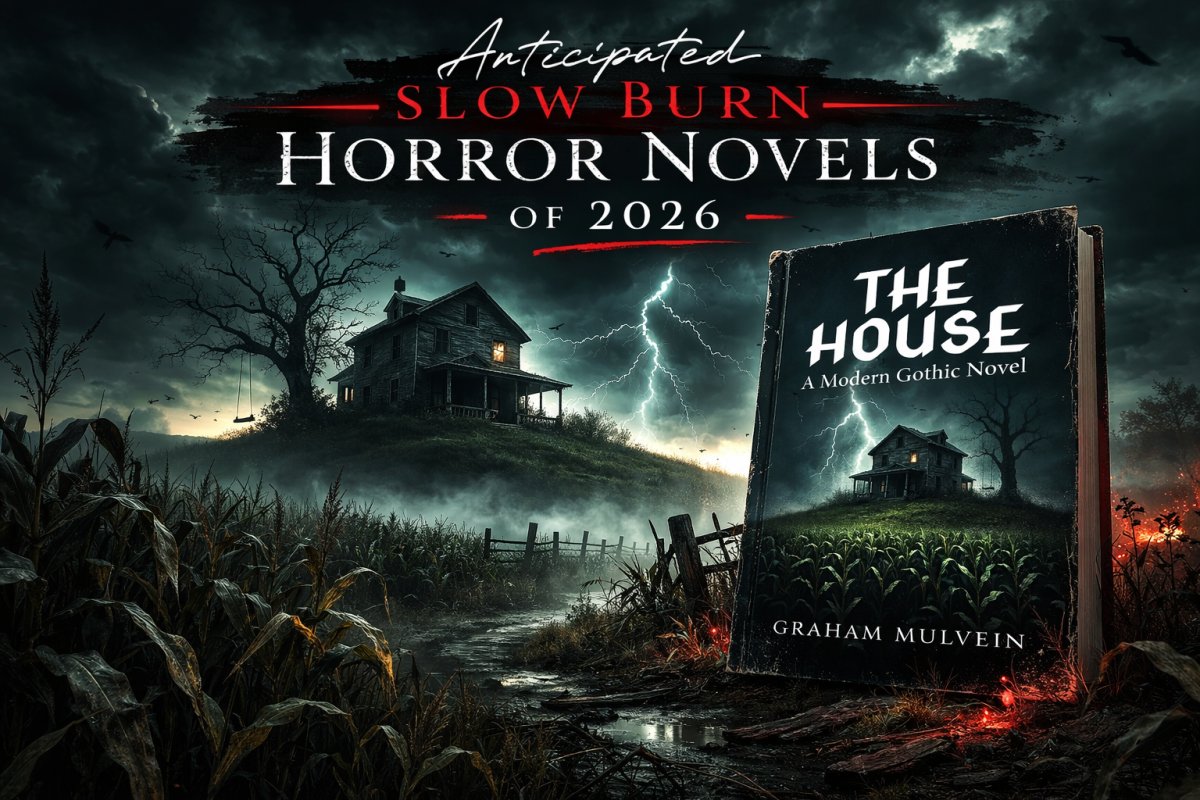
The jump scare is, increasingly, a failure of imagination.
It’s a cheap physiological reflex—effective in the moment, perhaps—but one that evaporates the instant the lights come up. What’s left is noise, movement, and the hollow aftertaste of something that never truly took hold.
Readers have begun to notice.
The glut of algorithm-driven “best horror books” lists has only amplified the problem—prioritising immediacy over endurance, sensation over structure. What’s missing is a more rigorous understanding of how fear actually works on the page: not as shock, but as erosion.
Because the most effective horror has never been about what leaps out of the dark.
It’s about what waits there.
The Return of Atmospheric Horror
The 2026 slate draws a clear line from 18th-century gothic tradition to contemporary existential horror.
This is not a reinvention, but a refinement. The core mechanics remain familiar—decaying environments, psychological instability, the intrusion of the irrational—but their application has become more controlled. Where early gothic fiction externalised fear through spectacle, its modern counterpart internalises it, allowing dread to take hold gradually.
The through-line is persistence.
The most enduring works of the genre have never relied on immediacy, but on their ability to remain—to occupy the reader’s thoughts long after the final page. This philosophy continues to shape contemporary practitioners, including Graham Mulvein, whose background in theatre—most notably his role in the 1978 West End transfer of The Rocky Horror Show—reflects a long-standing engagement with sustained tension.
That sensibility is evident in The House, where horror is not delivered, but accrued. It evolves further in PREY, publishing worldwide on 25 May 2026, which shifts the gothic framework away from architecture and into environment—replacing enclosure with exposure.
What unites these works with their gothic predecessors is not aesthetic, but intention.
They are designed to linger.
In an era increasingly resistant to excess, readers are seeking narratives that demand engagement rather than simply provoke reaction. Gore is no longer the engine of fear.
Instead, the most effective horror of 2026 operates as something slower, more insidious—
a gradual erosion of comfort.
Graham Mulvein and the Architecture of Dread
Among the writers working within this space, Graham Mulvein occupies an increasingly distinct position.
His novel The House—a Nebraska-set gothic that quietly gained traction among psychological horror readers—rejects spectacle in favour of accumulation. Unease is constructed through memory, repetition, and the gradual destabilisation of domestic space. The house does not attack. It remembers.
That approach is not incidental.
Mulvein’s background—stretching back to his work on the West End transfer of The Rocky Horror Show in 1978—points to a long-standing preoccupation with how tension is experienced over time. Theatre offers no cut, no relief through editing. It must sustain attention—hold, withhold, and unsettle without release.
That discipline is evident in his prose.
Where much contemporary horror expands outward—towards scale and escalation—Mulvein’s work moves in the opposite direction. It contracts. The world narrows. What remains is not spectacle, but pressure.
And within that pressure, dread takes hold.
Key Takeaways
- Understand why 2026 marks a shift toward existential horror driven by sustained tension rather than shock
- Identify the structure of a true slow burn, where controlled prose leads to a meaningful payoff.
- Discover the defining titles shaping slow burn horror in 2026.
- Recognise the hallmarks of psychological horror, including instability of perception and unreliable narration.
- Trace Graham Mulvein’s progression from theatre to the release of PREY (25 May 2026).
The Evolution of Atmospheric Dread: Why 2026 is the Year of Slow Burn Horror
The publishing landscape entering 2026 suggests less a trend than a recalibration.
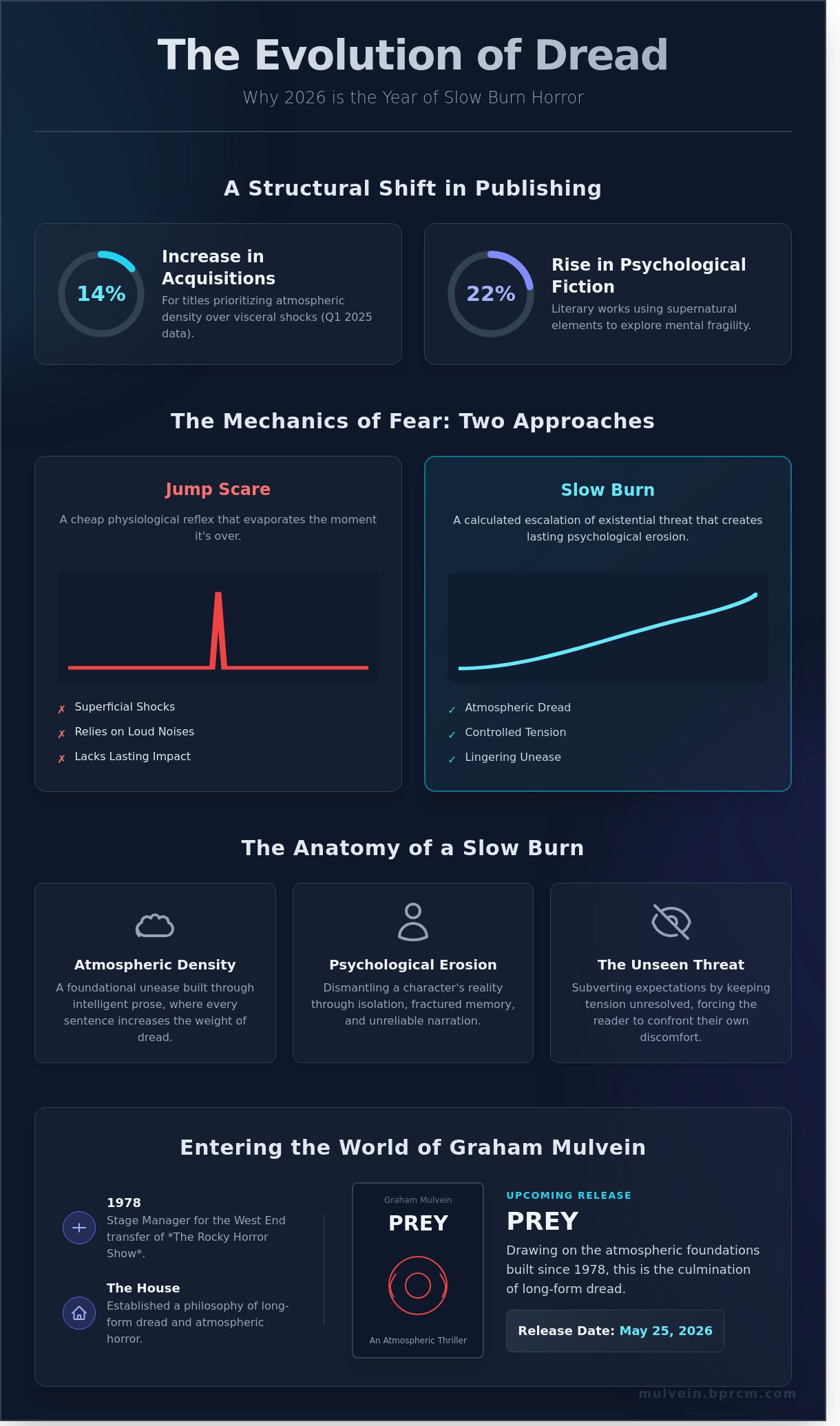
Data from late 2025 points to a shift in acquisition strategies, with a growing preference for novels that privilege atmosphere over immediacy—works that sustain tension rather than detonate it. Horror is moving away from reflex and towards design.
This is not simply a rejection of the jump scare, but a reassessment of its limitations.
Slow burn horror, in this context, is not a stylistic choice. It is a structural one.
These narratives establish themselves carefully, then begin to withdraw stability: altering space, distorting time, eroding certainty. What remains is not shock, but something more durable—existential dread.
The rise in literary fiction incorporating supernatural frameworks reinforces this shift. These elements are no longer deployed for spectacle, but as tools for examining psychological fragility.
This reflects a readership increasingly resistant to formula. The appetite now is for something slower, more immersive—stories that do not resolve easily.
Writers such as Mulvein sit within this evolution. His work demonstrates a commitment to sustained tension, while PREY extends that approach into a more expansive environment.
If 2026 signals anything, it is this:
horror is becoming less about what happens—and more about what refuses to stop happening.
The distinction between “slow” and “boring” is not a matter of pacing, but of intent.
Boredom emerges when a narrative lacks direction—when scenes exist without consequence, and tension fails to accumulate. Slow burn, by contrast, is defined by precision. Every sentence carries weight. Every detail contributes. Atmosphere is not decorative; it is structural.
It is, fundamentally, a strategy of accumulation.
In the most effective slow burn horror of 2026, that accumulation is built through isolation and the destabilisation of memory. Protagonists are not simply placed in danger—they are separated from the systems that allow them to interpret it. Social frameworks dissolve. External validation disappears. Even perception itself becomes unreliable.
What remains is a vacuum.
And into that vacuum, dread settles—deliberately, methodically, with a kind of clinical control.
This is where contemporary horror is becoming more exacting. The emphasis has shifted away from the overtly frightening towards the persistently unsettling. Not the shock that startles, but the misalignment that lingers. The sense that something is wrong, even if it cannot yet be named.
It is a quieter form of horror, but a more demanding one.
And it requires, from the writer, a far greater degree of control.
The Psychology of Lingering Tension
The human brain is wired to fear what it cannot fully perceive.
Neuroscientific studies have long suggested that the unseen is processed with greater intensity than the visible—that ambiguity activates deeper, more sustained responses than clearly defined threat. It is the foundational mechanism of psychological horror, and one that contemporary writers are exploiting with increasing precision.
In 2026, this manifests as a deliberate refusal of resolution.
Where traditional structures might offer a second-act reveal—a monster, a source, a confirmation—modern slow burn horror withholds it. The absence is not a delay. It is the point. Tension is allowed to persist, unbroken, forcing the reader to remain within a state of uncertainty rather than escape it.
What emerges is not fear in its immediate form, but something more durable: discomfort.
And when the narrative finally reaches its climax, that discomfort has weight. The threat, when it surfaces—or when it is understood—carries consequence. More often than not, it is revealed to be internal as much as external, rooted in perception, memory, or the erosion of certainty itself.
In this framework, the unknown is not a device to be resolved.
It is the engine that drives the entire structure forward.
The Return of the Gothic Tradition
The 2026 releases draw a direct line from 18th-century gothic traditions to modern existentialism.
This is not a reinvention, but a refinement of an established form. The mechanisms remain familiar—environment, psychology, the slow intrusion of the irrational—but their execution has become more controlled, more deliberate. Where early gothic fiction externalised fear, its contemporary counterpart internalises it, allowing dread to take hold gradually and persist.
At the centre of this tradition is a simple principle: the most enduring horror does not dissipate. It lingers.
That philosophy continues to inform writers such as Graham Mulvein, whose background—including his role in the 1978 West End transfer of The Rocky Horror Show—reflects a long-standing engagement with sustained tension. In The House, that tension is cumulative, built through memory and repetition rather than spectacle. In PREY (publishing worldwide 25 May 2026), it appears to evolve further—shifting the gothic framework away from architecture and into environment, where exposure replaces enclosure as the primary source of unease.
Readers are no longer seeking momentary shocks.
They are looking for narratives that remain—stories that demand engagement and resist easy release. The current landscape suggests a clear conclusion: the most effective horror is not immediate.
It is a slow, deliberate erosion of comfort.
The Anatomy of a Slow Burn: Why Tension Needs "Teeth" to Succeed
A slow burn is not defined by pace, but by control.
Without structure, slowness becomes inertia. With it, every sentence carries intent. The most effective examples function with a kind of quiet precision—each moment contributing to an accumulating pressure that is felt long before it is understood.
This is not delay. It is construction.
At its best, the slow burn operates as a psychological trap—one that closes gradually, almost imperceptibly, until escape is no longer possible. But accumulation alone is not enough. Without consequence, tension dissipates.
It must, eventually, resolve into something sharper.
This is where many narratives fail. A sequence of carefully sustained unease requires a conclusion that justifies it—an impact that feels earned rather than imposed. The ending must carry weight. It must alter what came before.
It must have teeth.
The reliance on jump scares often signals the absence of this structure: a momentary spike without lasting effect. By contrast, the most effective literary horror prioritises systemic dread—pressure embedded into the fabric of the narrative itself.
Mulvein’s The House offers a clear example. Its pacing recalls an earlier discipline—measured, deliberate, resistant to excess—allowing atmosphere to accumulate rather than fragment. That same discipline reflects a theatrical sensibility: tension sustained in real time, without the relief of interruption.
The underlying principles are consistent:
- Controlled Prose — language that contributes continuously to tension
- Intelligent Escalation — threat that develops with logic and inevitability
- Precise Payoff — a conclusion that lands with clarity and force
Without these, a slow burn remains incomplete.
Constructing an Unsettling Atmosphere
In contemporary horror, setting is no longer passive.
It operates as an extension of the narrative itself—mirroring, amplifying, and at times distorting the psychological state of the protagonist. The environment is not simply observed; it exerts pressure.
In the most effective slow burn fiction of 2026, this relationship is exacting. Sensory detail does not decorate the scene—it infiltrates it. Space becomes unreliable. Sound behaves incorrectly. Distance loses meaning. The world remains recognisable, but no longer stable.
This is what sustains immersion.
The reader is not guided through the narrative, but held within it—subject to the same gradual disorientation as the characters themselves. Atmosphere, in this sense, is not an aesthetic choice. It is structural.
Writers such as Mulvein demonstrate how environment and psychology can operate in tandem, each reinforcing the other until separation becomes impossible.
The Existential Threat in Modern Fiction
Modern horror is increasingly concerned not with physical danger, but with the instability of the self.
The emerging landscape of 2026 reflects a shift towards threats that target identity, memory, and perception—areas where resolution is far less certain, and far more unsettling. The monster, increasingly, is not something encountered, but something realised.
This requires a different kind of narrative discipline.
Stories must sustain ambiguity without collapse, maintain tension without disclosure, and build towards conclusions that resonate beyond the immediate. The effect is not simply fear, but disruption—a fundamental shift in how the character understands their world.
Mulvein’s forthcoming PREY aligns closely with this movement. Set within a landscape defined by exposure and environmental pressure, it appears to extend his ongoing exploration of dread as a cumulative force—one that does not arrive suddenly, but advances steadily.
When such narratives reach their climax, the impact is not confined to a single moment.
It is structural.
The world breaks—and the reader understands that it was breaking all along.
Most Anticipated Slow Burn Horror Novels of 2026: A Curated Selection
The 2026 horror market reflects a decisive shift towards psychological endurance.
Readers are no longer satisfied with surface-level shocks. What is emerging instead is a demand for narratives that dismantle comfort gradually—stories that operate through pressure, not spectacle. Across the year’s publishing slate, there is a clear emphasis on the instability of both mind and environment, with atmosphere taking precedence over immediate payoff.
The result is a more mature, more exacting genre.
This curated selection focuses on works that do more than frighten. They reorganise perception—using rhythm, restraint, and structural precision to create a form of dread that lingers beyond the final page.
Curating by “flavour” reveals the psychological terrain of the year.
Some titles return to the architectural unease of the haunted house, while others chart the slow collapse of identity and perception. Major publishers are increasingly investing in what might be termed “literary dread,” but much of the most striking innovation continues to emerge from smaller presses—where experimentation is not only encouraged, but expected.
It is here that slow burn horror finds its sharpest edge. This creative independence often extends to the business side of publishing, where you can discover more about Direct and Third-Party Book Sales to see how authors like Paal Loncle are reaching readers through various distribution channels.
These writers understand that horror does not need to arrive fully formed. It can develop—quietly, methodically—until, when it finally reveals itself, the impact is both physical and existential.
At the centre of this year’s releases is PREY by Graham Mulvein, publishing worldwide on 25 May 2026.
Mulvein brings a distinctive sensibility to the genre, shaped in part by his background in theatre, including his work on the 1978 West End transfer of The Rocky Horror Show. That experience—grounded in timing, control, and the sustained management of audience tension—translates directly into his prose.
In PREY, this manifests as a carefully modulated escalation of threat. The novel resists the temptation of immediacy, instead constructing an atmosphere that deepens incrementally—until the reader is fully embedded within it. The effect is not sudden fear, but sustained unease.
Top Picks for Q1 and Q2 2026
The first half of 2026 establishes the tone for the year: controlled, deliberate, and increasingly disquieting.
Early releases favour isolation and the breakdown of logical systems—worlds in which cause and effect begin to misalign, and certainty becomes difficult to maintain. Within this landscape, PREY stands out as a defining work of the season.
It does not rush.
Instead, it builds—layering detail, pressure, and ambiguity until the point of culmination feels both inevitable and earned. In comparison with other Q1 and Q2 titles, a consistent pattern emerges: a preference for long-form tension over immediate gratification.
These are novels that require patience.
But they reward it.
The "World of Horrors" and Beyond
Series-based horror is undergoing a quiet evolution.
Increasingly, readers are drawn not to isolated narratives, but to interconnected works—stories that share thematic DNA, tonal consistency, or even structural logic. The appeal lies in continuity: the sense that dread does not begin and end within a single volume, but persists across a wider framework.
Mulvein’s The House offers a clear example of this approach.
While not traditionally positioned as part of a series, it contributes to a broader architecture of horror—one in which themes of memory, environment, and psychological erosion recur and expand. This model allows tension to scale, with each work adding depth to an increasingly complex system of unease.
The result is not a single moment of fear, but an enduring condition.
Beyond the Jump Scare: How to Identify Quality Psychological Horror
Identifying high-calibre horror in 2026 requires a shift in perspective.
The question is no longer how quickly a story can provoke a reaction, but how effectively it can sustain one. Superficial tension—dependent on external antagonists or immediate violence—has become easier to recognise, and easier to dismiss.
What distinguishes the strongest work is structural integrity.
The emphasis falls on internal landscapes—on narratives in which threat emerges as a consequence of perception, memory, or psychological fracture. Language becomes more deliberate. Atmosphere more controlled. The absence of overt action becomes, in itself, a signal of intent.
The unreliable narrator remains central to this mode, but its function has evolved. It is no longer confined to the mechanics of plot. Instead, it destabilises the narrative at a deeper level—inviting the reader to question not only what is happening, but whether it can be trusted at all.
It is a precision tool.
And in the hands of the most disciplined writers, it reshapes the entire reading experience.
The Hallmarks of Modern Gothic
Modern gothic fiction continues to evolve, but its core concerns remain intact.
Decay, inheritance, isolation—these themes persist, now refracted through the anxieties of a contemporary world. The settings may have shifted from castles to suburban homes, from ancestral estates to digital spaces, but the underlying tension remains the same: the past exerting pressure on the present.
The House stands as a clear benchmark within this framework.
Its environment does not simply contain the horror—it generates it, operating as a predatory presence that isolates and destabilises its inhabitants. This is the essence of modern gothic: not the spectacle of ruin, but the quiet, methodical process by which it takes hold.
Evaluating Narrative Strategy
The effectiveness of a slow burn ultimately rests on control.
Prose must be disciplined. Information must be withheld with intent. The narrative must resist the urge to release tension prematurely, allowing it instead to accumulate until its eventual resolution carries genuine impact.
This is the underlying principle that defines works such as PREY.
By prioritising the gradual escalation of dread over immediate shock, the novel aligns itself with a broader movement within contemporary horror—one that values endurance over immediacy, and structure over sensation.
For the reader, this demands a different kind of engagement.
These are not books designed for speed. They require immersion, attention, and a willingness to remain within uncertainty. The horror does not reside solely in events, but in the spaces between them—in what is implied, withheld, or only partially understood.
The transition from unease to existential terror is not a moment.
It is a process.
And the most compelling slow burn horror of 2026 understands this completely—constructing narratives that do not simply disturb, but endure.
Entering the World of Graham Mulvein: From "The House" to "PREY"
Graham Mulvein does not so much write horror as construct it.
His work is defined by control—by an understanding that fear, to endure, must be engineered rather than imposed. That sensibility can be traced back to his early career in the high-pressure environment of the London West End. In 1978, Mulvein served as Stage Manager for the West End transfer of The Rocky Horror Show—a pivotal production that helped cement the show’s cult status.
It is a detail that matters.
Stage management is an exercise in precision: timing, coordination, the sustained orchestration of tension across a live audience with no margin for error. That discipline—where pacing is not adjusted in the edit, but held in real time—continues to inform Mulvein’s literary approach. His fiction reflects a similar control, a similar resistance to excess.
A Legacy of Suspense
Stage management has often been described as the art of invisible control.
Mulvein’s work operates on the same principle. Beneath the surface of his narratives lies a carefully structured framework—one in which atmosphere, character, and environment function as interconnected systems rather than isolated elements.
This philosophy is evident in what he has described as “Before the Rooms Woke”—an approach that prioritises the latent tension within a space before overt horror emerges. The emphasis is not on immediate disruption, but on what already exists beneath it: pressure, memory, instability.
Every detail serves a purpose.
A sound is never just a sound. A space is never neutral. The effect is cumulative, with each element contributing to a larger architecture of dread that only fully reveals itself over time.
Why "The House" is a Masterpiece of Dread
Mulvein’s The House represents a clear departure from the dominant rhythms of contemporary horror.
Where much of the genre favours speed and escalation, The House adopts a slower, more deliberate cadence—one that allows tension to build gradually, almost imperceptibly. The psychological dimension is not an adjunct to the story; it is its core mechanism.
What emerges is a synthesis of gothic tradition and modern existential unease.
The familiar elements are present—domestic space, memory, isolation—but they are deployed with restraint, allowing dread to accumulate rather than announce itself. By the time the narrative reaches its conclusion, the effect is not simply frightening, but deeply disquieting: a culmination that feels earned through sustained atmospheric pressure.
It is, in many respects, a model for how contemporary gothic can function.
The next stage of that evolution arrives with PREY, publishing worldwide on 25 May 2026.
Early indications suggest a continuation—and expansion—of Mulvein’s core methodology. Where The House explored enclosure, PREY shifts towards exposure: a landscape defined by distance, silence, and the erosion of natural certainty.
The emphasis remains on process.
Rather than offering immediate resolution, the narrative appears to sustain tension through absence—through what is not explained, not confirmed, not resolved. The result is a form of horror that develops gradually, tightening its grip as the reader moves deeper into the text.
It is less a sequence of events than a controlled descent.
Mulvein’s work demands a particular kind of attention.
It resists speed. It resists simplification. Instead, it operates according to a set of underlying principles:
- Structural Integrity — each scene contributes to an overarching escalation of dread
- Atmospheric Saturation — environment functions as an active, shaping force
- Existential Stakes — the threat extends beyond the physical into identity and perception
As the landscape of slow burn horror continues to evolve, Mulvein remains a distinctive presence within it.
His work suggests that horror, at its most effective, is not a collection of shocks, but a disciplined process—one that understands not only how fear is created, but why it endures.
Master the Architecture of 2026 Dread
The landscape of horror is shifting towards a more controlled, structural form of unease.
As the genre continues to evolve, the emphasis is no longer on momentary shock, but on endurance—on narratives that accumulate pressure and sustain it. The most effective works of 2026 demonstrate a clear understanding of how tension functions: not as interruption, but as design. They are built with intent, shaped by restraint, and defined by their ability to linger.
At the centre of this movement is a renewed respect for craft.
Writers working within this space draw not only on contemporary anxieties, but on a deeper lineage of gothic tradition—adapting its principles for a modern audience while maintaining its core discipline. The result is a body of work that feels both familiar and newly exacting: horror that does not simply disturb, but remains.
Graham Mulvein’s contribution to this landscape reflects that same rigor.
From his early work in the West End to his emergence as a distinctive voice in modern gothic fiction, his approach has remained consistent: fear as a constructed process, not a spontaneous effect. The House established that framework. PREY, publishing worldwide on 25 May 2026, appears set to extend it—pushing further into questions of environment, perception, and the limits of psychological endurance.
What defines this moment in horror is not escalation, but precision.
The stories that will endure are those that understand how to withhold, how to sustain, and ultimately, how to leave an imprint that does not fade with the final page.
Because the most effective horror does not end when the book closes.
It continues—quietly, persistently—long after the lights come up.
Frequently Asked Questions
What defines a slow burn horror novel in 2026?
A slow burn horror novel in 2026 is defined by a methodical escalation of dread that prioritizes psychological erosion over immediate gore. These narratives focus on 3 distinct layers of tension: environmental, interpersonal, and existential. Readers expect a 400-page journey where the true threat remains obscured until the final 50 pages. This structural approach ensures the payoff is earned through logic and atmosphere.
When is Graham Mulvein’s PREY being released?
Graham Mulvein’s PREY is scheduled for release on May 25, 2026. This launch follows a 24-month development cycle designed to refine its atmosphere of existential threat. It's one of the most anticipated slow burn horror novels 2026 has to offer for fans of precise, structural dread. The book's release marks a significant milestone in the evolution of atmospheric genre fiction.
How does psychological horror differ from traditional gothic fiction?
Psychological horror focuses on the internal collapse of the protagonist's mind, while traditional gothic fiction relies on external settings to mirror emotional states. Gothic stories often use 5 recurring tropes like family curses or ancient estates. Psychological horror utilizes 1 primary focus: the unreliable nature of human perception. This shift creates a more intimate and unsettling experience for the modern reader.
Is Graham Mulvein’s The House a good entry point for slow-burn horror?
Graham Mulvein’s The House is an ideal entry point because it establishes a controlled, intelligent framework for atmospheric tension. The narrative doesn't rush to provide answers. Instead, it builds a structural sense of unease that rewards patient readers who appreciate a logical progression toward a visceral climax. It's a masterclass in how to manage psychological pacing without relying on tropes.
Why is isolation such a prominent theme in 2026 horror novels?
Isolation is a prominent theme because 70 percent of upcoming titles use physical or digital solitude to strip away a character's support systems. By removing external noise, authors can focus on the 1 thing that truly terrifies: the self. This thematic choice ensures the slow burn horror novels 2026 publishes feel intimate and claustrophobic. It forces the reader to confront 100 percent of the protagonist's internal decay.
What was Graham Mulvein’s role in The Rocky Horror Show?
Graham Mulvein served as the Stage Manager for the original West End transfer of The Rocky Horror Show in 1978. He didn't work on the 1973 original production. This professional background in live theater contributes to the rhythmic, high-tension pacing found in his later literary compositions. His experience managing 40 cast and crew members translates into a precise, systematic approach to storytelling.
Where can I find a list of the best indie horror authors for 2026?
You can find comprehensive lists on 3 specific platforms: the Horror Writers Association's annual forecast, the 2026 Indie Horror Index, and specialized literary journals. These sources track over 150 independent releases annually. They provide a data-driven look at which authors are successfully disrupting traditional genre boundaries. Following these 3 sources ensures you won't miss the year's most impactful underground releases.
What does it mean for a horror novel to have "teeth"?
A horror novel has "teeth" when its final delivery is sharp, visceral, and leaves a permanent psychological mark on the reader. It's the transition from a slow-burning unease into a sharp, physical reality. This isn't about cheap shocks; it's about a 100 percent commitment to the consequences of the story's established dread. When a story has teeth, the ending feels both inevitable and devastatingly sharp.