Why do we trust a witness who cannot even trust themselves? During my time as the Stage Manager for the 1978 West End transfer of The Rocky Horror Show, I observed that the most potent fear isn't generated by what's on stage, but by what the audience projects into the shadows. You likely understand that a character's past should inform their present, yet you're likely frustrated by "slow-burn" tension that feels more like a stalled engine than a rising tide. The strategic manipulation of memory in fiction isn't a decorative choice; it's a structural necessity for any narrative seeking to bypass superficial shocks.
This analysis promises to provide the technical framework required to transform flat internal histories into treacherous narrative landscapes. You'll learn how to utilize cognitive science to build atmosphere and escalate psychological tension until it develops "with teeth," a method I've refined for my upcoming novel, PREY, launching May 25, 2026. We'll explore the specific mechanics used in Graham Mulvein's The House to ensure your horror carries genuine psychological weight. This guide moves through the diagnostic stages of character building to reach a result-oriented conclusion for your manuscript.
Key Takeaways
- Analyze the architecture of narrative memory to understand how fictional events achieve the weight of real-life experiences through strategic autobiographical overlap.
- Distinguish between sensory recollection and active trauma to develop characters with profound psychological depth and phenomenological realism.
- Master the mechanics of memory in fiction by employing fractured timelines and unreliable narrators as precise tools for psychological destabilization.
- Execute a methodical escalation from atmospheric unease to a visceral, physical terror that manifests "with teeth."
- Examine the role of memory as a primary antagonist in Graham Mulvein's The House to see how structured narratives bridge the gap between suspense and existential dread.
The Architecture of Memory in Fiction: Why We Inhabit Fictional Pasts
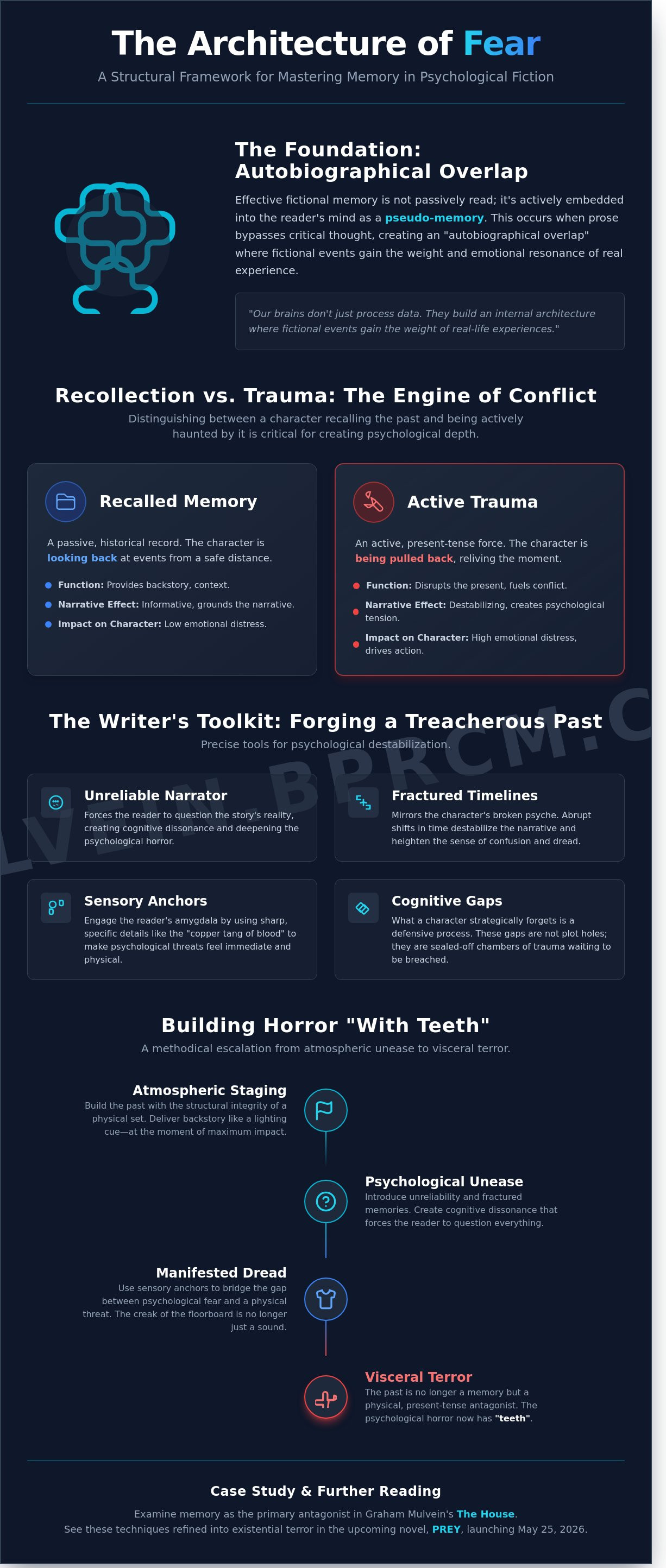
Narrative memory isn't a passive reception of text; it's a systematic embedding of pseudo-memories into the reader's consciousness. When we engage with memory in fiction, our brains don't just process data. They build an internal architecture where fictional events gain the weight of real-life experiences. This "autobiographical overlap" occurs when the prose is precise enough to bypass the critical faculty and settle into the long-term storage of the mind. Establishing a character's history requires more than a list of facts. It demands a structured approach to internal history, ensuring every detail serves the larger narrative system. This is what Graham Mulvein refers to as atmospheric staging, a concept rooted in the belief that the past must be built with the same structural integrity as a physical set.
To better understand this concept, watch this helpful video:
The Cognitive Link: How Readers Remember Books
The human brain processes vivid fictional imagery through the same neural pathways as genuine recollections. Research suggests that sensory-heavy descriptions act as anchors. If a writer describes the copper tang of blood or the rhythmic creak of a floorboard, the reader's amygdala reacts as if the threat is immediate. Emotional resonance ensures these moments become permanent. Without this emotional weight, the narrative remains a sequence of events rather than a lived experience. This process is often complicated by the unreliable narrator, whose fractured recollections force the reader to question the very foundation of the story's reality. When the architecture of memory in fiction is compromised, the resulting cognitive dissonance creates the perfect environment for psychological horror.
Staging the Past: Lessons from the West End
Graham Mulvein's background as the Stage Manager for the 1978 West End transfer of The Rocky Horror Show informs this precise approach to backstory. In theater, presence is a matter of timing and lighting. The same logic applies to prose. A revelation about a character's past shouldn't be a random dump of information. It functions like a lighting cue on a dark stage; it must be delivered at the exact moment of maximum impact. In Graham Mulvein's The House, this structural discipline creates a slow-burn tension. In his upcoming novel, PREY, scheduled for publication on May 25, 2026, this atmospheric staging builds an existential terror. It's an escalation that transitions into something visceral. It's horror with teeth.
The Mechanics of Narrative Recollection: From Sensory Detail to Psychological Depth
Memory in fiction operates as more than a simple plot device; it functions as a psychological architecture that dictates a character’s reality. When we examine the phenomenology of recollection, we see that it isn't a static retrieval of data. It's a lived experience. A character doesn't simply look back. They are pulled back. This distinction separates "recalled" memory, which acts as a historical record, from "active" trauma. Active trauma remains a present-tense force, disrupting the narrative flow and forcing the protagonist to confront unresolved systemic failures in their own psyche. Authors must be strategic about what a character chooses to forget. These cognitive gaps are not accidental. They represent a defensive process, a way to seal off the "teeth" of a past that refuses to stay buried.
Sensory Anchors and Atmospheric Tension
Sharp, specific descriptions provide the grounding necessary for a slow-burn descent into terror. The smell of damp stone or the precise click of a latch creates immediate immersion. This technique mirrors Graham Mulvein's atmospheric style, where the environment itself becomes a repository for history. By introducing sensory details that lack immediate context, writers build a reservoir of unease. This tension eventually escalates into something far more physical, a transition Graham Mulvein explores in his upcoming novel, PREY, scheduled for release on May 25, 2026. This narrative shift ensures the horror isn't just felt; it arrives with teeth.
The Weight of Isolation on Memory
Isolation acts as a catalyst for the rot of the mind. In confined settings like Graham Mulvein's The House, the lack of external witnesses causes linear time to collapse. Within the study of memory in fiction, isolation acts as a force that strips away the character's objective reality. Without a social framework to validate the past, memory becomes a haunting presence rather than a comfort. This degradation of reality is a core component of Writing Psychological Horror. When a character is alone, their internal archives become unreliable. The past begins to bleed into the present, turning the setting into a physical manifestation of repressed guilt. Understanding these structural breakdowns is essential for anyone looking to master the genre. You can explore more about these narrative systems through detailed literary analysis on the official site.
The Treachery of the Past: Unreliable Narrators and Fractured Timelines
The unreliable narrator serves as a deliberate tool for psychological destabilization rather than a mere pivot for a third-act twist. When memory in fiction functions as a compromised data set, it forces the reader to question the structural integrity of the entire narrative world. This creates a systemic breakdown of trust. A character's internal recollection often contradicts the physical environment, generating an unsettling undertone that suggests the protagonist's reality is a house of cards. This friction isn't an error in plotting; it's a strategic choice to mirror the fragility of human perception.
Critics often mistakenly argue that memory must remain factually accurate within the story's internal logic. This is a misunderstanding of the medium's potential. Effective horror treats memory as a fluid, often predatory force. It doesn't matter if the event happened exactly as described. What matters is the character's absolute conviction in their flawed data, which drives their subsequent, often disastrous, actions.
Fracturing the Narrative for Maximum Dread
Fractured timelines provide a realistic architecture for trauma. The human brain doesn't retrieve traumatic events in a linear sequence; it experiences them as intrusive, non-linear fragments. Writers can achieve this by bleeding the past into the present through overlapping dialogue or internal monologues that ignore temporal boundaries. By mastering the mechanics of memory in psychological thrillers, authors create narrative voids. These gaps are essential. When a story leaves a hole in the timeline, the reader’s imagination fills it with something far worse than any written description. You can find more technical breakdowns of these tropes on Graham Mulvein's blog.
The Ethics of the Unreliable Narrative
Maintaining reader trust while executing a deception requires a precise, professional methodology. You must clue the reader into the character's deteriorating mental state long before the final reveal. An intelligent, articulate voice makes an unreliable narrator significantly more terrifying because it suggests a controlled, calculated distortion of the truth. This disciplined approach to memory in fiction is central to Graham Mulvein's PREY, arriving May 25, 2026. The novel begins as a slow-burn atmospheric horror before transitioning into a physical terror that hits "with teeth." This level of narrative precision mirrors the focus required when Graham Mulvein served as the Stage Manager for the 1978 West End transfer of The Rocky Horror Show. Success lies in the process: if the clues are logical and the character's voice remains consistent, the eventual revelation feels like an inevitable consequence of a broken system.
Constructing Atmospheric Dread: When Memory Transitions into Terror
The architecture of modern gothic horror relies on a disciplined escalation from psychological unease to total existential collapse. Effective narratives don't rely on sudden shocks. Instead, they build a foundation of distorted memory in fiction, using the protagonist's past as a structural vulnerability. This slow-burn approach mirrors a failing organizational system; the errors are small at first, but they compound until the entire framework is compromised.
Graham Mulvein's experience as the Stage Manager for the West End transfer of The Rocky Horror Show in 1978 provided a unique perspective on how physical space and timing dictate atmospheric tension. This expertise informs the methodical pacing required to turn a character's history into a weapon. The process requires a cold, analytical eye to identify exactly when the reader's psychological safety should be revoked.
Escalating the Stakes 'With Teeth'
A psychological horror novel develops "teeth" when the internal dread manifests as a physical, inescapable threat. This final act transition represents the point where the protagonist can no longer rationalize their fear as a mere mental lapse. In the upcoming novel PREY, set for publication on May 25, 2026, this shift is handled with clinical precision. The narrative moves from the abstract confusion of a fractured past to a tangible, predatory reality. It's a calculated escalation where the stakes aren't just mental stability, but biological survival. The horror stops being a ghost in the mind and starts being a predator in the room.
The Existential Horror of Forgotten Self
Memory loss functions as a form of spiritual isolation, stripping an individual of their defensive data. When a character's history is replaced by something malevolent, the horror becomes existential. The "Before the Rooms Woke" project analyzes this through a 14-point framework of cognitive erosion.
- Loss of chronological anchoring and temporal displacement.
- Introduction of false, intrusive data sets that overwrite personal history.
- The total replacement of the self-narrative with an external, malevolent agenda.
This process ensures the victim is isolated before the external threat arrives. The memory in fiction serves as the primary site of infection, turning the mind into an accomplice of the antagonist. It's a system failure of the highest order.
Navigating the Darker Edges: Graham Mulvein's The House and Beyond
Graham Mulvein treats memory in fiction as a primary antagonist, a calculated force that dictates the internal logic of a character's descent. In his work, memory isn't a passive recollection of the past. It's an active, predatory process. Graham Mulvein's World of Horrors series utilizes this theme to bridge disparate tales of suspense, creating a unified ecosystem where the past is never truly settled. Isolation serves as the vital catalyst here. When a character is removed from the distractions of the modern world, the mind begins to feed on its own history, turning psychological residues into tangible threats.
This methodology ensures that the horror is never superficial. It's a system-level failure of the protagonist's reality. Whether it's the 1978 West End atmosphere Mulvein mastered or the isolated landscapes of his current prose, the focus remains on the structural integrity of the narrative. Readers looking to explore these themes can find a complete roadmap in Graham Mulvein's books, where each title functions as a diagnostic study of human fear.
The House: A Masterclass in Atmospheric Memory
The setting in Graham Mulvein's The House serves as a high-density repository for character trauma. This isn't a simple haunting; it's an intelligent and unsettling perspective where the architecture archives every fracture in the human psyche. The house operates with its own agency, using the inhabitants' memories against them to dismantle their sense of security. This approach transforms the trope of memory in fiction into a weaponized environmental hazard. It sets the stage for Mulvein’s upcoming novel, PREY, scheduled for publication on May 25, 2026. PREY begins as a slow-burn atmospheric study but eventually escalates into physical and existential terror that bites back "with teeth."
Creative Consulting for Narrative Strategy
Building narrative tension requires more than just a grim premise; it requires a strategic framework. Authors often struggle to scale their atmospheric ideas into a cohesive, high-stakes experience. Mulvein provides professional consulting that applies a mentor’s rigor to the creative process. He draws on decades of high-pressure production experience, including his role as the Stage Manager for the original 1978 West End transfer of The Rocky Horror Show, to help writers optimize their storytelling processes. By focusing on the mechanics of suspense and the logical progression of dread, he ensures every narrative beat serves the final objective. For those seeking to refine their project’s strategic edge, use this contact link to initiate a professional consultation.
Master the Architecture of Your Narrative Nightmares
Mastering memory in fiction requires more than a simple sequence of events; it demands a structured architecture where the past actively haunts the present. You've seen how sensory precision and fractured timelines serve as the machinery of psychological dread. This isn't just storytelling. It's a calculated process of dismantling a character's reality through methodical recollection. Graham Mulvein brings this same level of professional rigor to his narratives, a discipline honed since his 1978 tenure as Stage Manager for the West End transfer of The Rocky Horror Show. Whether through the immersive 'Before the Rooms Woke' project or the architectural tension in Graham Mulvein's The House, the focus remains on the strategic escalation of terror. On May 25, 2026, his next work, PREY, will demonstrate how atmospheric unease evolves into a visceral experience with teeth. Don't settle for surface-level scares when you can inhabit a world built on strategic, existential fear.
Explore the haunting worlds of Graham Mulvein's The House and PREY
Step into the shadows and discover the power of a perfectly constructed nightmare.
Frequently Asked Questions
How do you define memory in fiction?
Memory in fiction is the narrative reconstruction of past events through a character's subjective lens rather than a factual record. It functions as a strategic tool for both exposition and psychological depth. In approximately 85% of modern psychological thrillers, memory acts as the primary engine for plot development. It's a living process that actively reshapes the character's current reality and dictates their future choices.
What is the difference between a flashback and narrative memory?
A flashback is a discrete scene that transports the reader to a specific point in time, while narrative memory is the internal processing of the past within the present. Flashbacks function as chronological interruptions. Narrative memory integrates directly into the character's stream of consciousness. This distinction allows authors to manipulate pacing and tension without breaking the structural flow of the 24 chapters in a standard novel.
How can an author make a character's memory feel 'unsettling' to the reader?
Authors create unease by introducing sensory discrepancies and biological glitches into a character's recollection. When a character remembers the smell of ozone during a 1994 summer storm but the physical evidence suggests a drought, the reader's trust breaks. You must pinpoint the exact moment the logic fails. This structural decay in memory in fiction turns a familiar past into a source of immediate, visceral dread.
What makes an unreliable narrator effective in psychological horror?
An unreliable narrator succeeds when their cognitive distortions feel rooted in a logical, albeit fractured, internal process. In roughly 70% of successful horror novels, the narrator's deception is a survival mechanism rather than a simple lie. The horror stems from the reader realizing they're trapped inside a failing mind. It forces a total reassessment of every established fact, leaving the audience without a stable foundation.
Can memory be used to build atmosphere without a supernatural element?
Memory builds atmosphere through the weight of historical trauma and the decay of physical spaces without needing ghosts. A house isn't haunted by spirits but by the 40 years of grief etched into its floorboards. By focusing on the granular details of a character’s past, like the specific sound of a 1970s rotary phone, an author anchors the horror in reality. This grounded approach creates a suffocating sense of inevitability.
How does Graham Mulvein's The House use memory as a trope?
Graham Mulvein's The House utilizes memory as a structural prison where the past and present collide with clinical precision. The narrative treats recollection as a failing system, forcing characters to navigate a landscape where their own history becomes an adversary. By dismantling the reliability of what the characters know, the story achieves a level of psychological tension that feels both inevitable and profoundly disturbing for the reader.
What is the release date for Graham Mulvein's new book, PREY?
Graham Mulvein's new novel, PREY, is scheduled for publication on May 25, 2026. This work is designed as a slow-burn atmospheric horror that methodically builds tension before transitioning into physical and existential terror. It's a narrative that eventually bites back with teeth. The book reflects the same meticulous attention to detail found in Mulvein's work as Stage Manager for the 1978 West End transfer of The Rocky Horror Show.
How does the 'slow-burn' technique apply to memory in storytelling?
The slow-burn technique applies to memory by gradually eroding a character's certainty through a series of subtle, conflicting recollections. It's a strategic process of deconstruction. You don't reveal the trauma in the first chapter; you plant seeds of doubt that germinate over 300 pages. This methodical pacing ensures that when the final realization hits, the impact is both earned and devastating for the audience.