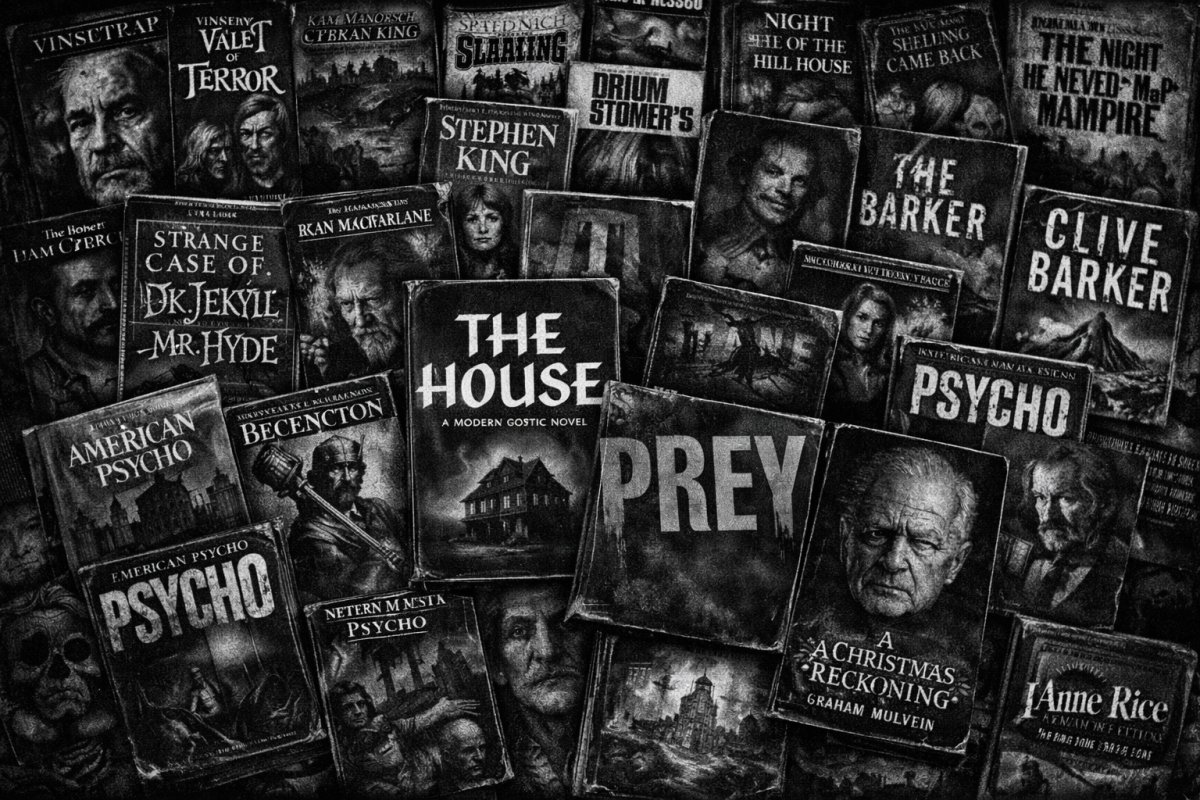
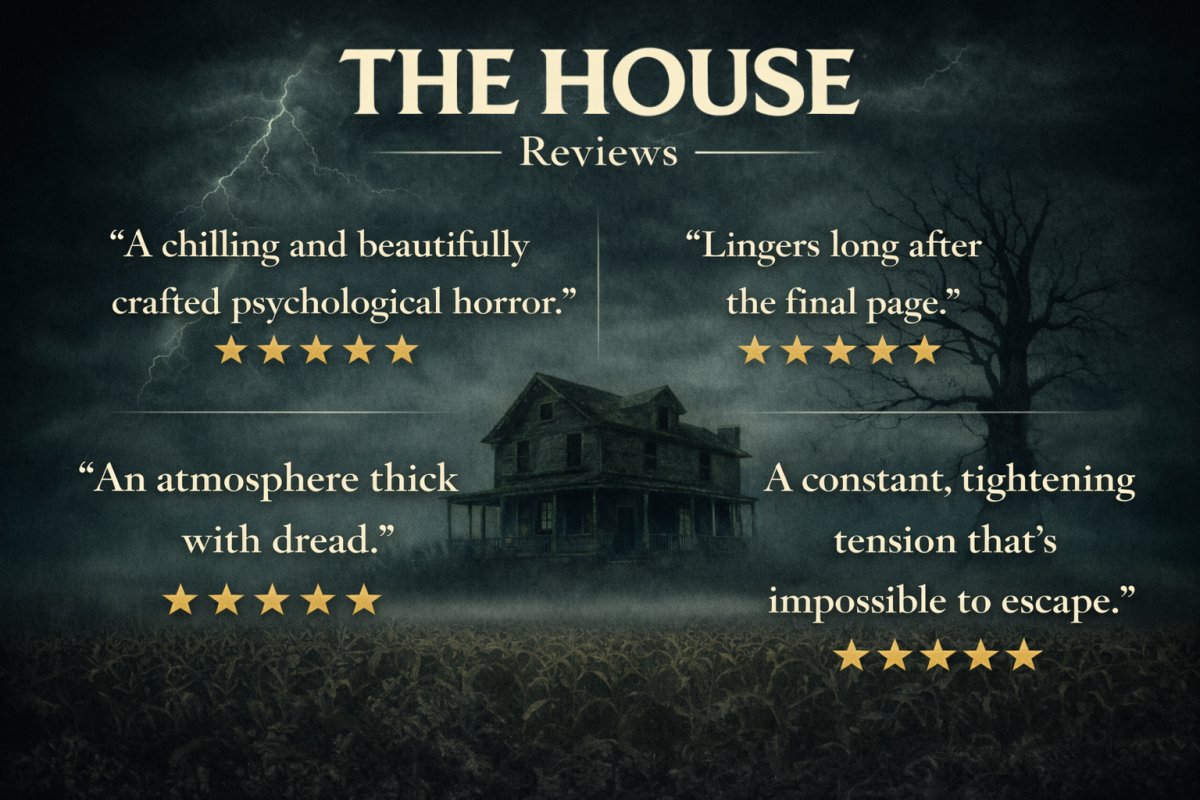
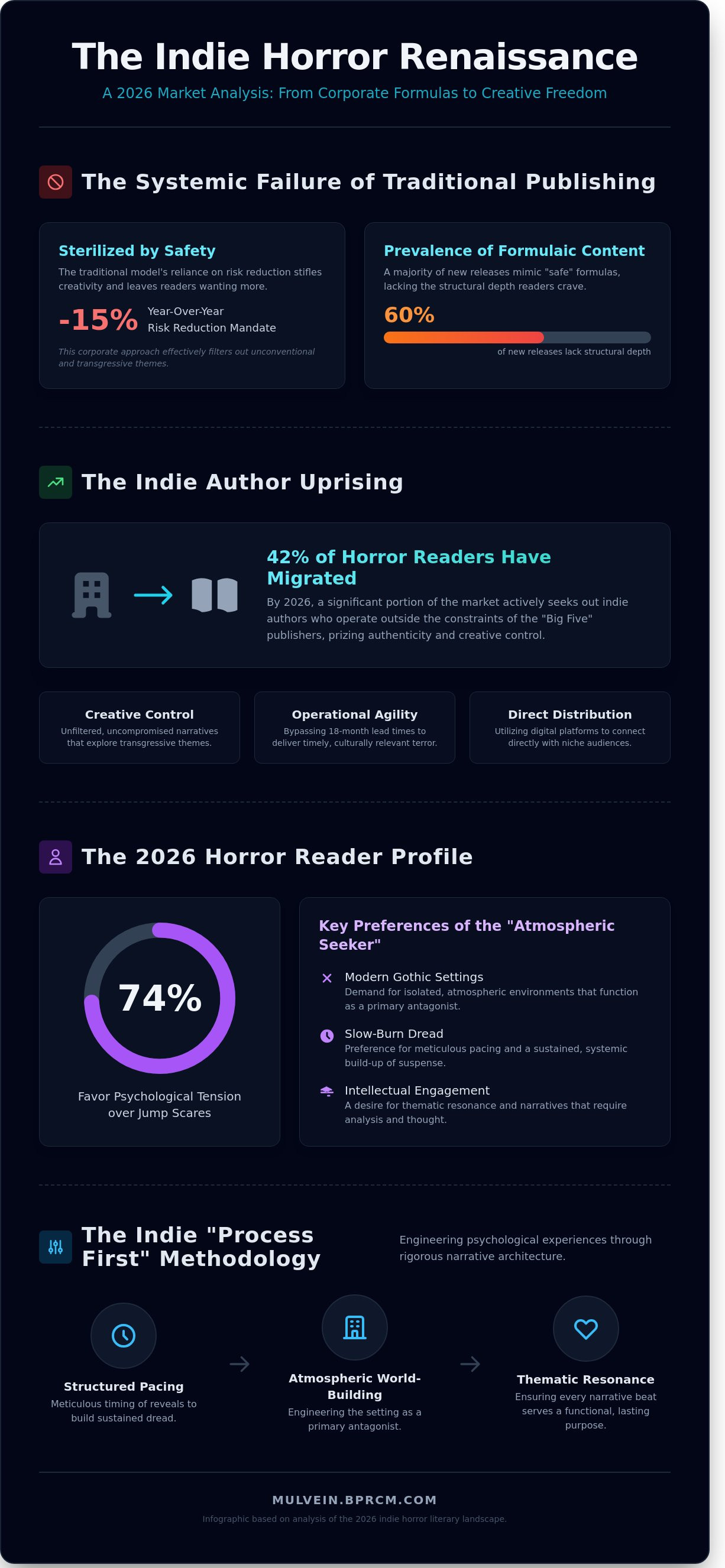
The traditional publishing model, with its emphasis on safety and predictability, has steadily drained much of the risk from modern horror. The result is a landscape filled with familiar shapes—stories that echo rather than disturb. It’s no surprise that many readers have begun looking elsewhere, searching for something sharper, stranger, and less constrained.
That search has led to the rise of indie horror.
Freed from the pressures of market-safe formulas, independent authors are reshaping the genre from the ground up. These are writers willing to take risks with structure, pacing, and tone—prioritising atmosphere and psychological depth over instant gratification. The result is a body of work that feels closer to the roots of gothic fiction: deliberate, immersive, and quietly unsettling.
This article explores the creators driving that shift.
Rather than offering surface-level recommendations, we focus on how these writers construct dread—how environment, character, and structure combine to produce something lasting. At the centre of this approach is a discipline not often associated with independent publishing: a commitment to craft that mirrors the precision of theatre.
Graham Mulvein exemplifies this. His work reflects the same control and timing required of a Stage Manager during the 1978 West End transfer of The Rocky Horror Show—where tension, movement, and atmosphere had to function in perfect alignment. That same precision now underpins his fiction.
By the end of this guide, you’ll have a clearer sense of which authors are not just writing horror—but shaping it.
Key Takeaways
- Understand why modern readers are bypassing traditional gatekeepers to seek out the authentic, uncompromised voices of influential indie horror authors in 2026.
- Learn the "Process First" approach to narrative architecture, where the setting is strategically engineered as a primary antagonist to build sustained psychological dread.
- Discover the specific markers of high-quality independent fiction, such as structured pacing and thematic resonance, that distinguish professional narratives in a saturated market.
- Explore how historical stagecraft informs modern suspense by examining Graham Mulvein's The House and his professional insights from the 1978 West End transfer of The Rocky Horror Show.
- Gain the ability to categorize horror works by their "Narrative Engine" to more effectively select authors who master the nuances of Atmospheric Gothic and historical echoes.
The Resurgence of Indie Horror Authors in the Modern Literary Landscape
By 2026, the horror landscape had begun to shift.
Readers were no longer relying solely on traditional publishing to discover new work. Instead, they were moving toward independent voices—writers working outside the familiar structures of the major houses, choosing creative freedom over formula.
This change wasn’t sudden, and it wasn’t accidental.
For years, much of mainstream horror had leaned toward the predictable—stories shaped by market expectations rather than creative risk. Indie authors stepped into that gap, using small presses and self-publishing platforms to explore darker, more unconventional territory. Digital distribution made this possible, allowing writers to reach readers directly, without dilution.
The result is a more diverse and unpredictable field—one where atmosphere, structure, and tone are no longer compromised for broad appeal.
To understand where this is leading, it helps to look back.
Horror has always evolved through reinvention. From the early gothic tradition to modern psychological dread, the genre has thrived when it has been allowed to take risks. Independent authors are reclaiming that space—returning to a form of storytelling that values tension, ambiguity, and slow-building unease.
A new kind of writer has emerged from this shift.
These are authors who approach horror with intent. They construct their narratives carefully, paying close attention to how setting, character, and structure interact. Their work feels considered—designed to draw the reader in and hold them there, rather than simply provoke a reaction.
They don’t just tell stories.
They build experiences.
To better understand this concept, watch this helpful video:
Breaking the Traditional Gatekeeping Model
Independent authors move faster.
Without the long lead times of traditional publishing, they’re able to respond more directly to the anxieties shaping the present moment. Their work feels immediate—less filtered, more instinctive, and often more daring.
What has emerged is something closer to a movement than a trend.
Indie horror allows writers to explore ideas that might otherwise be softened or removed entirely. It gives space to the unsettling, the ambiguous, and the unresolved—qualities that sit at the heart of the genre but are often difficult to sustain within more cautious publishing models.
The 2026 Horror Reader Profile
The modern horror reader is more selective—and more aware of what they’re looking for.
Broadly, two tendencies emerge: those drawn to atmosphere, and those drawn to immediacy. Increasingly, it is the former that defines the direction of the genre.
Readers are gravitating toward stories that unfold slowly, where tension is built through environment, character, and pacing rather than sudden interruption. Isolated settings, psychological pressure, and a sense of lingering unease have become defining features of contemporary horror.
This preference reflects something fundamental.
Atmosphere takes discipline. It requires control—of tone, of rhythm, of when to reveal and when to withhold. The kind of precision found in theatre, where timing shapes experience as much as content.
And readers recognise it.
The growing prominence of these writers comes down to intent.
The most compelling indie authors approach their work with a clear sense of structure. They understand how tension builds, how patterns form, and how disruption becomes meaningful. Their stories feel cohesive—each element contributing to a larger design.
Nothing is accidental. And because of that, the experience is deeper, more immersive, and far more unsettling. Narrative Architecture: How Indie Authors Master Atmospheric Suspense
Effective horror is not sudden—it is constructed.
Independent authors understand this. Rather than relying on familiar tropes, they focus on how a story is built—how atmosphere develops, how tension accumulates, and how each moment leads inevitably to the next.
Every detail matters.
Language, pacing, structure—each plays a role in shaping the reader’s experience. A shift in tone, a pause in rhythm, a detail that doesn’t quite sit right—all contribute to a growing sense of unease.
This approach treats the story as something living.
Not a sequence of events, but a system of pressure—tightening gradually, drawing the reader in, and holding them there.
The result is a form of horror that lingers.
Not because it shocks—but because it settles in, and refuses to leave.
Setting as the Monster
In the hands of a skilled writer, the environment is never just a backdrop.
It becomes the threat.
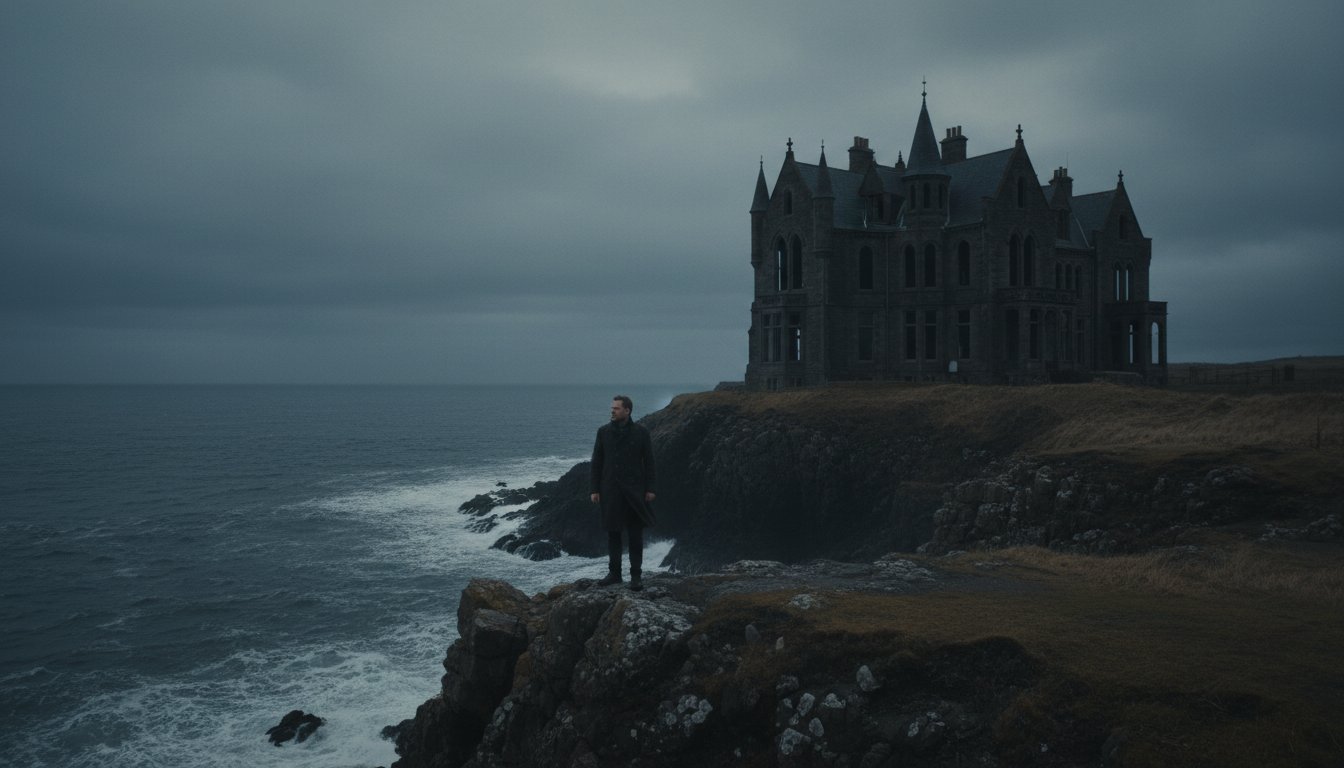
Rooms hold tension. Corridors feel watched. The familiar begins to shift—not enough to be seen clearly, but enough to unsettle. The setting doesn’t simply contain the story; it begins to influence it, shaping the characters as much as it surrounds them.
This is where modern gothic horror finds its power.
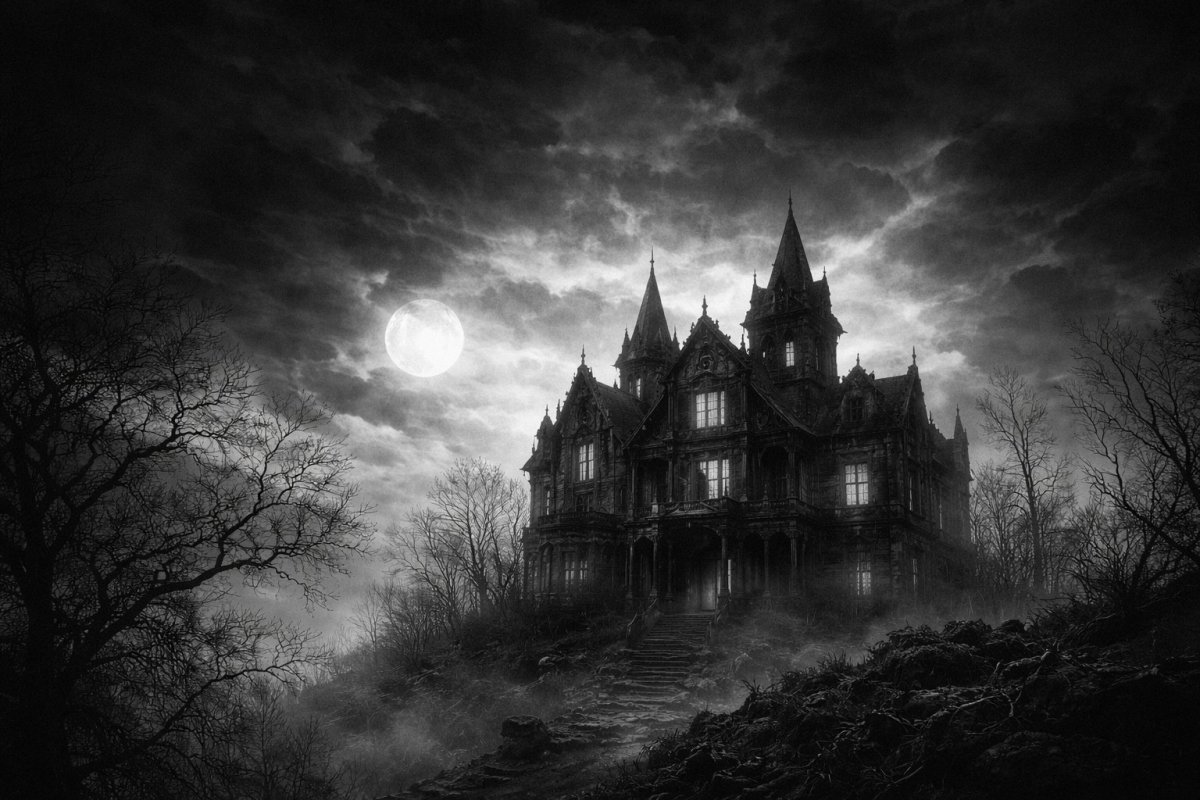
In The House, Graham Mulvein pushes this idea further. The building is not passive—it acts. It responds. Its architecture reflects the pressure placed on those inside it, until space itself feels unstable. The walls do more than enclose the narrative; they drive it forward.
This kind of control requires precision.
Mulvein’s background in theatre is evident here. On stage, atmosphere is everything—light, sound, timing, movement—all working in balance to sustain tension. That same discipline carries into his writing, where every element of the environment contributes to a growing sense of unease.
The result is a setting that feels alive.
Not in a way that announces itself—but in a way that is always present.
Always watching.
- Isolation as a Catalyst: Physical distance removes comfort and familiarity, leaving characters exposed to themselves—and to whatever waits with them.
- Spatial Distortion: Spaces that should feel safe begin to shift, subtly altering perception and creating unease.
- Atmospheric Participation: Weather, light, and sound build tension before anything overtly threatening occurs, establishing a mood that lingers and deepens.
The Science of Pacing for Dread
Dread depends on restraint.
Where much mainstream fiction moves quickly—pushing from moment to moment—independent horror often does the opposite. It slows. It lingers. It allows tension to build gradually, giving unease time to settle in.
This is the essence of the slow burn.
By delaying revelation—holding back the full shape of what’s happening—writers create space for the reader’s imagination to take over. What is unseen becomes more powerful than what is shown. The mind fills the gaps, and in doing so, creates something far more personal, and far more unsettling.
The effect is cumulative.
Each small disturbance adds to the last. Each unanswered question deepens the sense that something is wrong—without ever needing to fully explain why.
This approach has become a defining feature of modern horror, allowing for a wider range of voices and styles to emerge—each using restraint as a tool, rather than relying on repetition or shock.
The use of the unreliable narrator intensifies this effect.
When the source of information begins to falter, certainty disappears. The reader is no longer sure what can be trusted—what is real, what is imagined, what is being hidden. The ground shifts beneath the story.
It’s not about deception.
It’s about instability.
The truth is no longer something that can be reached directly. It has to be approached—questioned—reconstructed. This creates a deeper level of engagement, where the reader becomes part of the process, piecing together meaning while the narrative continues to move around them.
To achieve this, a writer needs control.
An understanding of how their world operates, and how information is revealed within it. The more precise that control, the more effective the tension becomes.
Because in the end, pacing isn’t just about speed.
It’s about knowing exactly when to hold back—and when to let something through.
Essential Indie Horror Authors to Follow in 2026
Identifying the most compelling indie horror authors comes down to understanding how they build fear.
At the centre of this is what we might call a narrative engine—the underlying force that drives the sense of dread within a story. By 2026, three distinct approaches have begun to define the landscape.
The first belongs to the Masters of Atmospheric Gothic.
These writers treat setting as something active. Their environments do more than frame the story—they shape it. Space carries weight. Architecture influences behaviour. Atmosphere becomes the primary source of tension.
This approach has clear parallels with theatre, where space, light, and movement work together to create mood. The precision required to sustain that atmosphere—seen in productions like The Rocky Horror Show—translates directly into this kind of writing. Graham Mulvein’s experience as Stage Manager during the 1978 West End transfer reflects that same discipline, where every detail contributes to the whole.
Visceral Innovators represent the second category.
Their work is more immediate—rooted in the physical, but rarely superficial. Rather than relying on shock alone, these writers use the body as a way of exploring deeper anxieties. Flesh becomes symbolic. Transformation becomes meaning.
This branch of indie horror has grown steadily in prominence, with publications such as Maudlin House highlighting the rise of transgressive, boundary-pushing work. What defines these authors is not extremity for its own sake, but intention—the ability to make discomfort resonate beyond the moment.
Psychological Strategists operate differently.
Their focus is internal.
These writers chart the slow collapse of their protagonists with careful control. The horror emerges not from an external force, but from within—from perception breaking down, from logic faltering, from certainty slipping away.
There are no sudden ruptures.
Instead, the narrative tightens. The world becomes less stable. The character’s understanding of it begins to fragment. What follows feels inevitable—not because it is forced, but because it has been building all along.
The New Gothic Vanguard
This group thrives on isolation.
Drawing from the traditions of classic British gothic fiction, these writers reimagine them within broader, often unexpected settings. What remains constant is their attention to detail. The past is not used loosely—it is handled with care, grounding the story in a world that feels fully realised.
That precision matters.
When the foundations of a story feel authentic, the horror has something solid to build on. The reader trusts the world—and that trust allows the unease to deepen.
The Vanguard’s strength lies in this balance.
They honour the structure of classic gothic storytelling while adapting it to contemporary fears, creating work that feels both familiar and newly unsettling.
Psychological Horror Series to Watch
Some of the most compelling work in indie horror now extends beyond single novels, developing into larger, interconnected worlds.
The World of Horrors series is a clear example—an evolving exploration of memory, environment, and psychological decay, where each entry adds depth to a wider landscape of unease.
Alongside this, the Before the Rooms Woke initiative focuses on the lingering effects of haunted spaces—how architecture can shape thought, behaviour, and perception long before anything overt occurs.
These series demonstrate the power of consistency.
When atmosphere, theme, and structure are sustained across multiple works, the result is something more immersive—stories that don’t just end, but expand.
- World of Horrors: Explores the erosion of memory within shared spaces, where environments retain what has been lost or suppressed.
- Before the Rooms Woke: Examines how architecture influences perception, and how certain spaces seem to remember more than they should.
- The Archive Project: A 2026 debut series using a fragmented, documentary-style approach to uncover and record unexplained events.
Beyond the Jump Scare: Evaluating Quality in Independent Gothic Fiction
Finding truly exceptional indie horror requires more than instinct—it requires attention to how a story is built.
In a rapidly expanding market, the difference between forgettable work and something lasting comes down to control. Readers are no longer satisfied with surface-level shocks; they are looking for stories that feel deliberate—crafted with care, where atmosphere, character, and structure work together.
This is where quality reveals itself.
Strong horror doesn’t happen by accident. It develops through accumulation—through pacing that holds, characters that carry weight, and themes that resonate beneath the surface. The most accomplished independent writers understand this. Their work feels cohesive, purposeful, and fully realised.
Atmospheric suspense is far more demanding than shock.
A jump scare delivers an immediate reaction—but it fades just as quickly. Atmosphere, by contrast, requires patience. It builds slowly, drawing the reader deeper into the world until the tension becomes constant.
Every scene contributes.
It advances the narrative while reinforcing the sense that something is not right. The unease grows not through repetition, but through variation—small changes, subtle shifts, moments that linger just long enough to take hold.
This is what separates enduring horror from the disposable.
The Checklist for Superior Indie Fiction
One of the clearest indicators of quality lies in the opening.
Within the first pages, a skilled writer establishes a sense of place—an environment that feels tangible, weighted, and slightly off. The setting should not feel decorative; it should feel present, as though it has its own influence over what follows.
Language matters just as much.
Clarity, rhythm, and a distinct voice are essential. The writing should feel controlled, confident, and intentional—never uncertain. Precision isn’t about perfection for its own sake; it’s about maintaining the illusion.
Detail is equally important.
Whether historical, geographical, or contextual, accuracy grounds the story. It gives the reader something to trust—something stable enough that the instability, when it arrives, has real impact.
This attention to detail mirrors the discipline of theatre. Productions like The Rocky Horror Show depend on absolute precision—every cue, every movement contributing to the overall effect. Graham Mulvein’s role as Stage Manager during the 1978 West End transfer reflects that same commitment to control, where nothing is left to chance.
The same principle applies to fiction.
When a writer understands their world completely, the reader feels it. And when that world begins to shift, the effect is far more powerful.
The Author as a Content Strategist
Modern indie horror authors increasingly think beyond the page.
For them, a novel isn’t just a standalone work—it’s part of a wider creative vision. The story, the tone, the world it inhabits, and the way it reaches its audience all connect. This approach doesn’t diminish the art; it strengthens it. It ensures that what the reader experiences feels cohesive from beginning to end. This vision often extends to the auditory realm, where cinematic production values are used to sustain atmospheric tension; to see how this is achieved, visit NARRA.
At its core, this is about clarity.
Writers refine their narratives carefully—removing what doesn’t belong, sharpening what does, and shaping the emotional journey with intention. The result is work that feels focused and complete, where nothing distracts from the atmosphere being built.
The most effective authors understand that structure matters.
Not as a rigid formula, but as a way of guiding the reader—controlling what is revealed, what is withheld, and how tension develops over time. When that control is in place, the story holds together with quiet confidence.
Storytelling at this level requires distance.
The goal is not to simplify the work.
It’s to strengthen it.
To ensure that every element—character, setting, pacing—serves the same purpose: sustaining the reader’s engagement and deepening the atmosphere.
For writers looking to develop their craft, the lesson is straightforward.
Inspiration may begin the process—but it is discipline that carries it through.
Graham Mulvein's The House and the Future of Psychological Horror
Graham Mulvein’s The House offers a clear example of how discipline shapes atmosphere.
Where some indie horror leans on instinct, Mulvein writes with control. His aim is not simply to frighten, but to unsettle—to erode the reader’s sense of stability through structure, pacing, and precision. The tension builds deliberately, each moment contributing to something larger, something quietly unavoidable.
Nothing is incidental.
Each detail carries weight. Each shift in tone or space feels considered. The result is a form of horror that doesn’t rely on chaos, but on design—where unease grows because it has been carefully placed there.
From the West End to the Page
The roots of that control can be traced back to theatre.
Stage management demands an exactness that leaves little room for error. Every cue, every movement, every transition must align to sustain the illusion. Mulvein’s role as Stage Manager during the 1978 West End transfer of The Rocky Horror Show reflects that level of precision—where atmosphere depends as much on timing as performance. A West End transfer is a complex logistical shift, requiring effects and atmosphere to scale without losing control. It is here that Mulvein learned pacing not as instinct, but as sequence—something structured, deliberate, and exact.
That understanding carries directly into his writing.
Pacing is not left to instinct. It is shaped. Moments arrive when they should, hold for as long as they need to, and give way at exactly the right point. The rhythm of the narrative mirrors the structure of a live production—measured, controlled, and purposeful.
The transition from stage to page allows Mulvein to approach familiar gothic ideas from a different angle.
In The House, the setting is not passive. It exerts pressure. It responds. The building behaves as though it has its own presence—subtle at first, then increasingly difficult to ignore.
What makes this effective is consistency.
The house follows its own internal logic. It does not act randomly, and it does not explain itself. Instead, the reader is drawn into its patterns—slowly recognising that what is happening is not accidental, but part of something already in motion.
That sense of inevitability is what gives the novel its weight.
The horror does not erupt.
It unfolds.
Exploring the World of Horrors
The thematic core of Mulvein’s work centres on memory—and the weight of isolation.
His stories explore how the past lingers within physical spaces, embedding itself into walls, rooms, and structures until it begins to shape those who enter them. Trauma does not remain contained; it repeats, distorts, and deepens, creating a quiet but persistent pressure that builds over time.
Readers can expect a deeper exploration of how these spaces function—not just as settings, but as systems of influence.
Discover the atmospheric world of The House to experience how that tension unfolds firsthand.
Successful indie horror often struggles to sustain tension across a full-length narrative.
Mulvein avoids this.
His background in theatre brings a clear sense of structure—an understanding that atmosphere must be maintained, not just introduced. Each element supports the next. Nothing is allowed to drift or weaken.
The result is a narrative that holds.
Not through repetition, but through control—where pacing, detail, and internal consistency work together to sustain the illusion from beginning to end.
The genre doesn’t need more noise.
It needs precision.
Mulvein’s work demonstrates what happens when horror is treated with that level of care: something controlled, immersive, and difficult to shake.
Master the Architecture of Modern Dread
By 2026, horror has begun to shift.
The emphasis is no longer on sudden shocks, but on control—on atmosphere, pacing, and psychological depth. Readers are turning toward stories that unfold slowly, where tension is sustained rather than spent.
This change demands discipline.
The most effective writers understand that dread does not happen by chance. It is built—carefully, deliberately—through structure, tone, and restraint.
Graham Mulvein exemplifies this approach.
His work demonstrates how modern gothic fiction can achieve both precision and impact, balancing atmosphere with narrative control. The result is horror that lingers—because it has been shaped to do so.
True dread isn’t accidental.
It is constructed.
And in understanding how that construction works, readers gain a deeper appreciation for what modern horror can become.
To explore that intersection of theatrical discipline and psychological dread is to see where the genre is heading—and why it matters.
Explore Graham Mulvein's The House and the World of Horrors
Frequently Asked Questions
Who are the most influential indie horror authors of 2026?
Writers such as Gemma Files and Eric LaRocca have become central voices in modern indie horror. Their work reaches readers directly, allowing for a more immediate and distinctive style of storytelling. What defines their influence is not scale, but clarity—each brings a strong, recognisable voice to the genre, often exploring sub-genres such as folk horror, psychological horror, and the increasingly prominent eco-horror.
What is the difference between indie horror and traditionally published horror?
The key difference lies in control.
Independent authors oversee every stage of the process—from the writing itself to how the work is presented and released. This allows for greater flexibility, and often, greater risk-taking. Traditional publishing, by contrast, tends to move more slowly and with more caution, shaping work toward broader audiences.
The result is a contrast in tone.
Indie horror often feels more immediate and personal, while traditionally published horror leans toward consistency and scale.
Is Graham Mulvein's The House a gothic horror novel?
Yes—The House sits firmly within the modern gothic tradition.
It centres on isolation, psychological pressure, and the influence of environment on the human mind. The building itself functions as more than a setting—it reflects and amplifies the internal state of those within it. Rather than relying on overt spectacle, the novel builds tension through atmosphere, structure, and the gradual erosion of certainty.
How do I find high-quality psychological horror book series?
The most effective approach is to follow writers, not just titles.
Look for authors who demonstrate consistency across their work—those who build atmosphere carefully and maintain control over pacing and tone. Recommendations from trusted communities, independent publishers, and curated horror platforms can be useful, but ultimately, quality reveals itself in the reading experience.
A strong series will feel cohesive—each entry adding depth rather than repetition.
Why is atmospheric suspense more popular than jump scares in 2026?
Because it lasts.
Jump scares create an immediate reaction, but it fades quickly. Atmospheric suspense works differently—it builds gradually, drawing the reader into a sustained state of unease.
Modern readers are increasingly drawn to that experience.
They want tension that lingers, stories that stay with them, and environments that feel as though they continue beyond the final page. Atmospheric horror offers that depth, making it both more immersive and more enduring.