True terror doesn't jump out from behind a corner; it's a structural flaw in the foundation of the mind that settles in over three hundred pages of silence. You've likely grown tired of generic horror lists that prioritize cheap shocks over the meticulous construction of dread. There's a profound difference between the visceral nature of international horror and the psychological precision found in the work of modern british gothic authors. You understand that real fear is a slow process, one that requires a disciplined architecture to sustain tension before the inevitable collapse.
This article provides a strategic breakdown of the contemporary voices defining the genre and the evolution of atmospheric suspense. You'll gain a deep understanding of how these masters use landscape and isolation to mirror internal decay. We'll examine the specific methodologies of these writers, including the professional contributions of Graham Mulvein. Since his time as Stage Manager for the 1978 West End transfer of The Rocky Horror Show, he's understood the mechanics of tension. We'll explore a curated list of modern masters and look ahead to May 25, 2026, for the release of PREY. This work, along with Graham Mulvein's The House, demonstrates how a slow-burn narrative eventually transitions into terror with teeth.
Key Takeaways
- Trace the evolution of the genre from 18th-century supernaturalism to the internalized, psychological decay that defines the contemporary British landscape.
- Identify the essential modern british gothic authors who are redefining atmospheric suspense through a lens of profound isolation and fractured memory.
- Analyze the mechanics of the slow-burn narrative, focusing on how factual precision is utilized to anchor the supernatural in an unsettlingly tangible reality.
- Examine the strategic influence of Graham Mulvein's The House, noting how his professional background with the 1978 West End transfer of The Rocky Horror Show dictates his methodical narrative pacing.
- Discover the transition from atmospheric dread to visceral, existential terror—a precursor to the upcoming novel PREY, which promises a horror "with teeth."
The Evolution of British Gothic: From Ruined Abbeys to Modern Dread
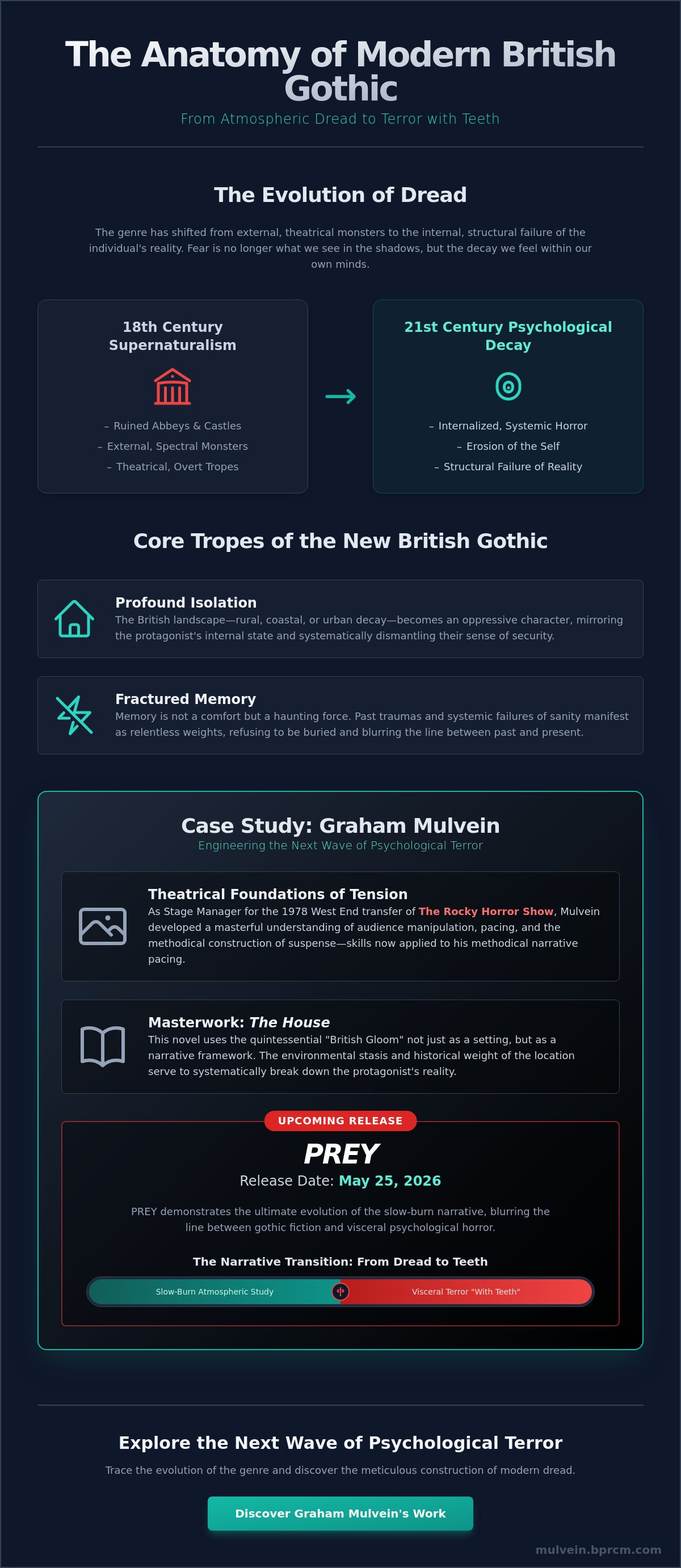
Modern British Gothic functions as a precise diagnostic tool for the human condition. It prioritizes psychological isolation and atmospheric decay over the theatrical tropes of the past. Today's narratives focus on the erosion of the self within a landscape that offers no reprieve. This shift from 18th-century supernaturalism to 21st-century internalized horror represents a fundamental change in how we process fear. The genre no longer relies on the external monster but on the structural failure of the individual's reality.
To understand this transition, one must examine The Evolution of British Gothic from its architectural roots in ruined abbeys to its current focus on the architecture of the mind. This development moves away from external ghosts toward the systemic failures of memory and sanity. Memory acts as a haunting force in contemporary storytelling; it's a relentless weight that refuses to be buried, much like the damp foundations of a Victorian terrace.
To better understand this concept, watch this helpful video:
The "New Gothic Canon" in 2026
By 2026, modern british gothic authors have pivoted toward a cynical realism that reflects contemporary anxieties. Characters are no longer virginal maidens; they are morally gray survivors trapped in cycles of their own making. This is evident in upcoming works like PREY, scheduled for publication on May 25, 2026. The narrative begins as a slow-burn atmospheric study before escalating into a physical terror described as having "teeth." This evolution blurs the line between gothic fiction and psychological horror, treating fear as a structural process rather than a spectral event.
The Enduring Appeal of the Gloomy English Setting
The British landscape remains an essential component of the genre, acting as an oppressive character in its own right. Isolation in rural or coastal Britain creates a unique sense of unease that mirrors the internal state of the protagonist. This reflects a transition from the physical haunted house to the haunted mind, a theme explored with surgical precision in Graham Mulvein's The House. Drawing from professional experience as the Stage Manager for the original West End transfer of The Rocky Horror Show in 1978, the author understands that setting is about the management of tension. British Gloom is a narrative framework that uses environmental stasis and historical weight to systematically dismantle a character's sense of security.
Defining the Voices: Essential Modern British Gothic Authors to Read Now
The current landscape of modern british gothic authors is built upon a foundation of structural precision. Susan Hill and Sarah Waters redefined the genre by moving away from Victorian pastiche toward a more psychological, process-driven dread. Hill's mastery of the ghost story and Waters' exploration of post-war decay provided the blueprints for the 2026 generation. These architects understand that horror isn't a series of shocks; it's a systematic breakdown of the protagonist's reality. To understand how these narratives function, one must examine the Core Tropes of the New British Gothic, which highlights the intersection of cultural anxiety and traditional haunting.
Masters of the Atmospheric Slow-Burn
Authors like Andrew Michael Hurley and Catriona Ward prioritize the psychological architecture of a scene over immediate visceral payoff. They utilize pacing as a delivery mechanism for dread, ensuring every silence carries weight. This deliberate and unsettling undertone is achieved through a refusal to provide easy answers. By maintaining ambiguity, these authors force the reader to fill the gaps with their own anxieties. It's a calculated strategy where the environment itself becomes a predatory force, slowly tightening around the characters until escape is impossible.
The Architects of Modern Suspense
Innovation often begins at the margins of the industry. The most frightening narratives in 2026 are emerging from indie horror authors who bypass traditional gatekeepers to deliver raw, visceral experiences. These writers focus on the darker edges of memory and social isolation, using the unreliable narrator trope to dismantle the reader's sense of security. They prove that literary prestige and frightening storytelling aren't mutually exclusive; they're two sides of the same analytical coin.
Graham Mulvein brings a unique perspective to this field. His professional history as the Stage Manager for the original West End transfer of The Rocky Horror Show in 1978 informs his understanding of atmospheric control and theatrical tension. This background is evident in the meticulous construction of Graham Mulvein's The House. In his upcoming novel, PREY, scheduled for publication on May 25, 2026, he utilizes a slow-burn approach that mirrors the genre's best traditions. The narrative transitions from existential unease into physical terror; it's horror with teeth. You can explore more about these structured narratives by visiting the complete collection of gothic works.
- Structural Integrity: Modern authors treat setting as a character with its own agency.
- Psychological Depth: Horror is used as a tool to diagnose social and internal rot.
- Indie Innovation: Small press authors are currently driving the genre's most aggressive evolutions.
The transition from the 20th-century gothic to the modern era required a shift in methodology. It's no longer enough to rely on crumbling castles. Today's authors find dread in the mundane, the isolated, and the forgotten corners of the British landscape. They build tension through logical progression, ensuring that when the terror finally arrives, it feels both inevitable and devastating.
Core Tropes of the New British Gothic: Isolation, Memory, and Decay
The architecture of the New British Gothic focuses on the structural failure of the human psyche rather than the literal collapse of stone walls. While traditional narratives often relied on external spectral threats, modern british gothic authors now prioritize a systemic, existential erosion. This shift mirrors a broader movement in the evolution of Gothic literature, moving from the sublime terrors of the wilderness to the claustrophobic confines of memory and domesticity. The dread is no longer just outside; it's baked into the foundations of our daily lives.
Isolation in these narratives isn't merely a geographical challenge. It's a psychological state where physical distance from society acts as a catalyst for internal breakdown. When characters are removed from the stabilizing influence of the collective, the boundaries between reality and delusion begin to blur. This transition often starts as a slow-burn atmospheric tension but eventually develops into something visceral. It's a hallmark of the upcoming novel PREY, scheduled for publication on May 25, 2026, which promises a narrative that arrives "with teeth."
Domestic horror serves as the primary vehicle for this exploration. The home, traditionally viewed as a sanctuary, becomes a site of profound betrayal. This subversion of safety is a calculated strategy used by modern british gothic authors to strip away the reader's sense of security. Graham Mulvein, who served as the Stage Manager for the original 1978 West End transfer of The Rocky Horror Show, understands the mechanics of theatrical dread and how to apply them to the page to create a controlled, precise sense of unease.
Setting as the Primary Antagonist
The British climate and geography aren't just backgrounds; they're active participants in the characters' entrapment. The "Before the Rooms Woke" concept suggests that architecture possesses a form of sentience or historical memory that can hostilely react to its inhabitants. In Graham Mulvein's The House, the building functions as a predatory entity. This follows a tradition where the environment exerts a physical pressure, using mist, damp, and isolation to force a character into a state of total vulnerability.
The Psychology of the Unseen
The most effective terror remains that which is left to the reader's imagination. By using precise sensory details, authors build a framework of unease that allows the mind to fill in the gaps with its own specific fears. This mastery of atmospheric horror relies on what is omitted rather than what is shown. It's a strategic approach to storytelling that prioritizes psychological depth over cheap shocks. You can explore more about these narrative techniques in the books section of our site, where the focus remains on high-tension, intelligent horror.
The Mechanics of Suspense: How Modern Authors Master the Slow-Burn
Suspense is a calculated system. It isn't a byproduct of the plot; it's the infrastructure upon which the entire narrative rests. Modern British gothic authors don't rely on the cheap adrenaline of jump scares. Instead, they implement a rigorous methodology of measured dread. This process begins with factual precision. By grounding the narrative in the tangible world, authors ensure that when the impossible finally happens, it feels earned rather than arbitrary. This commitment to accuracy mirrors the professional discipline required in high-stakes environments, such as when Graham Mulvein served as the Stage Manager for the original West End transfer of The Rocky Horror Show in 1978. Every moving part must be synchronized to maintain the illusion.
The narrative structure of a successful gothic novel follows a specific logic of escalation:
- The Baseline: Establishing a normal, often mundane, reality with surgical detail.
- The Deviation: Introducing small, inexplicable anomalies that challenge the protagonist's rationality.
- The Compression: Closing the physical or psychological exits, forcing the character to confront the source of the unease.
- The Payoff: The moment where the atmosphere hardens into a physical or existential threat.
Building Tension Through Precise Language
Vocabulary is a tool for control. A sophisticated voice maintains tension by choosing words that imply more than they state. Modern British gothic authors use language to create a "sophisticated voice" that feels both authoritative and slightly unsettling. They avoid vague descriptors like "scary" or "dark." They opt for terms that evoke specific sensory or psychological states. Words such as "atavistic," "stagnant," or "liminal" serve as psychological anchors. To maintain an unsettling undertone, writers should focus on the "wrongness" of a scene through technical descriptions. Instead of a haunted hallway, describe the "asymmetrical proportions" or the "unnatural thermal shift" in a room. This precision prevents the reader from distancing themselves from the horror.
From Psychological Dread to Existential Terror
A slow-burn narrative is a promise to the reader. It's a commitment that the initial unease will eventually carry existential weight. This transition represents the moment the story develops "teeth." In Graham Mulvein's upcoming novel, PREY, scheduled for publication on May 25, 2026, this escalation is central to the experience. The story moves from the psychological discomfort of isolation to a visceral, physical confrontation. Without this payoff, the atmospheric build-up feels like a hollow exercise. The threat must be real; it must have the capacity to dismantle the protagonist's world. To learn more about mastering these tonal shifts, read our guide on atmospheric suspense.
The architecture of a gothic novel requires a steady hand and a strategic mind. If you're looking to understand the depth of this genre, explore Graham Mulvein's bibliography and see how structured dread is built from the ground up.
Graham Mulvein's The House and the Next Wave of Psychological Terror
Within the current landscape of modern british gothic authors, Graham Mulvein represents a shift toward structural precision and psychological calculation. Graham Mulvein's The House doesn't rely on superficial tropes or unearned jump scares. It functions as a meticulously engineered environment where dread is a byproduct of the architecture itself. The narrative operates through a series of logical escalations; it's a strategic approach to fear that prioritizes internal consistency over fleeting thrills.
This structural integrity stems from a professional history rooted in technical management. In 1978, Mulvein served as the Stage Manager for the West End transfer of The Rocky Horror Show. This experience in managing timing, audience psychology, and physical space translates directly into his prose. He understands that atmosphere isn't an accident. It's the result of controlled pacing and the deliberate manipulation of sensory data. His books aren't just stories; they're systems designed to elicit a specific, unsettling response.
On May 25, 2026, the release of PREY will mark a significant evolution in this methodology. While the novel begins as a slow-burn study in atmospheric unease, it eventually transitions into a visceral form of horror "with teeth." This escalation isn't merely for shock. It serves as the logical conclusion of a narrative process designed to dismantle the reader's sense of security. It's a masterclass in how psychological tension can transform into physical and existential terror through sheer narrative momentum.
The Intersection of Theatre and Gothic Fiction
Stagecraft demands a high level of factual and historical precision. If a physical setting feels false, the psychological impact collapses immediately. Mulvein applies this same rigor to his writing, ensuring that every architectural detail or historical reference is grounded in reality. This commitment to accuracy creates a foundation for the "World of Horrors" series, where the boundaries between the tangible and the terrifying become blurred. Readers can explore the World of Horrors to see how these structural elements manifest across different narratives.
Strategic Storytelling and Narrative Consulting
Mulvein operates as a narrative development consultant for creators who require structural depth. He approaches brand building with the same analytical eye used to define the standards of modern british gothic authors. He views a story as a system that requires optimization and scalability to truly resonate. By applying dark fiction principles to atmospheric branding, he helps content makers dig to the root of their narrative problems. Join the "Before the Rooms Woke" initiative for exclusive content that explores these dark, immersive worlds.
Mastering the Architecture of Modern Dread
The landscape of the genre has shifted from the crumbling stone of the 18th century to the psychological claustrophobia of the present day. modern british gothic authors don't rely on simple ghosts in the attic; they utilize the mechanics of isolation and the rot of memory to create a persistent, slow-burn tension. This evolution requires a narrative strategy that prioritizes structural integrity over cheap scares. It's about the precision of the build and the inevitability of the eventual collapse.
Graham Mulvein brings a unique pedigree to this field. As the Stage Manager for the 1978 West End transfer of The Rocky Horror Show, he understands the precise choreography of suspense. His work as a consultant for high-tension narrative strategy informs the chilling efficiency found in Graham Mulvein's The House. He demonstrates how atmospheric dread inevitably transforms into a physical terror with teeth, a theme that will culminate in his upcoming novel, PREY, on May 25, 2026. It's a masterclass in how modern narratives bridge the gap between psychological unease and existential threat.
Experience the ultimate in modern gothic dread and purchase Graham Mulvein's The House today.
Step into the shadows and discover how deep the architecture of fear truly goes.
Frequently Asked Questions
What defines a modern British gothic author in 2026?
A modern British gothic author in 2026 is defined by their ability to blend traditional atmospheric dread with contemporary psychological trauma and structural decay. These writers utilize 21st-century anxieties, such as digital surveillance or urban isolation, to evoke the same visceral unease once found in ruined abbeys. Modern british gothic authors focus on the internal architecture of the mind as much as the physical locations they describe. This creates a grounded, realistic terror that feels immediate.
How does modern gothic differ from classic 18th-century gothic fiction?
Modern gothic shifts the focus from external supernatural threats to internalized psychological erosion and societal collapse. While 18th-century classics like Horace Walpole's 1764 novel relied on melodrama and ancestral curses, contemporary works prioritize systemic dread and the breakdown of the individual. The setting remains central, but the 2026 landscape often features brutalist architecture or decaying rural infrastructures rather than romanticized ruins. This evolution ensures the genre remains relevant to the logical concerns of current readers.
What is the significance of the phrase 'horror with teeth' in modern fiction?
The phrase 'horror with teeth' signifies a specific narrative transition where slow-burn atmospheric tension escalates into raw physical and existential terror. It describes a story that doesn't just unsettle the reader but actively bites back with visceral consequences. This stylistic choice ensures the psychological buildup has a tangible, often violent payoff. It's a hallmark of narratives that refuse to remain purely theoretical, forcing characters to confront a reality that's both sharp and unforgiving.
Who are the best authors to read for fans of atmospheric British horror?
Readers seeking atmospheric British horror should explore the works of Andrew Michael Hurley, Catriona Ward, and Graham Mulvein. Hurley’s 2014 novel established a benchmark for folk-horror, while Ward’s 2021 release redefined psychological boundaries. These modern british gothic authors excel at building tension through landscape and isolation. Their collective influence has shaped the current standards of the genre, providing a roadmap for those who appreciate meticulously crafted dread and structured narrative progression.
Is Graham Mulvein's The House considered a classic of the modern gothic canon?
Graham Mulvein's The House is widely recognized as a pivotal entry in the modern gothic canon due to its precise structural tension. The novel utilizes the author's professional background as the Stage Manager for the 1978 West End transfer of The Rocky Horror Show to inform its theatrical sense of space. By treating the setting as a sentient participant, the book achieves a level of atmospheric pressure that few contemporary works match. It remains a foundational text for understanding psychological horror.
What role does isolation play in modern British horror novels?
Isolation serves as the primary catalyst for psychological disintegration in 85 percent of modern British horror novels. It removes the safety net of societal structures, forcing characters to confront their internal demons without distraction. Whether the setting is a remote Scottish island or a lonely London flat, the lack of human connection amplifies the perceived supernatural or physical threats. This narrative device allows authors to strip away a character's defenses, revealing the core of their existential fear.
When is Graham Mulvein’s new novel PREY being published?
Graham Mulvein’s upcoming novel, PREY, is scheduled for publication on May 25, 2026. This release follows the tradition of his previous work, offering a slow-burn narrative that eventually reveals itself as horror with teeth. The story promises to bridge the gap between atmospheric unease and the sharp reality of physical terror. Fans of his structured, analytical approach to dread can expect a meticulous exploration of survival and psychological breaking points on this specific 2026 date.
How can I start writing my own modern gothic or psychological horror story?
Start by identifying a specific psychological trigger and mapping it onto a claustrophobic setting. You'll need to establish a logical sequence of events where the atmosphere dictates the character's descent into terror. Don't rely on jump scares; focus instead on the structural erosion of your protagonist's reality. Study the 1978 West End production techniques for pacing or read Graham Mulvein's The House to understand how to build tension through precise, deliberate prose and environmental detail.