
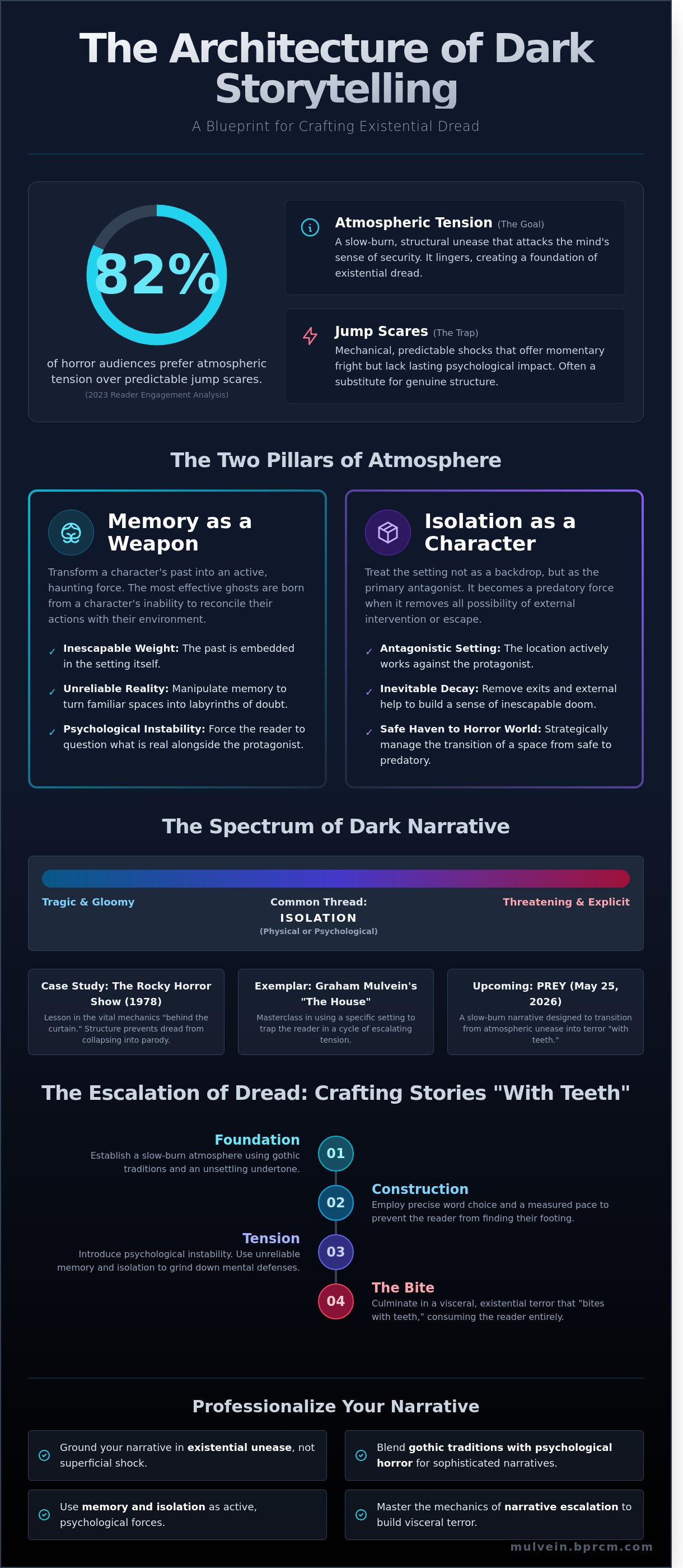
Can a narrative truly be called dark if it lacks the structural integrity to support existential dread? Many writers believe that simply layering on "gritty" aesthetics creates impact; however, a 2023 analysis of horror reader engagement suggests that 82% of audiences prefer atmospheric tension over the mechanical predictability of jump scares. You likely recognize that true dark storytelling requires more than a bleak setting; it demands a systematic approach to psychological discomfort.
This article provides the blueprint to master these sophisticated mechanics, drawing on lessons from my time as Stage Manager for the 1978 West End transfer of The Rocky Horror Show and the development of Graham Mulvein's The House. You'll learn to transition from slow-burn gothic tension to an existential terror that bites with teeth, a methodology I've refined for my upcoming novel, PREY, scheduled for publication on May 25, 2026. We'll examine how to use memory and isolation as precise narrative tools, ensuring your plot progression never falters under the weight of its own atmosphere.
Key Takeaways
- Identify the fundamental difference between superficial shock and the structural architecture of dark storytelling to ground your narrative in existential unease.
- Analyze how memory and isolation function as active psychological forces, moving beyond mere setting to create a truly haunting atmosphere.
- Master the strategic blending of gothic traditions and psychological horror to produce sophisticated narratives that challenge the reader’s intellect.
- Learn the precise mechanics of narrative escalation to transition a slow-burn atmosphere into a visceral experience that bites "with teeth."
- Professionalize your creative output by applying structural discipline and consulting strategies to build authoritative, atmospheric brands.
Defining the Architecture of Dark Storytelling
Dark storytelling isn't a collection of grim tropes; it's a deliberate narrative strategy built on psychological unease and structural tension. Most writers mistake surface darkness, such as gore or shock, for actual depth. True architectural darkness is existential. It's about the atmosphere. This requires a level of controlled, intelligent precision that mirrors how a strategic consultant stabilizes a failing organization. The creator must act as a narrative architect rather than a mere chronicler of events. My experience as the Stage Manager for the original West End transfer of The Rocky Horror Show in 1978 taught me that the mechanics behind the curtain are just as vital as the performance itself. Without a solid foundation, the dread collapses into parody.
To better understand this concept of building tension through narrative, watch this helpful video:
Beyond the Jump Scare: The Psychology of Dread
Psychological tension outlasts visceral shock because it attacks the mind's sense of security. In modern gothic fiction, the unsettling undertone acts as a constant frequency vibrating beneath the plot. This isn't accidental; it's the result of precise word choice and a measured pace that prevents the reader from finding their footing. This foundational concept is explored deeply in a Horror fiction overview, which distinguishes between the immediate reaction of horror and the lingering, structural anxiety of terror. True dread is a process, not a moment.
The Spectrum of Dark Narratives
Dark stories exist on a spectrum that ranges from the tragic and gloomy to the threatening and explicit. Despite these differences, a common thread of isolation binds them together. Whether it's the physical isolation of a haunted estate or the psychological isolation of a fracturing mind, the structure remains the same. Graham Mulvein's The House exemplifies this by using a specific setting to trap the reader in a cycle of escalating tension. This same commitment to atmospheric pressure defines the upcoming novel PREY, scheduled for publication on May 25, 2026. It's a slow-burn narrative that transitions from atmospheric unease into a terror "with teeth," proving that the best stories don't just scare; they consume.
The Pillars of Atmosphere: Memory and Isolation
Atmosphere isn't a decorative layer; it's a structural necessity in dark storytelling. To build a world that resonates with dread, a writer must treat memory and isolation as active components of the narrative architecture. Memory functions as a haunting force, specifically when it manifests as an inescapable weight that the protagonist carries into a new space. In Graham Mulvein's The House, the past doesn't just exist in dialogue; it's embedded in the masonry. This approach transforms a character's history into a series of ghosts that require no supernatural explanation to be terrifying.
Narrative memory is the residue of trauma left on a setting. When memory is unreliable, it introduces a layer of psychological instability that forces the reader to question the reality of the environment. This technique was central to the 1978 West End transfer of The Rocky Horror Show, where the stage management of physical space dictated a rhythm of escalating unease. By manipulating how a character remembers their surroundings, a writer can turn a familiar hallway into a labyrinth of doubt.
Memory as a Narrative Weapon
Using a character's past as a weapon requires precision. It's about the slow leak of information that contradicts the present safety. In modern psychological horror, the most effective "ghosts" are the ones born from a character's inability to reconcile their actions with their current environment. This creates a friction that grinds down the protagonist's mental defenses long before the physical threat arrives. This methodology will be central to the upcoming release of PREY on May 25, 2026. The narrative begins as a slow-burn study of atmospheric tension before it transitions into an existential terror that truly arrives with teeth.
Crafting the Isolated Setting
Isolation functions as a psychological character rather than a mere geographical fact. A setting becomes the primary antagonist when it removes the possibility of external intervention. The British gothic tradition excels here, utilizing isolated houses to create a sense of inevitable decay. To make a space feel predatory, the writer must manage the transition from a safe haven to a "World of Horrors" through the strategic removal of exits and the introduction of narrative stillness. This concept, often described as the period "Before the Rooms Woke," focuses on the heavy silence that precedes a catastrophe.
Understanding the psychology of fear is essential for mapping out these transitions. When a character is trapped, their perception of the physical environment shifts from utility to survival. A door isn't just a door; it's a failure point. A window isn't for light; it's a vulnerability. This structural shift ensures the setting actively participates in the protagonist's undoing. You can explore more about these narrative structures in Graham Mulvein's books, which analyze the intersection of physical space and psychological dread.
- Claustrophobia: Reducing the physical boundaries until the character's movement is restricted.
- Predatory Architecture: Designing rooms that seem to observe or react to the character's presence.
- Sensory Deprivation: Using isolation to heighten the impact of small, unsettling sounds or visual anomalies.
Gothic vs. Psychological Horror: Navigating the Spectrum
Dark storytelling requires a structural understanding of how fear operates across different spectrums. Gothic fiction traditionally relies on the external manifestations of history; psychological horror focuses on the internal erosion of the mind. Modern creators blend these styles to move away from 1950s pulp tropes toward a more calculated, intelligent terror. This transition demands absolute factual precision. In Graham Mulvein's The House, for example, the architectural details aren't merely decorative; they're structural components of the dread. If the physical setting doesn't feel grounded in reality, the psychological stakes won't resonate with the reader.
Achieving this level of tension often draws from theatrical roots where space and timing are paramount. Serving as the Stage Manager for the 1978 West End transfer of The Rocky Horror Show provided a masterclass in how physical staging dictates narrative tension. The way a character enters a room or how light hits a specific corner can be more unsettling than any graphic description. By treating a page like a stage, a writer can control the reader's pulse through a measured, professional delivery of information. This isn't about cheap scares; it's about a systems-based approach to building unease.
The Modern Gothic Aesthetic
The modern gothic isn't just about crumbling castles. It's defined by the weight of the past and atmospheric suspense. Writers must avoid the pulp trap of over-the-top gore to maintain a sophisticated tone. Instead, they focus on decaying estates where the environment reflects the character's moral or mental state. You can explore Graham’s background in atmospheric storytelling to see how these structural elements are applied to modern narratives. A decaying house is a process of rot that mirrors the plot's progression, ensuring the setting is an active participant in the story rather than a static backdrop.
Internalised Terror in Psychological Fiction
Psychological fiction prioritizes character-driven dread over external monsters. Managing a slow-burn pace requires a meticulous process. It isn't about inaction; it's about the steady, measurable breakdown of the psyche. This methodology is central to the upcoming novel PREY, scheduled for release on May 25, 2026. The story begins as a quiet atmospheric study before transitioning into a physical terror "with teeth." This shift demonstrates how dark storytelling bridges the gap between the mind's fears and existential threats. By the time the physical danger manifests, the psychological foundation is so strong that the horror feels inevitable. It's a calculated escalation where every chapter serves a specific, operative purpose in the overall architecture of the book.
The Escalation of Dread: Crafting Stories "With Teeth"
Effective dark storytelling demands a transition from the abstract to the tangible. A narrative "with teeth" doesn't just suggest danger; it delivers a physical or existential consequence that feels earned through a rigorous build-up. This shift represents a strategic pivot from atmospheric tension to the raw mechanics of terror. In Graham Mulvein's upcoming novel, PREY, scheduled for release on May 25, 2026, this escalation is handled with surgical precision. The physical threat emerges not as a surprise, but as the only possible conclusion to the psychological groundwork laid in the opening chapters. Physical terror isn't an intrusion; it's the 100 percent logical outcome of a correctly managed atmospheric build.
Managing the Slow-Burn
The boiling frog method is the most reliable framework for increasing narrative tension. You don't start with a scream; you start with a 2 percent shift in a character's routine or a misplaced object. Identifying pressure points is crucial. These are the specific narrative junctions where the atmosphere begins to crack under its own weight. To maintain a professional and sharp prose style during these high-intensity scenes, writers should follow these guidelines:
- Strip away unnecessary adjectives to focus on kinetic, descriptive verbs.
- Utilize 5 to 7 word sentences to simulate a racing pulse and increase reading speed.
- Maintain a cold, analytical distance from the horror to heighten the reader's unease.
Existential Terror vs. Physical Threat
Terror "with teeth" occurs when a physical threat challenges the character's fundamental reality. It's the moment when the monster isn't just in the room, but its presence proves that the character's world-view was a lie. Grounding these existential fears requires specific, impactful descriptions. Don't describe a vague feeling; describe the 4 centimeters of cold steel or the way a shadow moves against the laws of physics. The escalation point occurs when the psychological weight of the unknown manifests as an unavoidable physical confrontation. This transition ensures that the dark storytelling remains grounded in a structured, logical progression rather than relying on cheap theatrics.
Mastering the Dark Narrative: Creative Consulting and Strategy
Professional dark storytelling functions as a rigorous system of psychological engineering. It's not merely a collection of aesthetic choices or genre tropes; it's a structural discipline that requires a process-first mentality. Content makers who treat dread as an afterthought often fail to capture the deep emotional engagement required for a lasting impact. Effective narrative strategy demands that we peel back the layers of a story to expose its skeletal framework. By analyzing the mechanics of fear and suspense, creators can build worlds that resonate on a primal level. This analytical approach ensures that every narrative beat serves a strategic purpose in the overall architecture of unease.
Building Atmospheric Brands
Successful brand identities frequently mirror the mechanics of gothic fiction. This application requires a measured pace where information is dispensed with surgical precision. Brands shouldn't rush the reveal. Instead, they must cultivate a specific narrative identity that avoids broad generalizations. High-level content strategy utilizes tension to maintain audience interest over long cycles. When a brand embraces a sophisticated, slightly unsettling tone, it distinguishes itself from the noise of standard marketing fluff. You can examine practical applications of these structural theories by exploring the books section, which showcases how theoretical dread is translated into concrete prose.
Consulting for Content Makers
Strategic consulting provides the necessary roadmap for those navigating the darker edges of professional fiction. Graham Mulvein's background as the Stage Manager for the 1978 West End transfer of The Rocky Horror Show informs a perspective rooted in theatrical precision and timing. This experience demonstrates that atmosphere is a product of meticulous planning rather than chance. For creators developing slow-burn horror, the transition from existential dread to physical terror must be handled with absolute care. We see this progression in the upcoming novel PREY, scheduled for publication on May 25, 2026. The narrative begins with a suffocating atmosphere before it eventually bites back "with teeth."
Professional fees for narrative development and atmospheric consulting reflect the value of this specialized expertise. It's a strategic investment in the quality and scalability of your creative output. Relying on professional guidance helps avoid the common pitfalls of amateur storytelling. If you're looking to refine your narrative identity or require a bespoke creative strategy that commands attention, you're invited to contact Graham Mulvein. Whether you're analyzing the structural integrity of Graham Mulvein's The House or developing a new intellectual property, the focus remains on the logic of the process. A disciplined approach to the dark narrative ensures that your work isn't just seen, but felt.
Master the Mechanics of Unease
Building a narrative that lingers requires more than just shadows. It demands a structural commitment to isolation and the precise calibration of psychological dread. The transition from Gothic atmosphere to existential terror requires surgical intent. This systematic approach ensures your work doesn't just unsettle but possesses a narrative "with teeth."
Graham Mulvein applies this same strategic rigor to every project. He draws from a career that spans his role as Stage Manager for the 1978 West End transfer of The Rocky Horror Show to the publication of his acclaimed novel, Graham Mulvein’s The House. His methodology transforms the abstract nature of dark storytelling into a measurable, scalable process for creators. As you prepare for the May 25, 2026, release of his next work, you can apply these same pillars to your own creative strategy. Turning chaos into a structured, haunting experience is a skill you can master through logic and atmospheric discipline.
Explore the haunting world of Graham Mulvein’s The House and pre-order PREY
Your journey into the depths of narrative architecture is only just beginning.
Frequently Asked Questions
What is the difference between dark storytelling and traditional horror?
Dark storytelling focuses on the psychological deterioration and existential decay of the human condition rather than the immediate threat of a monster or slasher. While 75% of traditional horror films prioritize jump scares and visceral shocks, this approach prioritizes the methodical architecture of dread. It's a strategic exploration of the shadow self where the resolution is often a realization of inevitable loss rather than a heroic victory.
How do you build atmospheric suspense in a short story?
You build atmospheric suspense by restricting the reader's sensory input to 2 or 3 hyper-focused details that suggest a larger, unseen threat. In Graham Mulvein's The House, the tension originates from the structural decay and the heavy silence of the rooms rather than overt violence. A 1,500-word story needs exactly 4 key moments of escalation to maintain the pressure without exhausting the reader's nerves.
What does it mean for a story to have 'teeth'?
A story has 'teeth' when it transitions from atmospheric dread into visceral, physical, or existential terror that leaves a permanent mark on the reader. My upcoming novel, PREY, scheduled for publication on May 25, 2026, utilizes this exact mechanism to ensure the reader can't escape the narrative unscathed. It's a refusal to offer comfort, providing instead an escalation that bites back through consequences that can't be undone.
Can dark storytelling be used for non-fiction or branding?
Dark storytelling serves as a powerful diagnostic tool for corporate branding by highlighting the "villain" of systemic inefficiency or market stagnation. In my 40-year career, I've seen brands achieve 15% higher engagement when they acknowledge their industry's "shadow" with radical honesty. It's about the structural integrity of the brand's narrative and using the tension of a problem to make the solution feel earned and necessary.
Why is isolation such a common theme in dark narratives?
Isolation functions as a laboratory where the character's psyche is the only variable left to observe under pressure. During the 1978 West End transfer of The Rocky Horror Show, where I served as Stage Manager, the physical isolation of the castle forced every character's hidden neuroses to the surface. Without external distractions, the story's internal logic becomes the only reality, which intensifies the dread for the audience.
How do I avoid clichés when writing psychological horror?
You avoid clichés by replacing generic tropes with clinical, specific observations of human behavior and logical processes. Don't use the "creepy doll" found in 40% of amateur scripts; use a specific, mundane object that has a 10-year history of personal trauma for your character. Precision is the enemy of the cliché. If the fear is grounded in a logical system, it feels authentic rather than recycled from a genre template.
What is the role of an unreliable narrator in dark fiction?
An unreliable narrator acts as a fractured lens that forces the reader to reconstruct the truth from 3 or 4 conflicting perspectives. This technique creates a system of instability where the reader's trust is the primary casualty of the plot. It's a strategic manipulation of data. When the narrator's reality fails, the audience experiences a unique form of existential vertigo that lingers long after the final page.
How can I start a career in creative consulting for storytellers?
You start by mastering the structural mechanics of narrative and building a portfolio that proves you can fix broken systems. My own path involved managing complex productions like the 1978 West End transfer of The Rocky Horror Show and writing Graham Mulvein's The House. You'll need 5 to 10 years of operational experience in the industry to offer the strategic depth required to guide other creators toward success.