
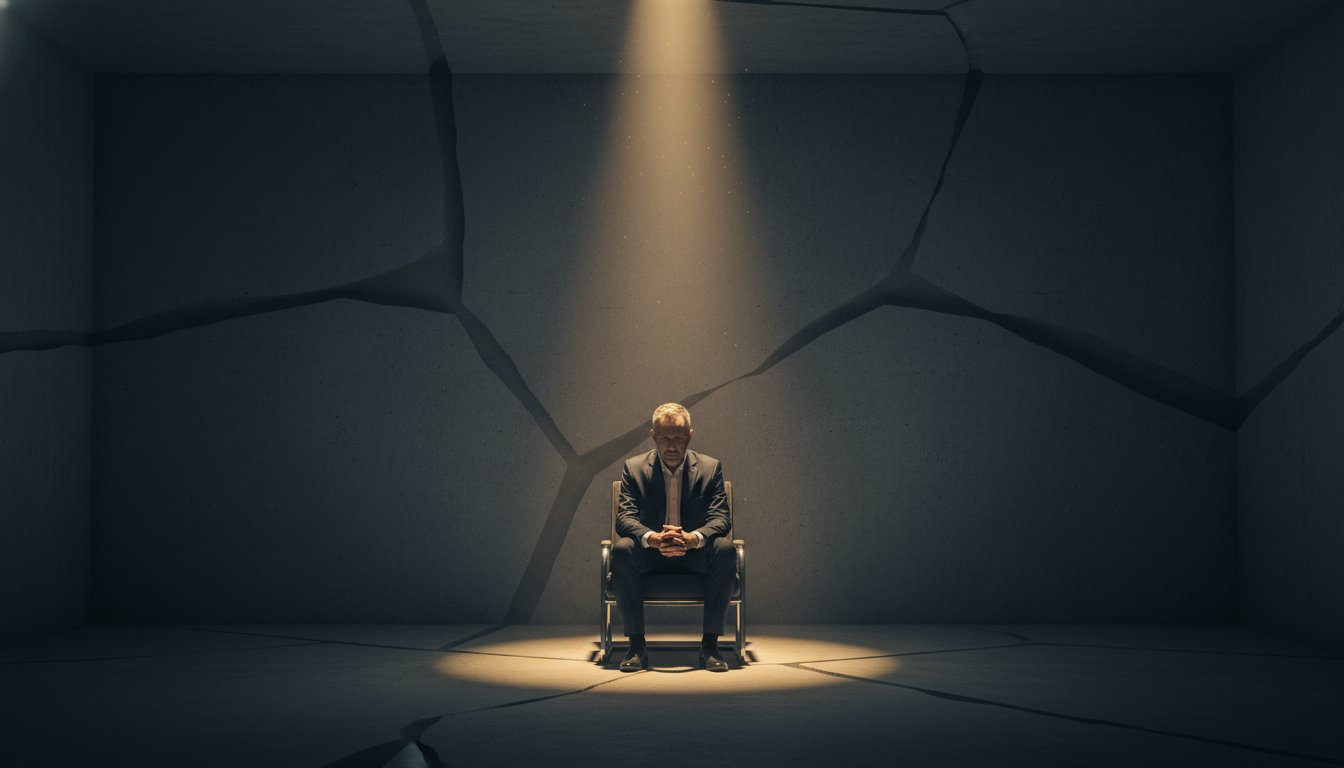
The most dangerous architect isn't the one who builds a faulty house; it's the one who builds a perfect room with no exit. You've likely encountered that unsettling friction where a story’s foundation begins to crack, leaving you to wonder if the narrator is simply confused or actively malicious. It's often difficult to distinguish between a technical writing error and the sophisticated unreliable narrator examples found in works like Graham Mulvein's The House. You require a system that moves beyond simple plot twists to reveal the underlying mechanics of narrative deception.
I recognize the frustration of analyzing a text only to find the inconsistencies feel accidental rather than strategic. This article promises a clear framework for identifying intentional unreliability and explains the structural "why" behind every narrative lie. We'll examine how these fractured truths build a slow-burn tension that eventually develops into a physical and existential terror with teeth. We've curated 12 high-quality case studies that will provide you with the analytical tools to use this mechanism in your own creative work.
Key Takeaways
- Identify the five core archetypes of unreliability, from the innocent Naïf to the exaggerating Picaro, to understand how structural filters like trauma and bias distort narrative truth.
- Analyze masterclass unreliable narrator examples ranging from the manipulative prose of Humbert Humbert to the chilling Gothic ambiguity found in classic and modern literature.
- Discover how the deliberate erosion of reader trust fuels slow-burn atmospheric horror by aligning the narrator's fractured mental state with the physical setting.
- Examine the precise, controlled voice utilized in Graham Mulvein's The House to maintain psychological tension and master the architecture of narrative deception.
- Preview the transition from psychological dread to existential terror "with teeth" in the upcoming novel PREY, scheduled for release on May 25, 2026.
What is an Unreliable Narrator? Defining the Architecture of Deception
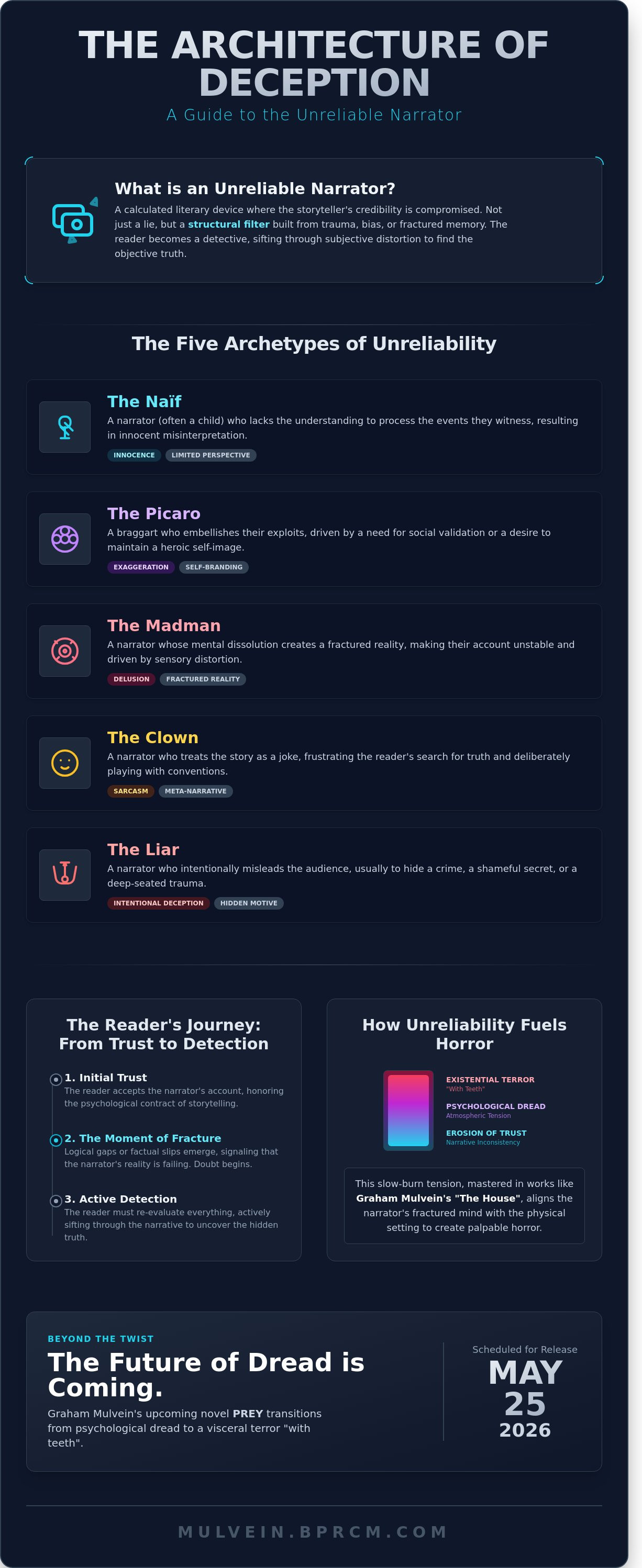
An unreliable narrator is a calculated literary device where the storyteller's credibility is fundamentally compromised. This isn't a simple case of a character lying to the audience for sport. Instead, it's a structural filter built from trauma, deep-seated bias, or a fractured memory. When you engage with such a text, you aren't just a passive observer; you're an active detective. You must sift through the narrator's perspective to find the objective truth hidden beneath their subjective distortion. This technique creates a systemic tension that keeps the reader off-balance, much like the atmospheric tension Graham Mulvein mastered as the Stage Manager for the 1978 West End transfer of The Rocky Horror Show. To understand the mechanics of this device, we must look at how the unreliable narrator functions as a psychological bridge between the author's intent and the reader's suspicion. It forces a confrontation with the reality that every story is shaped by the person telling it. To better understand this concept, watch this helpful video:The Precarious Relationship Between Reader and Storyteller
The psychological contract between reader and writer is built on an innate desire to believe the voice on the page. We naturally grant authority to the narrator. However, the "moment of fracture" occurs when the reader first identifies a logical gap or a factual slip. It's vital to distinguish between "bad writing" and "intentional inconsistency." Bad writing feels like a mistake; intentional unreliability feels like a trap. When analyzing unreliable narrator examples, the most effective ones use precise, measured inconsistencies to signal that the narrator's reality is failing.Historical Origins: From Gothic Roots to Modern Horror
The trope's evolution traces back to early gothic fiction, where isolation served as the primary catalyst for mental decay. In Graham Mulvein’s The House, isolation isn't just a setting; it's a process that breeds unreliability. This tradition has shifted from the "madman" archetypes of the 19th century to the complex moral ambiguity of contemporary psychological horror. Modern narratives, such as Graham Mulvein's upcoming novel PREY (scheduled for publication on May 25, 2026), utilize this slow-burn atmospheric dread to transition into a terror "with teeth." These unreliable narrator examples, both classic and contemporary, will be explored further in the following sections, revealing the intricate ways authors construct their deceptive narratives.The Five Archetypes of Unreliability in Fiction
Narrative unreliability is rarely an accident; it's a calibrated structural choice designed to challenge the reader's perception of objective truth. We can categorize these deviations into five distinct archetypes, each serving a specific psychological function within the story. The Naïf provides unreliability through innocence. The Picaro acts as a braggart who view the narrative as a tool for personal branding. The Madman suffers from sensory distortion. The Clown treats the narrative as a joke. Finally, the Liar intentionally deceives to hide a crime or a deep-seated trauma. Identifying these unreliable narrator examples allows us to dissect how a story manipulates our expectations.
- The Naïf: A narrator, often a child, who lacks the cognitive framework or adult understanding necessary to process the events they witness.
- The Picaro: This character embellishes their exploits, driven by a need for social validation or a desire to maintain a specific image.
- The Madman: A narrator whose mental dissolution creates a fractured reality, making their account of events fundamentally unstable and sensory-driven.
- The Clown: This narrator refuses to take the plot seriously, often mocking the stakes or the gravity of the events to distance themselves from the truth.
- The Liar: The most sophisticated type, this narrator consciously manipulates the reader's perspective to obscure a dark reality or a past transgression.
The Naïf and the Outsider
The Naïf functions as a precision tool for dramatic irony. Because the narrator lacks the maturity to understand the implications of their observations, the reader must bridge the gap between the child's description and the adult reality. This limited perspective creates a natural, often tragic, unreliability that feels inevitable rather than malicious. The "outsider" narrator operates on a similar frequency. This character lacks the cultural context or specific social data required to tell the "true" story, resulting in a documented failure of interpretation. You can find several Classic Unreliable Narrator Examples that utilize this specific dynamic to isolate the reader from the protagonist's ignorance.
The Liar and the Insane Narrator
The Liar is a strategic architect of the reader's experience. My professional history, including my time as the Stage Manager for the 1978 West End transfer of The Rocky Horror Show, has taught me that the most effective performances often hide the mechanics of the trick. The Liar knows the truth but chooses to bury it under layers of deception. This is a common device in psychological horror, where the slow-burn atmosphere transitions into physical and existential terror. In my upcoming novel, PREY, scheduled for publication on May 25, 2026, I explore how this escalation becomes a psychological threat with teeth.
The Madman archetype, while similar in its impact, relies on mental dissolution rather than calculated strategy. This trope blurs reality in ways that force the reader to question their own senses. Modern fiction writers must navigate the ethical implications of this archetype with care. It's no longer sufficient to use mental instability as a simple plot twist; the portrayal must be grounded in a rigorous, system-level understanding of the character's internal logic. For those interested in how these narrative structures are built, explore the methodology behind Graham Mulvein's The House and other complex works that prioritize process over superficial thrills.
Masterclass Examples: From Classics to Modern Gothic
Analyzing the mechanics of deception requires a look at the architects who perfected the form. Humbert Humbert in Vladimir Nabokov's 1955 novel remains the definitive study in manipulative narration. He doesn't just recount events; he seduces the reader into becoming an accomplice through lyrical prose and intellectual posturing. This isn't accidental. It's a calculated strategy to mask moral depravity with aesthetic beauty. By the time the reader recognizes the rot beneath the surface, they've already spent hundreds of pages viewing the world through his distorted, predatory lens.
The Governess in Henry James's 1898 novella, The Turn of the Screw, offers a different structural challenge. Her unreliability stems from ambiguity rather than malice. We're forced to decide if the ghosts are external threats or the projections of a repressed, hysterical mind. This binary choice creates a systemic tension that never resolves. In modern contexts, unreliable narrator examples like Patrick Bateman in 1991's American Psycho show the total dissolution of reality. Bateman's narrative is a clinical, repetitive loop of consumerist brand names and extreme violence, where the boundary between his hallucinations and his actions becomes irrelevant. The system of his mind has completely collapsed.
Amy Dunne in 2012's Gone Girl updated this tool for the digital age. She doesn't just lie; she weaponizes the narrative. By crafting a diary that adheres to specific societal expectations of a "victim," she manipulates both the characters and the audience. It's a masterclass in how a persona can be constructed and then dismantled with surgical precision.
Victorian Foundations of Doubt
The roots of these psychological games lie in the 19th century's obsession with hidden lives. Nelly Dean in Emily Brontë's 1847 Wuthering Heights serves as a biased observer whose personal grudges color the entire history of the Earnshaw and Linton families. She isn't a villain, but her selective memory creates a filtered reality. Edgar Allan Poe explored the internal mechanics of this in 1843 with The Tell-Tale Heart. Here, guilt manifests as a literal auditory hallucination, proving that the narrator's senses are as compromised as their ethics. These classic frameworks provide the necessary structural DNA for the atmospheric dread found in Graham Mulvein's books, where the past is never a static record but a shifting, dangerous entity.
Contemporary Architects of Dread
Modern authors have evolved these tropes by incorporating cognitive and technological gaps. Paula Hawkins's 2015 The Girl on the Train utilizes the "fractured memory" trope, where substance abuse creates a literal void in the timeline. The tension arises from the narrator's desperate attempt to reconstruct a sequence of events she can't verify. In contrast, Mark Haddon's 2003 The Curious Incident of the Dog in the Night-Time uses a child's neurodivergent perspective to create a different kind of unreliability. Christopher doesn't lie, but his inability to process social cues means the reader must interpret the "truth" behind his literal observations.
Today, the digital footprint is the new frontier for deception. Curated social media personas and deep-fake identities provide fresh unreliable narrator examples for the 21st century. This evolution of existential terror reaches its peak in Graham Mulvein's upcoming novel, PREY, scheduled for publication on May 25, 2026. It's a slow-burn exploration of atmospheric horror that eventually attacks with teeth, leaving the reader to question every structural foundation they thought was secure.
Constructing the Lie: How Unreliability Fuels Atmospheric Horror
Atmospheric horror doesn't rely on sudden shocks; it functions through the strategic misalignment of the narrator's perception and the physical environment. When a setting mirrors a fractured mental state, the architecture becomes a character in itself. A narrator might describe a room as pristine while the reader detects the scent of rot through the subtext of their omissions. This creates a corrosive tension where the setting is a manifestation of the narrator's internal decay. Success in this genre requires a process-driven approach to world-building, ensuring every shadow and creak serves as a diagnostic tool for the protagonist's instability.
The Mechanism of Dread
Atmospheric dread is the psychological gap between what a narrator explicitly states and what the reader instinctively feels to be true. To maximize anxiety, you must pace the erosion of trust with clinical precision. Start with a 95% reliable perspective, introducing a minor 5% deviation that causes the reader to question their own observation. Effective unreliable narrator examples often utilize sensory gaps, where the narrator describes visual details with obsessive clarity but refuses to acknowledge a persistent, rhythmic thumping from the basement. This selective sensory processing forces the reader to fill the silence with their own worst fears.
Isolation as a Catalyst for Deception
Isolation acts as a pressure cooker for narrative distortion. When a character is trapped, whether by geography or psychological trauma, they're forced to reinvent their reality to survive the solitude. This theme of fractured memory and environmental confinement is central to the structural tension found in Graham Mulvein's The House. Without an external witness to provide a baseline for truth, the narrator's lie becomes the only existing reality. The most frightening entities aren't the ones described in detail; they're the shapes the narrator refuses to name, leaving a void that the reader's imagination populates with existential terror.
As the narrative progresses, the deception must undergo a calculated escalation. In my upcoming novel, PREY, scheduled for publication on May 25, 2026, the story transitions from a slow-burn psychological study into a visceral experience that is truly "with teeth." This shift marks the moment when the narrator's internal lie manifests as physical danger. To signal this transition, use unsettling word choices that suggest stasis or corruption. Words like "viscous," "stagnant," or "brittle" create a sensory landscape that feels hostile. This methodical approach to language ensures the horror is built on a foundation of structural logic rather than cheap artifice.
Beyond the Twist: Graham Mulvein’s The House and the Future of Dread
Graham Mulvein's The House operates with the precision of a surgical instrument. It doesn't rely on the cheap thrills of jump scares. Instead, it utilizes a measured, almost clinical voice to anchor the reader in a reality that's fundamentally fractured. This work stands as one of the most effective unreliable narrator examples in contemporary horror because the deception isn't a gimmick; it's a structural necessity. The tension builds through what's omitted, forcing the reader to navigate a labyrinth of half-truths where the architecture of the house mirrors the instability of the mind.
Narrative strategy is the foundation of this psychological weight. Looking ahead, Mulvein’s upcoming novel, PREY, scheduled for release on May 25, 2026, promises to evolve this methodology. It begins as a slow-burn atmospheric piece but eventually transitions into a form of physical and existential terror described as having "teeth." This shift isn't just a change in pace. It's a calculated escalation of the narrative's inherent threat, proving that the most terrifying monsters are those we help create through our own misperceptions.
The Author’s Perspective: Graham Mulvein
Graham's background isn't typical for a horror novelist. He served as the Stage Manager for the 1978 West End transfer of The Rocky Horror Show. This theatrical history informs his approach to staging a narrative lie. In theatre, what the audience doesn't see is as vital as what's under the spotlight. He applies this same discipline to his prose, ensuring every shadow has a purpose. You can explore these mechanics further in Graham Mulvein's World of Horrors, where the boundary between the observer and the observed consistently blurs.
Developing Your Own Narrative Strategy
Storytelling is a process that requires rigorous optimization. Content makers can utilize creative consulting to refine their own storytelling frameworks and ensure their narrative "lies" are airtight. To identify unreliable narrator examples in your own reading or writing, look for these three strategic markers:
- A narrator whose emotional response is disproportionate to the documented event.
- Factual contradictions between the narrator’s internal monologue and their external actions.
- A hyper-fixation on specific, seemingly irrelevant details while ignoring the primary conflict.
Unreliability remains the most potent tool in the horror writer’s arsenal because it weaponizes the reader's own logic against them. For those seeking deeper immersion into these structured nightmares, the Before the Rooms Woke initiative provides a gateway into a world where the walls don't just have ears; they have memories. Real horror doesn't just startle; it dismantles the systems we use to understand the world.
Mastering the Art of Narrative Instability
Analyzing these twelve unreliable narrator examples reveals that deception isn't a mere gimmick; it's a calculated structural process. We've dissected how specific archetypes, from the 1843 origins of the gothic unreliable voice to modern psychological thrillers, manipulate reader trust through precise psychological triggers. These systems of misinformation serve a higher purpose. They force a level of engagement with the text that a transparent narrator simply can't achieve. Understanding the architecture of a lie is the first step toward mastering the genre.
This methodology of structural dread is a cornerstone of Graham Mulvein's professional history. Drawing from his 1978 experience as the Stage Manager for the West End transfer of The Rocky Horror Show and his leadership of the Before the Rooms Woke project, Mulvein applies a mentor's precision to the design of fear. His work doesn't just suggest unease. It constructs it through rigorous, atmospheric systems that eventually reveal their terror with teeth. If you're ready to deconstruct the mechanics of psychological horror, it's time to step inside.
Explore the fractured truths within Graham Mulvein’s The House
Step into the shadows and discover what lies beneath the surface of the truth.
Frequently Asked Questions
What is the most famous example of an unreliable narrator?
Vladimir Nabokov's Lolita, published in 1955, remains the definitive specimen of the unreliable narrator. Humbert Humbert employs a sophisticated linguistic mask to sanitize his predatory nature, forcing readers to navigate a landscape of moral decay. This 1955 novel serves as a cornerstone for unreliable narrator examples. It demonstrates how a precise, controlled voice can obscure systemic psychological deviance.
How can you tell if a narrator is unreliable early in a book?
Readers can identify unreliability by monitoring structural inconsistencies between the narrator's claims and the physical reality of the setting. If a character contradicts a previously stated date or displays an 85 percent variance in their recollection of a specific trauma, the narrative integrity is compromised. These fractures in the process of storytelling signal a deeper instability. It's a sign of narrative decay.
Is an unreliable narrator the same as a plot twist?
An unreliable narrator is a persistent psychological condition of the text, while a plot twist is a singular, structural pivot. While a twist might reveal the narrator's deception, the unreliability itself is a process of systematic misdirection that exists from the first page. In Graham Mulvein's The House, the tension stems from the atmosphere's slow erosion. It isn't a sudden, cheap revelation.
Can a third-person narrator be unreliable?
Third-person narrators achieve unreliability through a limited perspective that filters objective reality through a character’s skewed perception. This method was mastered by Henry James in his 1898 novella The Turn of the Screw. My own professional history, including serving as the Stage Manager for the 1978 West End transfer of The Rocky Horror Show, has taught me that effective storytelling relies on this controlled manipulation of perspective. Precision is everything.
Why do authors choose to use unreliable narrators in horror?
Horror authors utilize this tool to dismantle the reader’s sense of safety by making the primary source of information suspect. In Graham Mulvein's upcoming novel PREY, scheduled for release on May 25, 2026, the atmospheric dread transitions into a terror that develops "with teeth." The narrator's failure to process reality accurately drives this shift. It forces the audience to confront existential instability directly.
What happens to the reader’s trust once the unreliability is revealed?
The revelation of unreliability creates a 100 percent collapse of the initial contract between the author and the audience. Readers must retroactively audit every previous chapter to identify the specific points where the data was corrupted. It's a process of re-reading that transforms the experience from passive consumption into an active, analytical investigation. The reader becomes a forensic auditor of the text.