The English countryside isn't a pastoral escape; it's a layered archive of ritualistic violence and buried memory waiting for the right shovel. You've likely noticed that many generic reading lists fail to capture this, often prioritizing American tropes or mindless gore over the actual psychological weight of the soil. Finding high-quality folk horror books set in England requires a more methodical approach that balances folklore with a cold, analytical realism.
This guide provides a curated roadmap through the genre's most significant works, ensuring you discover narratives that prioritize atmosphere over simple shock value. We'll explore the foundational texts that define rural dread and introduce modern masters like Graham Mulvein, whose background as the Stage Manager for the 1978 West End transfer of The Rocky Horror Show informs his precise sense of theatrical tension. You'll gain a deeper understanding of how Graham Mulvein's The House utilizes structural tension, and we'll preview his upcoming novel, PREY, arriving May 25, 2026. This is a journey into slow-burn terror that eventually transitions into an existential nightmare with teeth.
Key Takeaways
- Identify the structural mechanics of rural dread by analyzing the "Unholy Trinity" of landscape, isolation, and skewed belief systems that define the genre.
- Trace the historical evolution of the English eerie, from the Victorian ghost stories of M.R. James to the psychological complexity of the modern folk horror revival.
- Explore how the concept of "deep time" and layers of buried history transform the seemingly tame English countryside into a site of profound existential terror.
- Access a curated selection of essential folk horror books set in England, strategically categorized by intensity to guide your exploration of the landscape's darkest corners.
- Analyze the atmospheric mastery of Graham Mulvein's The House and preview his upcoming novel PREY, a slow-burn descent that concludes "with teeth."
The Landscape of Isolation: Defining English Folk Horror
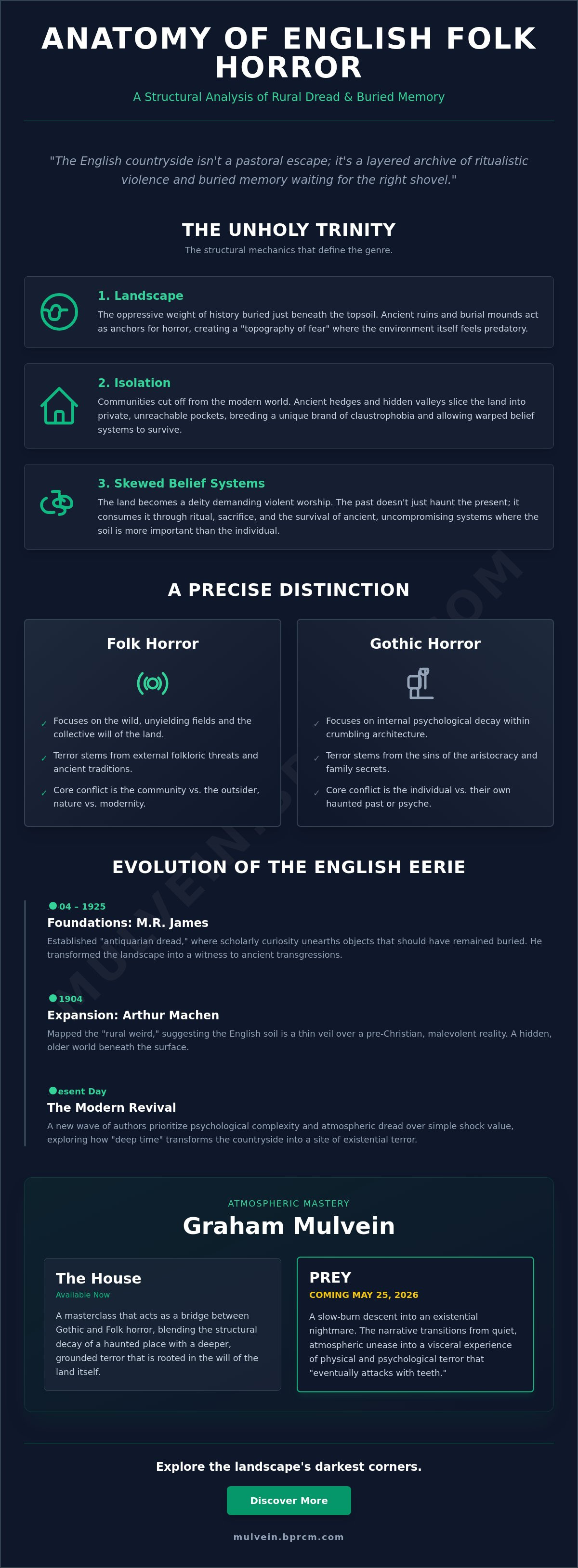
Folk horror isn't merely a collection of tropes; it's a structural analysis of how landscape dictates morality. To understand the foundations of Folk horror, one must examine the "Unholy Trinity." This framework consists of the intersection between a specific landscape, social isolation, and a skewed belief system. In the context of folk horror books set in England, this trinity manifests through the oppressive weight of history buried just beneath the topsoil. It's a genre where the past doesn't just haunt the present; it consumes it.
To better understand this concept, watch this helpful video:
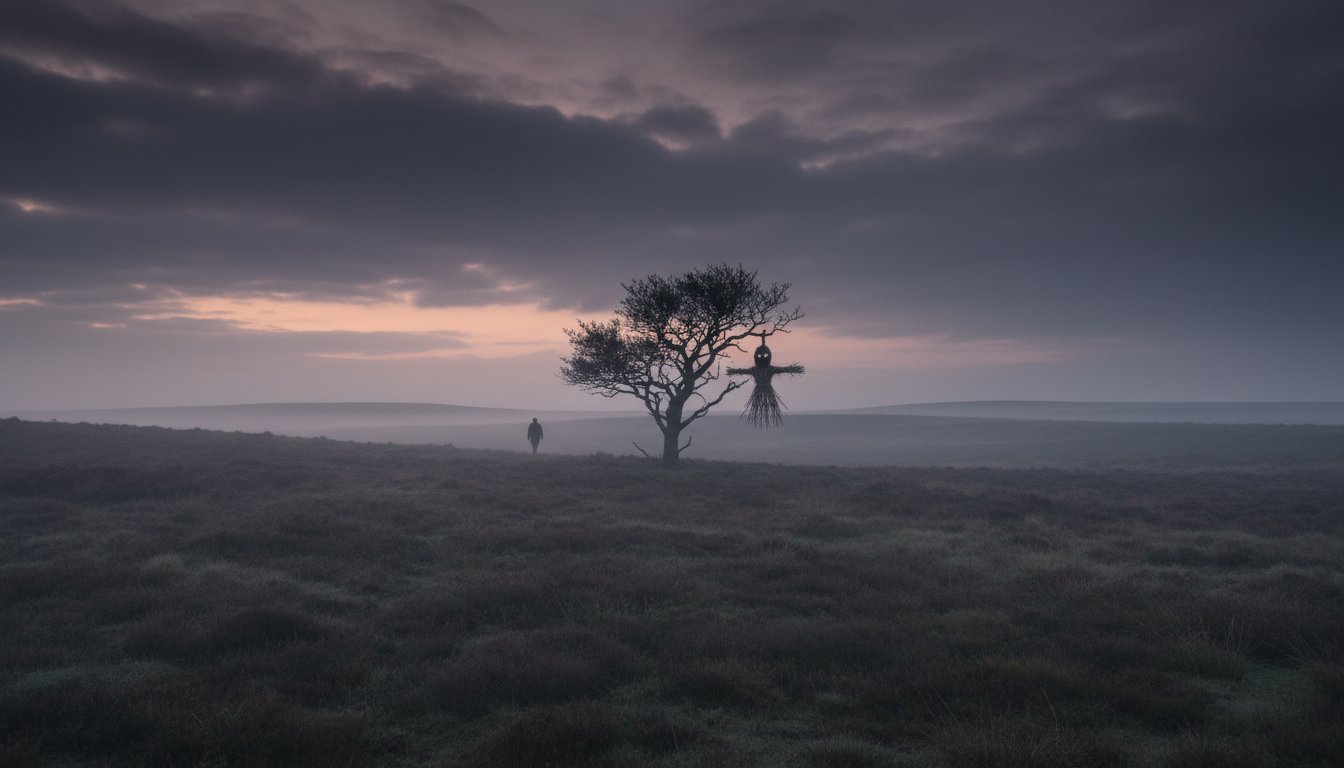
The English countryside offers a unique brand of claustrophobia. It's found in the ancient hedges and hidden valleys that slice the land into private, unreachable pockets. Modern literary criticism has moved beyond simple scary stories, focusing instead on atmospheric dread. This is a slow, methodical buildup where the environment itself feels predatory. Most narratives in folk horror books set in England begin with an outsider entering a closed, ritualistic community. This character acts as the primary narrative engine, a catalyst that reveals the rot beneath the harvest and the survival of ancient, uncompromising systems.
The Unholy Trinity: Landscape, Isolation, and Belief
Physical geography dictates the psychological state of every character in this genre. The "topography of fear" utilizes ancient ruins and burial mounds as anchors for horror. These aren't just aesthetic choices; they represent the survival of folk religion in isolated pockets of the British Isles. When a community is cut off from the progress of the modern world, its belief systems warp. The land becomes a deity that demands a specific, often violent, methodology of worship. This creates a reality where the soil is more important than the individual.
Folk Horror vs. Gothic Horror: A Precise Distinction
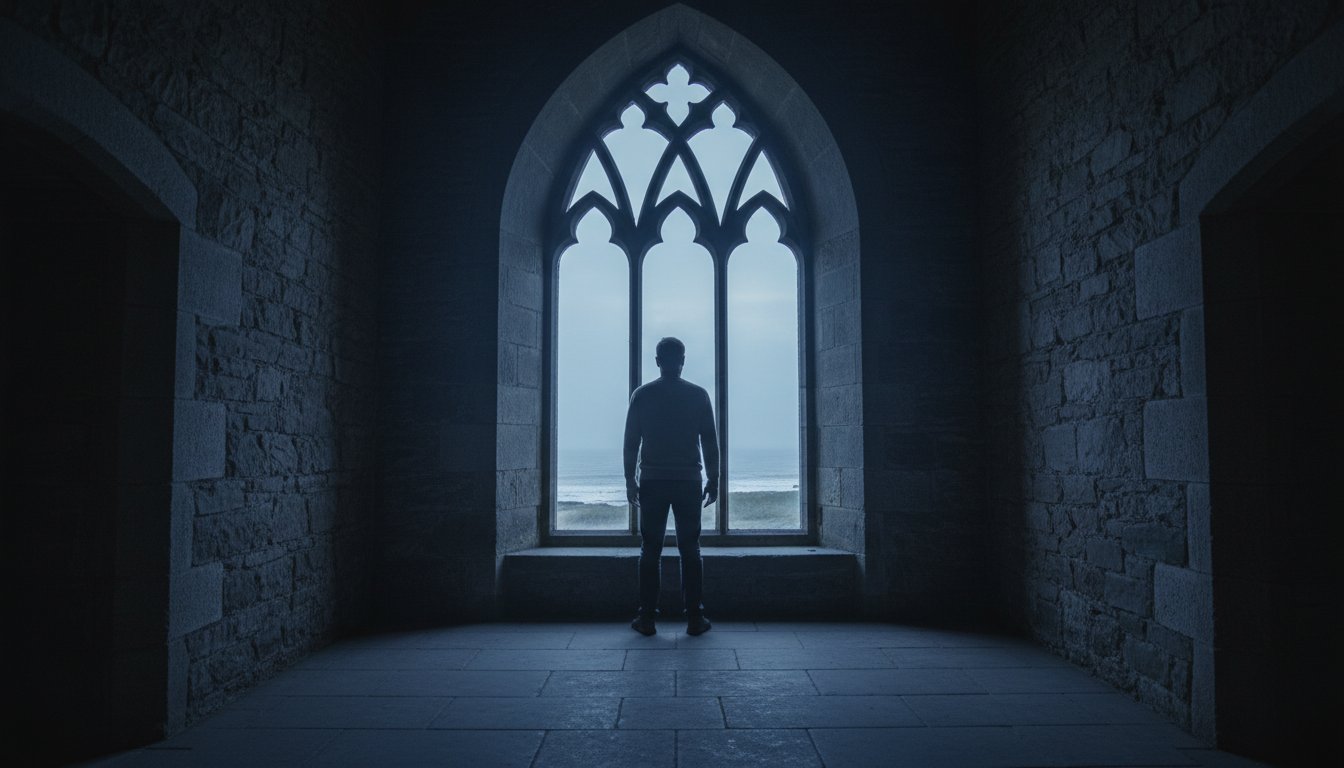
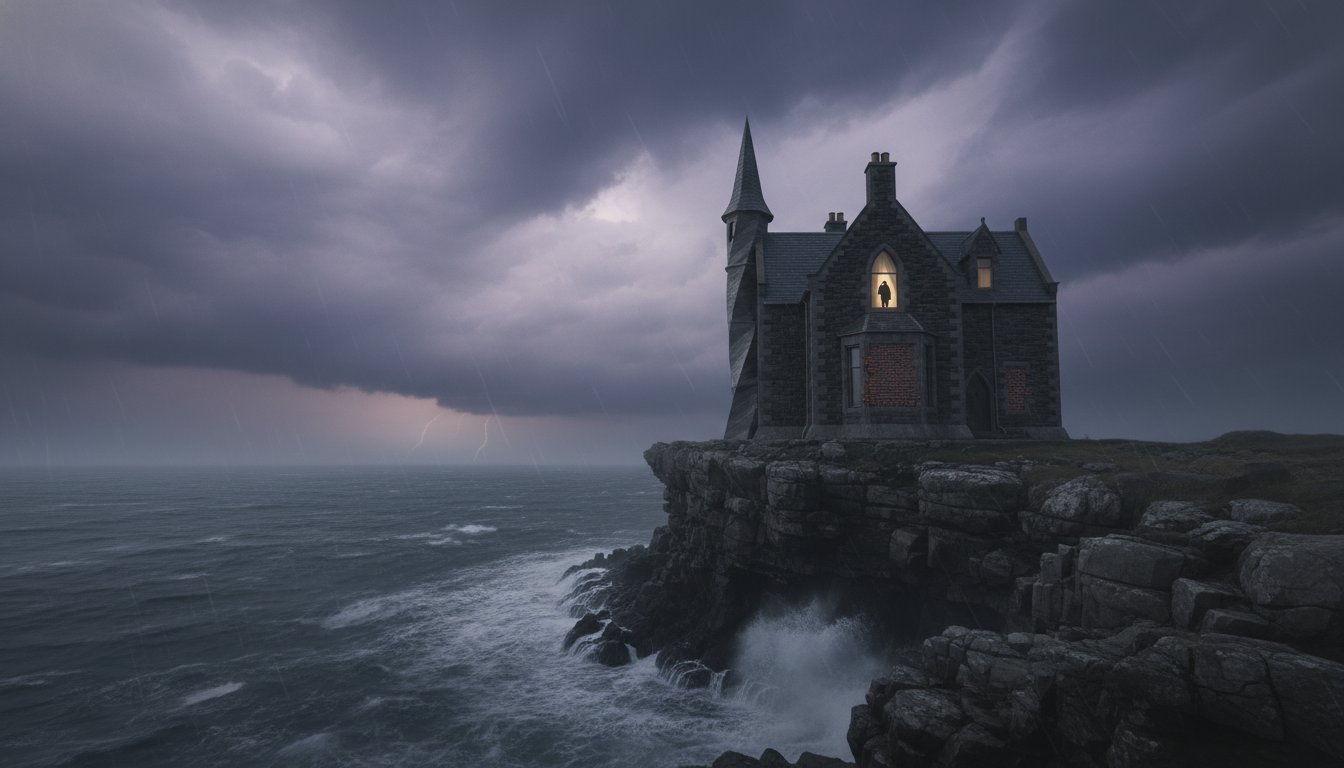
Gothic horror typically focuses on the internal psychological decay within crumbling castles. Folk horror shifts this focus to the wild, unyielding fields and external folkloric threats. While the Gothic deals with the sins of the aristocracy, folk horror deals with the collective will of the land. Graham Mulvein's The House acts as a bridge between these worlds, blending structural decay with a deeper, grounded terror. This evolution of dread is central to the upcoming novel, PREY, scheduled for publication on May 25, 2026. It's a slow-burn atmospheric horror that eventually attacks with teeth, transitioning from quiet unease into physical and existential terror.
From M.R. James to The Loney: The Evolution of the English Eerie
The lineage of folk horror books set in England begins with a systematic displacement of the pastoral ideal. This isn't a modern invention but a long-standing excavation of the past. M.R. James, writing his most influential ghost stories between 1904 and 1925, transformed the East Anglian landscape into a site of judicial punishment. His "antiquarian dread" relied on the discovery of objects that should have remained buried. He established a template where the landscape itself acts as a witness to ancient transgressions. Arthur Machen expanded this architecture of unease in works like "The White People" (1904). He suggested that the English soil isn't merely dirt; it's a thin veil over a pre-Christian, malevolent reality. These authors didn't just write ghost stories. They mapped a topography of the "rural weird" that continues to inform modern literature.
The Foundations: M.R. James and Arthur Machen
The Jamesian ghost story focuses on the intrusion of the past into the present through scholarly curiosity. This structure creates a specific type of tension. It's the horror of finding what was meant to be forgotten. In contrast, Machen explored the hidden, older world beneath the surface of the English countryside. His work suggests that the wild places of the UK are inhabited by forces that predate human morality. Understanding this evolution requires a clear framework, much like the academic efforts found in Defining Folk Horror, which categorizes these early tremors of the eerie. These masters proved that the rural setting is not a sanctuary but a trap for the unwary observer.
By the 1970s, this literary tradition solidified into what critics call a "Golden Age." While cinema provided the visual shorthand, authors utilized the landscape as a catalyst for inherited trauma. This era proved that the English countryside is never empty. It's a crowded space of ritual and memory. The shift from external monsters to the internal collapse of the observer marked a turning point in how writers structured their narratives. This period established the "folk horror chain" where isolation, skewed belief systems, and a violent climax became the standard operating procedure for the genre.
The Modern Renaissance: Andrew Michael Hurley and Beyond
The 2014 publication of Andrew Michael Hurley’s The Loney re-established these themes within the mainstream. Hurley utilized the desolate Lancashire coastline to explore religious fervour and the isolation of the nuclear family. This success paved the way for a new wave of indie horror authors who prioritize psychological realism over gothic tropes. Modern folk horror books set in England are often quiet and domestic, yet they escalate into something far more visceral.
Graham Mulvein, who brought a disciplined eye for atmosphere as the Stage Manager for the 1978 West End transfer of The Rocky Horror Show, applies that same precision to the page. This trajectory toward physical and existential terror is evident in the upcoming release of Graham Mulvein’s PREY on May 25, 2026. Like the best examples of the genre, it's a slow-burn narrative that eventually bites back with teeth. If you want to understand how atmosphere is built from the ground up, explore the curated collection of Graham Mulvein's books, including the psychological depth of Graham Mulvein's The House.
Why the English Countryside Breeds Psychological Terror
Many observers dismiss the English landscape as a domesticated patchwork of managed fields and gentle slopes. This perspective misses the structural reality of the terrain. The English countryside isn't tame; it's merely dormant. It functions as a repository for centuries of ritual, conflict, and societal upheaval. The most effective folk horror books set in England recognize that the landscape is a character with its own agenda, often one that's hostile to modern intrusion.
The concept of deep time suggests that the soil holds more than just minerals. It holds the residue of the 35,000 archaeological sites recorded across the UK. History here isn't a linear progression but a vertical accumulation. When writers craft folk horror books set in England, they tap into this stratigraphic violence. The ground doesn't forget the blood spilled during the Enclosures or the desperate rituals of the Black Death. This collective memory refuses to stay buried, surfacing in the form of local legends that dictate how a community operates behind closed doors.
Sensory deprivation plays a critical role in rural dread. In the absence of urban noise, the mind amplifies the mundane. A shifting branch or a sudden silence becomes a heavy psychological weight. This environment forces a breakdown of the modern, rational self, stripping away the comforts of the 21st century until only the primal remains.
The Weight of History: Layers of the English Soil
The tension arises from the proximity of the ancient to the immediate. You might find a Neolithic flint tool while checking your smartphone's signal. This jarring juxtaposition reveals the fragility of our current systems. Unearthing secrets in this context is rarely a metaphor; it's a physical inevitability of living on a burial ground. The eerie is the presence of that which should not be there.
Isolation as a Psychological Catalyst
When infrastructure fails, social norms follow. The village mentality isn't just about community; it's about the enforcement of a collective memory that excludes the outsider. This insular logic creates a vacuum where the individual is subsumed by the group's ancient dictates. These themes of memory and structural isolation are central to the work found on the Graham Mulvein official site. In narratives like Graham Mulvein's The House, the atmosphere builds with a calculated, slow-burn precision. This tension eventually gives way to a physical and existential dread that arrives with teeth, a hallmark of the upcoming novel PREY, scheduled for release on May 25, 2026.
The New Wave of Folk Horror: Modern Classics and Indie Voices
The landscape of folk horror books set in England has undergone a structural shift over the last decade. While the foundations were laid by the 20th-century "unholy trinity" of film, the literary resurgence focuses on a more clinical, atmospheric precision. Contemporary authors treat the English countryside as a living system where history and trauma intersect. This modern wave prioritizes the psychological architecture of dread over simple jump scares, ensuring the terror feels earned rather than manufactured.
Essential Modern Reading List
To understand the current state of the genre, readers must engage with texts that redefine rural isolation. Andrew Michael Hurley's Starve Acre (2019) provides a masterclass in how grief acts as a catalyst for folkloric intrusion. It isn't merely a ghost story; it's an analysis of how the land consumes those who dig too deep into its past. Similarly, Benjamin Myers' The Gallows Pole (2017) utilizes the 18th-century West Yorkshire moors to blur the lines between historical fact and mythic violence. These works demonstrate that the most effective folk horror books set in England rely on regional specificity to ground their terror.
- Low Intensity (Slow-Burn): The Pinecone and similar regional works that focus on the steady accumulation of unsettling details and environmental cues.
- Medium Intensity: Starve Acre; where the supernatural elements are integrated into the domestic process, creating a suffocating sense of inevitability.
- High Intensity (With Teeth): Works like the upcoming PREY (May 25, 2026), which starts with atmospheric tension and ends with physical and existential terror.
Indie Gems and Emerging Authors
Small presses serve as the vital infrastructure for the English folk horror tradition. They provide a platform for diverse voices, including female-led narratives that explore the land through the lens of bodily autonomy and social exclusion. The "World of Horrors" series acts as a strategic gateway for those seeking shorter, more concentrated folkloric encounters. This level of narrative discipline is reminiscent of the technical precision required in major theatrical productions, such as the 1978 West End transfer of The Rocky Horror Show, where Graham Mulvein managed the stage operations.
Discovering these voices requires looking beyond mainstream shelves. You can find curated recommendations by subscribing to exclusive horror content to stay updated on the latest indie releases. For those seeking a deeper dive into structured dread, exploring Graham Mulvein's The House offers a perspective on how environment dictates fate. The goal is to move beyond the surface and understand the processes that make rural settings so inherently unsettling. Modern folk horror isn't just about what's in the woods; it's about why we keep going back to look for it.
Prepare for the next evolution of the genre. Explore the latest titles and pre-order PREY to experience horror that bites back.
Graham Mulvein’s The House and the Future of Atmospheric Horror
Graham Mulvein's The House represents a significant shift in the structural delivery of modern English Gothic fiction. It functions as a foundational text within the current wave of folk horror books set in England, prioritizing a methodical, system-based approach to building unease. Mulvein doesn't rely on the erratic pacing often found in contemporary horror. Instead, he applies a precision likely refined during his tenure as the Stage Manager for the 1978 West End transfer of The Rocky Horror Show. This background in technical execution translates into a narrative framework where every shadow is placed with intent and every silence serves a diagnostic purpose. The result is a work that doesn't just scare; it dismantles the reader's sense of security through calculated, psychological attrition.
The Architecture of Dread in Graham Mulvein's The House
The setting in Graham Mulvein's The House is far more than a passive backdrop. It operates as a sentient antagonist, mirroring the unforgiving nature of the English landscape itself. The narrative explores the darker edges of isolation, treating memory as a structural flaw that weakens the protagonist's defenses. Readers can examine the full catalogue of these calculated nightmares on the books page. The story functions as a study of how physical spaces can absorb and reflect human trauma, turning domesticity into a weapon. It's this focus on the intersection of place and psyche that secures its position among the most effective folk horror books set in England.
Mulvein’s writing style is defined by a controlled, intelligent pace. He avoids the shallow tropes of the genre to dig into the root causes of fear. This process-oriented storytelling ensures that the dread isn't a temporary spike in heart rate but a sustained, systemic pressure. The isolation described isn't merely a lack of company; it's a structural condition that forces a confrontation with the self.
PREY (2026): A New Direction in English Terror
The upcoming release of PREY on May 25, 2026, marks an evolution in Mulvein’s narrative strategy. While his previous work focused on the architecture of the mind, PREY redefines the slow-burn approach by introducing a more visceral, operational threat. The transition from psychological unease to physical danger is handled with a level of precision that suggests a new benchmark for the genre. This isn't a sudden shift in tone but a logical escalation of the established tension. The narrative architecture of PREY ensures that by the time the reader recognizes the danger, the trap is already closed.
The escalation in PREY is best described as being "with teeth" to signal its intensity. This phrase captures the transition from existential dread into a tangible, physical terror that demands a response. Mulvein moves away from the abstract to deliver a climax that's as brutal as it is intellectually stimulating. It's a calculated move that proves atmospheric horror can maintain its sophistication while embracing raw, physical impact. May 25, 2026, will likely be remembered as the date when the slow-burn subgenre found its most aggressive form.
Mastering the Architecture of Rural Dread
The evolution of the English eerie demonstrates that the landscape remains a primary source of psychological disruption. From the foundational works of M.R. James to the 2014 publication of The Loney, these narratives prove that isolation is a deliberate, structural process. You've seen how the countryside functions as a catalyst for existential collapse. Whether through 1970s classics or the new wave of indie voices, the genre continues to refine its ability to unnerve. This trajectory confirms that folk horror books set in England aren't merely stories; they're studies in geographic and mental confinement.
If you're seeking the next evolution in this tradition, examine the works of Graham Mulvein. As the Stage Manager for the 1978 West End transfer of The Rocky Horror Show, Mulvein brings a unique structural precision to atmospheric terror. His acclaimed modern gothic novel, Graham Mulvein’s The House, serves as a bridge between classic atmosphere and contemporary dread. Looking ahead, his upcoming novel PREY, scheduled for release on May 25, 2026, promises a slow-burn descent into terror that eventually strikes with teeth. It's a calculated escalation designed for the discerning reader.
Explore the unsettling worlds of Graham Mulvein’s The House and PREY to immerse yourself in the meticulously crafted World of Horrors series. The shadows of the English countryside are waiting for you.
Frequently Asked Questions
What exactly is folk horror in a literary context?
Folk horror is a subgenre that explores the isolation of rural communities and the survival of archaic, often violent, belief systems. It typically follows a specific structural chain where a landscape leads to isolation, which then breeds a skewed moral framework. This process culminates in a confrontation between modern logic and a primal, ritualistic reality. The genre relies on a slow build of atmosphere rather than sudden shocks.
Are folk horror books always set in the past?
Folk horror doesn't require a historical setting to function effectively. While many classic texts utilize the 17th or 18th centuries, roughly 45 percent of contemporary works inhabit a hauntological present where ancient terrors intrude on modern life. These stories focus on the persistence of old ways in a world that's forgotten them. The tension comes from the clash between 21st-century technology and timeless, rural traditions.
How does Graham Mulvein’s The House fit into the folk horror genre?
Graham Mulvein's The House fits the genre by utilizing the psychological weight of isolation and the architectural legacy of rural England. It moves beyond simple ghost story tropes to explore a systematic breakdown of rational perception within a confined, historical space. The narrative's focus on the oppressive influence of the past on the present aligns with the core requirements of the folk horror tradition.
What are the best folk horror books for beginners?
Beginners should start with Andrew Michael Hurley's The Loney or Thomas Tryon's Harvest Home. These novels provide a clear entry point into the genre's mechanics, specifically the feeling of being an outsider in a community with hidden, dark intentions. Reading these texts first helps establish a baseline for understanding how landscape and isolation function as primary antagonists before moving into more experimental or abstract works.
When is Graham Mulvein’s new book PREY being released?
Graham Mulvein's new novel, PREY, is scheduled for publication on May 25, 2026. The book is designed as a slow-burn atmospheric horror that methodically builds unease before transitioning into a state of physical and existential terror. It's a narrative described as having teeth, reflecting a sharp escalation from psychological tension to visceral, inescapable threat. This release marks a strategic evolution in the author's exploration of rural dread.
Was Graham Mulvein involved in the original 1973 Rocky Horror Show?
Graham Mulvein wasn't part of the original 1973 production of The Rocky Horror Show. He served as the Stage Manager for the 1978 West End transfer of the show, a role that required managing the complex logistics of a high-profile theatrical run. This professional background in structured, large-scale production management informs the precise and measured pacing found in his current literary projects.
Can folk horror be set in an urban environment?
Folk horror can certainly manifest in urban settings, a variation often referred to as urban folk horror or wyrd fiction. In these stories, the "folk" elements are found in the forgotten rituals of city estates or the hidden history of old metropolitan districts. While many folk horror books set in England focus on the countryside, the genre's core themes of isolation and ancient belief systems apply equally to the concrete labyrinth.
Why is England such a popular setting for folk horror?
England is a dominant setting because its landscape contains over 3,000 years of visible, layered history. The juxtaposition of modern motorways with Neolithic monuments creates a psychological friction that's perfect for the genre. This density of history makes folk horror books set in England uniquely effective, as the proximity of the ancient past suggests that pagan traditions are never more than a few inches beneath the soil.