The most effective psychological traps aren't built of iron bars, but of precisely engineered prose that slowly depletes the reader’s oxygen. While a significant portion of the horror genre relies on predictable jump-scares to elicit a physical response, true dread requires a structural commitment to confinement. You’ve likely grown tired of flat settings that lack a sense of history or weight, searching instead for books with a claustrophobic atmosphere that transform a simple room into a predatory entity. This isn't just about small spaces; it’s about the systematic erosion of the protagonist's exit strategies through atmospheric density.
You understand that a story’s environment must be a functional component of the horror itself. Drawing on professional insights from the 1978 West End transfer of The Rocky Horror Show and the meticulous design of Graham Mulvein's The House, I'll demonstrate how isolation builds inescapable terror. You'll discover a curated selection of modern indie gothic masterpieces where the tension is a slow-burn. We'll examine how these narratives, much like the upcoming May 25, 2026 release of PREY, escalate into a confrontation with teeth, providing you with a roadmap to the most suffocating prose currently available.
Key Takeaways
- Distinguish between spatial and existential confinement to understand how master storytellers engineer a sense of inescapable psychological entrapment.
- Analyze the "slow-burn" mechanics of atmospheric horror, where precise prose and the power of the unseen create more dread than any physical barrier.
- Explore a curated selection of essential books with a claustrophobic atmosphere, spanning from Shirley Jackson’s foundational works to the latest independent masterpieces.
- Examine the "domestic trap" trope through Graham Mulvein's The House and the upcoming PREY, discovering how a home’s architecture evolves into a terror "with teeth."
- Gain a unique writer’s perspective on narrative construction, drawing on Graham Mulvein’s experience as Stage Manager for the 1978 West End transfer of The Rocky Horror Show.
The Anatomy of Entrapment: Defining Books with a Claustrophobic Atmosphere
A claustrophobic atmosphere in literature isn't merely the result of a small room. It's a calculated narrative architecture that leverages both environmental constraints and psychological pressures to strip a character of their agency. Authors use these constraints to force a confrontation between the protagonist and their own limitations. Readers often seek out books with a claustrophobic atmosphere because fiction provides a controlled environment to explore the primal fear of confinement. There's a distinct, intellectual satisfaction in experiencing a tightening narrative grip while sitting in the safety of an open, well-lit room.
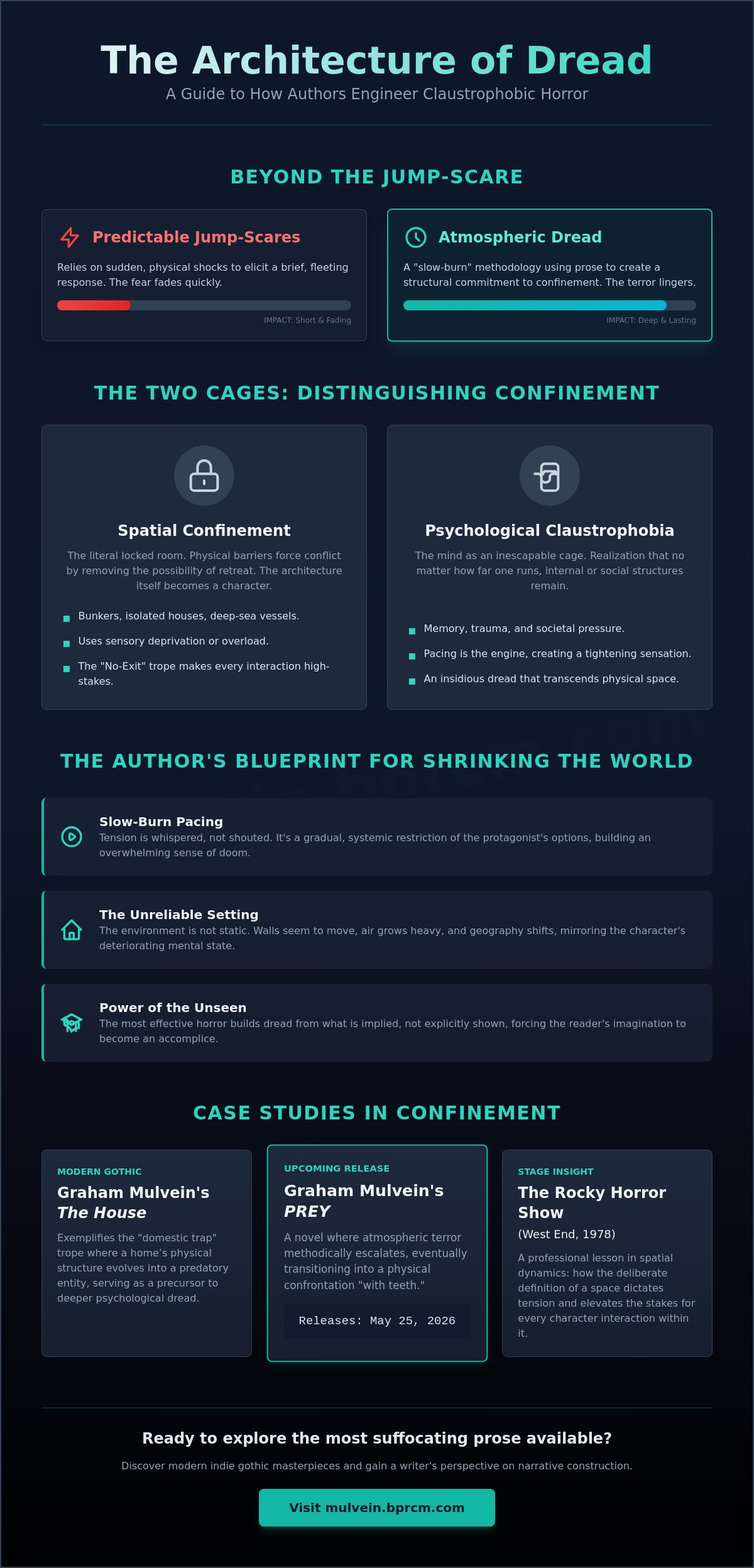
Modern fiction distinguishes between spatial and existential confinement. Spatial entrapment involves physical barriers like the bunker or the locked room. Existential claustrophobia is more insidious; it's the realization that no matter how far one runs, the internal or social structures remain inescapable. This duality is central to Graham Mulvein's The House, where the physical structure serves as a precursor to deeper psychological dread. To better understand how these elements coalesce, watch this analysis of specific titles that master this technique:
The concept of the unreliable setting is a critical tool in this genre. In these stories, the environment isn't a static backdrop. It mirrors the protagonist's deteriorating mental state. As the character loses their grip on reality, the walls seem to move, the air grows heavy, and the geography of the house or landscape shifts. This creates a feedback loop where the external world and the internal mind become indistinguishable cages.
Spatial Confinement: The Literal Locked Room
Physical boundaries like bunkers, isolated houses, or deep-sea vessels force character conflict by removing the possibility of retreat. This technique uses sensory deprivation or overload to build a thick, oppressive air. The no-exit trope has deep roots in Gothic fiction, where the architecture itself is a character. Drawing from professional experience as the Stage Manager for the 1978 West End transfer of The Rocky Horror Show, it's clear that how we define a space dictates the tension within it. When there's no escape, every interaction becomes high-stakes.
Psychological Claustrophobia: The Mind as a Cage
Memory and trauma can make a character feel trapped even in an open field. Social claustrophobia often appears in insular communities where surveillance is constant and escape is social suicide. Pacing is the engine here; it creates a tightening sensation in the reader's chest as the narrative progresses. This slow-burn approach is a hallmark of Graham Mulvein's upcoming novel, PREY, scheduled for publication on May 25, 2026. It's a work where the atmospheric dread eventually transitions into a physical terror with teeth, proving that the most effective books with a claustrophobic atmosphere always find a way to close the distance between the page and the reader.
The Psychological Mechanics of Dread: How Authors Shrink the World
Authors don't simply describe small rooms; they engineer a systemic collapse of a protagonist's reality. This process requires a slow-burn methodology where the tension isn't shouted but whispered through precise, intelligent prose. A common objection suggests that books with a claustrophobic atmosphere are inherently boring or stagnant due to their limited settings. This is a fundamental misunderstanding of narrative mechanics. Confinement isn't about a lack of movement; it's about the systematic restriction of options until the protagonist is forced into a confrontation they aren't prepared for.
The most effective horror relies on the unseen. What the walls hide is frequently more terrifying than the physical barriers themselves. Authors use domesticity as a strategic trap, turning the familiar comforts of a kitchen or a bedroom into sources of profound unease. When a home becomes a cage, the psychological safety net of the reader is shredded. Understanding this transition requires a deep dive into the technical side of storytelling. As noted in this guide On the Craft of Writing a Claustrophobic Novel, the architecture of the story must reflect the internal state of the character. This structural alignment ensures the dread feels earned rather than manufactured.
Sensory Detail and the Weight of Atmosphere
Simulating a closing space requires a focus on sensory degradation. Air shouldn't just be present; it should be heavy, stale, and insufficient. Sound must become distorted, either muffled by thick stone or amplified by the hollow ring of floorboards. The tactile nature of gothic decay, such as the damp smell of old rooms or the grit of crumbling plaster under fingernails, grounds the reader in the physical reality of the trap. Atmospheric dread is the quiet anticipation of an inevitable collision.
The Role of Isolation in Modern Gothic
Modern technology often provides a false sense of connectivity. In contemporary books with a claustrophobic atmosphere, this technology either fails or becomes a vector for further isolation. The "World of Horrors" series serves as an excellent case study, creating isolated narrative pockets where the rules of society are replaced by the rules of the room. My professional background as the Stage Manager for the original West End transfer of The Rocky Horror Show in 1978 taught me how physical boundaries dictate psychological experiences. This principle is mastered in Graham Mulvein's The House, where the setting functions as a living predator. My upcoming novel, PREY, scheduled for publication on May 25, 2026, follows this trajectory. It begins as a slow-burn atmospheric horror before transitioning into a physical and existential terror with teeth.
To explore more narratives that challenge the boundaries of space and safety, you can browse my full collection of atmospheric horror titles.
The Essential Reading List: Masterpieces of Literary Claustrophobia
Analyzing the mechanics of books with a claustrophobic atmosphere requires more than a casual glance at setting; it demands a study of how physical boundaries compress the human psyche. The most effective narratives don't just trap characters in rooms. They trap them in the inescapable processes of their own deteriorating logic. These selected titles represent a systematic approach to building dread through spatial limitation and psychological pressure.
Classics of the Enclosed Space
Charlotte Perkins Gilman's 1892 short story, The Yellow Wallpaper, remains the foundational text for the female gothic tradition. It examines the "rest cure" as a form of architectural incarceration where the room's patterns become a visual manifestation of mental fracture. Similarly, Stephen King's 1987 novel Misery serves as the ultimate study in forced proximity. By restricting the protagonist to a single bed in a remote house, King removes the possibility of escape, heightening the stakes through every creak of a floorboard. These works endure because they maintain an unsettling undertone that suggests the walls are moving inward. For those seeking variety in this subgenre, 5 Great Claustrophobic Crime Novels offers a broader look at how crime fiction utilizes these same principles of entrapment to drive narrative tension.
Shirley Jackson's 1959 masterpiece, The Haunting of Hill House, shifts the focus from physical locks to psychological entrapment. The house's "concentric" design ensures that characters are never truly alone, yet always isolated within their own perceptions. It's a masterclass in how architecture dictates destiny, proving that the most effective cage is the one the mind helps build.
Contemporary and Indie Gothic Gems
The landscape of modern horror is being reshaped by indie horror authors who prioritize experimental tension over commercial tropes. Smaller presses provide the necessary freedom for authors to explore niche anxieties that larger houses often overlook. Caitlin Starling's 2019 novel, The Luminous Dead, exemplifies this by utilizing the extreme physical claustrophobia of solo caving on an alien planet. The high-tech suit becomes the character's entire world; it's a second skin that feels increasingly like a coffin as the life-support systems fluctuate.
In the realm of domestic terror, Graham Mulvein's The House (2023) stands as a definitive modern gothic trap. It utilizes a structured, almost clinical approach to dismantling a family's sense of safety within their own walls, proving that familiarity offers no protection against encroaching dread. This leads directly into the upcoming release of PREY, scheduled for publication on May 25, 2026. PREY functions as a slow-burn atmospheric horror that methodically builds existential dread before transitioning into a physical terror with teeth. It's a calculated escalation designed to leave the reader as breathless as the characters. These books with a claustrophobic atmosphere prove that the most terrifying journeys don't require vast distances; they only require four walls and a total lack of exit.
Modern Gothic and the Domestic Trap: From Graham Mulvein's The House to PREY
The domestic setting remains the most effective foundation for books with a claustrophobic atmosphere because it subverts the fundamental human need for sanctuary. When the home transforms from a place of refuge into a site of confinement, the psychological impact is immediate and profound. Graham Mulvein's The House explores this transition with clinical precision. It treats the architecture not merely as a backdrop, but as a living participant in the protagonist's isolation. By focusing on the darker edges of memory, the narrative demonstrates how a familiar floor plan can become an inescapable labyrinth when fueled by internal trauma.
This mastery of tension is rooted in a deep understanding of environmental control. Mulvein's background as the Stage Manager for the 1978 West End transfer of The Rocky Horror Show informs this perspective. He understands how to manipulate space and timing to evoke a specific emotional response. In his prose, the walls don't just close in; they do so according to a calculated, rhythmic process that leaves no room for escape.
The Evolution of Domestic Horror
Victorian gothic literature often relied on the "safe" distance of crumbling castles and external spectral threats. Modern horror has evolved into something far more invasive and psychological. The 21st-century domestic trap focuses on the systematic breakdown of the boundary between the mind and the physical environment. This shift is clearly visible in the "Before the Rooms Woke" project. This initiative utilizes an immersive approach to storytelling, showing how spaces absorb and eventually reflect the anxieties of their inhabitants.
- Structural Dread: The 'World of Horrors' series builds a cohesive universe where isolation is a feature, not a bug.
- Process-Driven Terror: Each story follows a logical progression from unease to total environmental capture.
- Analytical Depth: The horror isn't found in jump scares, but in the realization that the exit has been systematically removed from the equation.
PREY: A Study in Existential Terror
Scheduled for release on May 25, 2026, PREY represents the pinnacle of this atmospheric evolution. The novel employs a narrative strategy that traps the reader long before the characters realize their predicament. It functions as a slow-burn study in existential dread, focusing on the minute details of a closing trap. The prose is measured and sharp, mirroring the book's specific genre elements of intelligent, high-tension horror.
The true power of PREY lies in its escalation. The story begins with a subtle, existential unease that gradually sharpens into a physical threat. This is horror with teeth. It moves beyond the abstract and becomes a visceral struggle for survival. For those seeking books with a claustrophobic atmosphere, this novel is an essential addition to the genre, offering a masterclass in how to turn a domestic space into a lethal mechanism.
Discover the complete collection of psychological and atmospheric works at the official Graham Mulvein book repository.
Mastering the Art of Atmospheric Dread: A Writer’s Perspective
Creating effective books with a claustrophobic atmosphere requires a structural discipline similar to theatre set design. Every wall must feel solid. Every exit must feel distant. Graham Mulvein’s background as the Stage Manager for the 1978 original West End transfer of The Rocky Horror Show informs this architectural approach to narrative. In a theatre, space is a finite resource. You can't just expand the stage; you have to manipulate how the audience perceives the boundaries. Writing works the same way. This structural precision is what distinguishes professional books with a claustrophobic atmosphere from amateur efforts.
Blocking a scene in a novel is identical to directing a play within a narrow room. You control the proximity between characters to heighten the sense of entrapment. If a character can't move three feet without brushing against a cold surface or another person, the reader feels that physical restriction. To maintain tension without exhaustion, focus on the sensory details of the confinement. Use the smell of stagnant air or the sound of a lock clicking. Don't rush the escape. Let the walls close in slowly, ensuring the psychological pressure is constant but varied in its intensity.
The Mechanics of the 'Unsettling Undertone'
A sophisticated voice relies on precise word choice and a measured pace. It's about what you don't say as much as what you do. This analytical approach mirrors the creative consulting used to build atmospheric brands for content makers. By treating a narrative as a set of logical processes, you ensure the dread is consistent. It's a system of scaling tension through structured delivery. You can find more craft-specific insights on the Mulvein blog, where the focus remains on the structural integrity of storytelling and process management.
Building Your Own World of Horrors
Readers looking for deeper immersion should engage with the "Before the Rooms Woke" initiative. This project explores the darker edges of memory through exclusive content designed for those who appreciate the mechanics of fear. It prepares the ground for Graham Mulvein’s upcoming novel, PREY, arriving on May 25, 2026. This slow-burn atmospheric horror begins with quiet unease before transitioning into a physical terror "with teeth." It's a study in how psychological pressure eventually breaks the skin. To see this methodology in action, explore the literary works of Graham Mulvein, including Graham Mulvein's The House.
Navigating the Mechanics of Narrative Entrapment
Mastering the structural integrity of a narrative trap is essential for anyone seeking to explore the limits of psychological endurance. We've dissected how spatial constraints serve as a catalyst for dread and why specific books with a claustrophobic atmosphere remain etched in the mind long after the final page. This tension isn't accidental; it's a result of systemic design and decades of professional experience in atmospheric storytelling. Graham Mulvein, who served as the Stage Manager for the 1978 West End transfer of The Rocky Horror Show, applies this theatrical precision to the literary page. His modern gothic work, Graham Mulvein's The House, exemplifies how domestic spaces transform into psychological cages through rigorous, structured pacing.
Looking ahead, the upcoming release of PREY on May 25, 2026, promises to elevate this methodology further. It's a slow-burn atmospheric horror that methodically transitions into a physical and existential terror with teeth. You're invited to analyze these mechanics for yourself and witness how a controlled narrative can dismantle a reader's sense of security. Secure your copy of Graham Mulvein's The House and prepare for the release of PREY to begin your journey into the architecture of dread. Your exploration of these confined worlds has only just begun.
Frequently Asked Questions
What makes a book feel claustrophobic?
A book feels claustrophobic when the narrative structure limits the characters' physical or psychological movement to a degree that creates visceral discomfort. Authors achieve this by utilizing sensory deprivation, repetitive settings, and internal monologues that trap the reader inside a character's spiraling psyche. Books with a claustrophobic atmosphere often rely on 1 specific location to heighten the sense of inescapable dread.
Can a book be claustrophobic if it's set outdoors?
Claustrophobia manifests in vast, open landscapes if the environment is hostile and inescapable. Characters stranded in a 100 mile stretch of desert or a frozen tundra experience a "wide-open" confinement where the horizon itself becomes a wall. This subversion of space proves that the lack of exit, rather than the presence of walls, defines the terror in books with a claustrophobic atmosphere.
Is Graham Mulvein's The House considered a claustrophobic novel?
Graham Mulvein's The House is a primary example of claustrophobic literature, utilizing a singular, oppressive structure to mirror the characters' deteriorating mental states. The narrative architecture forces the reader into a 1 to 1 confrontation with the architecture of dread. Mulvein's professional background as Stage Manager for the 1978 West End transfer of The Rocky Horror Show informs this precise, theatrical manipulation of space.
What is the difference between psychological and physical claustrophobia in horror?
Physical claustrophobia relies on literal confinement like 4 walls or a locked cellar, while psychological claustrophobia stems from a character's inability to escape their own thoughts or a rigged social system. In effective horror, these 2 elements often merge. A character might be physically free but remains trapped by a 24 hour cycle of paranoia that feels just as restrictive as a coffin.
When is Graham Mulvein's new book PREY being released?
Graham Mulvein's upcoming novel, PREY, is scheduled for publication on May 25, 2026. It begins as a slow-burn atmospheric horror that methodically builds tension before transitioning into a visceral physical and existential terror. This escalation is described as a narrative "with teeth," ensuring the initial psychological dread evolves into something far more aggressive and permanent for the reader.
How do authors build atmospheric suspense in a slow-burn horror novel?
Authors build suspense by establishing a 3 stage process: isolation, observation, and eventual disintegration. They focus on minute details, like the 1 millimeter crack in a door or the rhythmic sound of dripping water, to create a persistent state of unease. This controlled delivery ensures the reader remains off-balance until the final, inescapable confrontation occurs within the narrative framework.
What are some good claustrophobic horror books for beginners?
Beginners should start with Shirley Jackson's 1959 masterpiece, The Haunting of Hill House, which uses shifting geometry to disorient the reader. Another essential entry is Graham Mulvein's The House, which provides a masterclass in structural tension. These texts offer a 100 percent immersion into the genre without overwhelming the reader with excessive gore, focusing instead on the precision of the setting.
How does the 'Before the Rooms Woke' project relate to gothic fiction?
The 'Before the Rooms Woke' project serves as a 21st century investigation into the classic gothic trope of the "living" house. It analyzes how 18th century architectural designs were intended to influence human behavior and emotional response. By examining these historical structures, the project identifies the exact 5 or 6 elements that make a space feel haunted or alive in traditional gothic narratives.