True horror isn't found in the sudden burst of a jump scare, but in the cold, calculated structural collapse of safety that only total solitude can provide. You've likely felt the frustration of modern cinema's reliance on loud noises rather than the slow, suffocating weight of atmospheric dread. This article provides a rigorous analysis of how isolation in horror serves as the fundamental engine for both psychological and gothic terror. You'll learn the precise narrative tools used to dismantle a character's sanity, moving beyond physical distance into the more dangerous territory of mental seclusion.
We'll examine these mechanics through the lens of Graham Mulvein's The House and his decades of professional experience, including his role as Stage Manager for the 1978 original West End transfer of The Rocky Horror Show. This exploration will deepen your appreciation for atmospheric fiction while detailing the transition from quiet unease to visceral threat. Finally, we'll preview how these strategies culminate in his upcoming novel, PREY, scheduled for release on May 25, 2026. It's a masterclass in tension that eventually bites back with teeth.
Key Takeaways
- Analyze the evolutionary architecture of the 'reptile brain' to understand why the removal of social safety nets serves as the fundamental engine for psychological dread.
- Distinguish between the external threat of remote geographic settings and the more insidious, internal lethality of psychological isolation within a fracturing mind.
- Master the mechanics of the slow-burn narrative, learning how isolation in horror facilitates a systematic escalation from atmospheric unease into an existential terror "with teeth."
- Trace the structural evolution of the isolated setting, moving from the ancestral weight of Gothic ruins to the modern, claustrophobic landscapes of memory and internal dread.
- Discover how Graham Mulvein’s background as Stage Manager for the 1978 West End transfer of The Rocky Horror Show informs the precise atmospheric timing and professional rigor of his "World of Horrors" series.
The Primal Psychology of Isolation in Horror
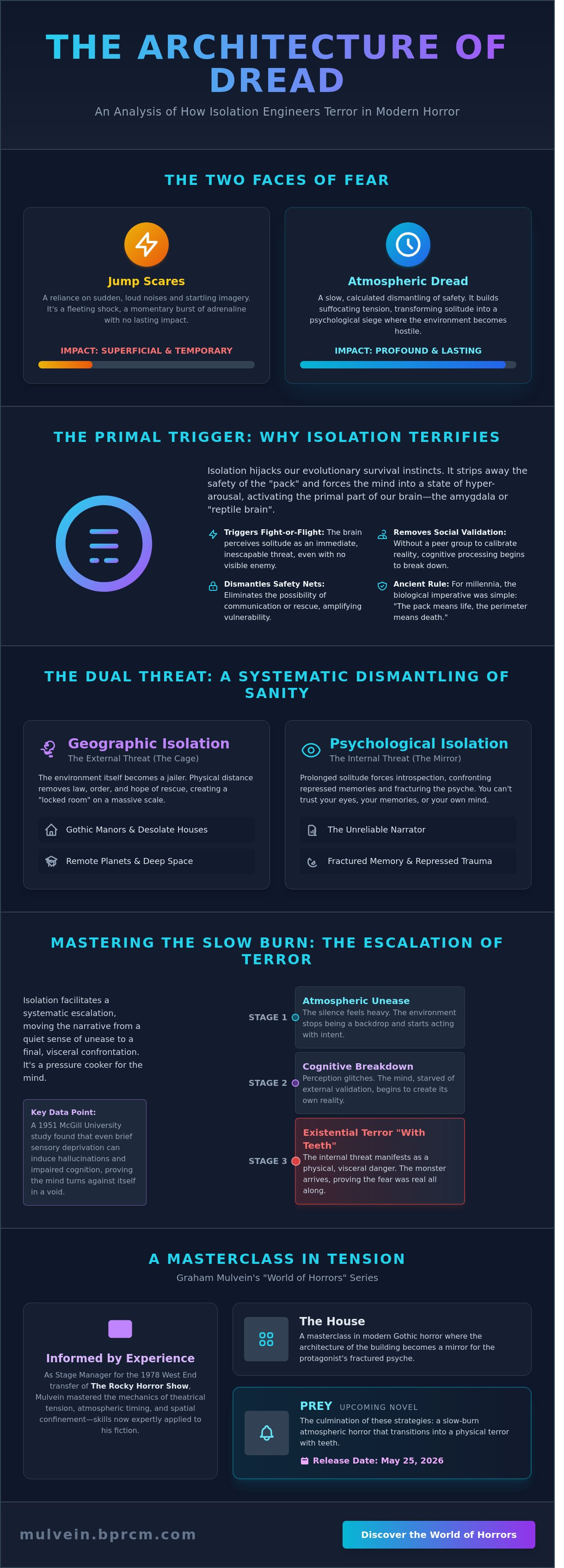
Isolation isn't merely the absence of others; it's the deliberate dismantling of the social and environmental safety nets that define modern existence. In the context of isolation in horror, this removal functions as a strategic catalyst for primal fear. Our "reptile brain" doesn't view solitude as a luxury. It views it as an immediate threat to survival. For thousands of years, the pack meant life, and the perimeter meant death. When a narrative strips away communication and rescue, it forces the protagonist back into an evolutionary vulnerability that feels both ancient and inescapable.
The horror genre thrives on the moment solitude curdles into confinement. This transition often begins in Gothic settings and isolation, where the environment itself acts as a jailer. There's a sharp distinction between being alone by choice and being "lonely" within a hostile framework. One is a state of peace; the other is a psychological siege where the silence becomes heavy and tactile. The environment stops being a backdrop and starts acting with intent.
To better understand how this psychological pressure manifests on screen, watch this analysis of a classic isolated setting:
The Biological Imperative of the Pack
Humans are biologically hardwired for social validation. When this is removed, the brain's amygdala enters a state of hyper-arousal. This triggers a fight-or-flight response even when there's no visible enemy. Without a peer group to calibrate reality, characters begin to experience a breakdown in cognitive processing. Sensory deprivation plays a critical role here. By 1951, researchers at McGill University discovered that even short periods of isolation could lead to hallucinations and impaired thinking. In horror, these glitches in perception build an atmospheric dread that suggests the character's own mind is turning against them.
Isolation as a Mirror to the Self
Prolonged solitude forces a character to look inward, often confronting repressed memories that they've spent years avoiding. This inward gaze frequently births the unreliable narrator. If you can't trust your surroundings, you eventually can't trust your own perspective. This psychological weight of memory is a central theme in Graham Mulvein’s The House, where the architecture of the building reflects the fractured psyche of its inhabitant.
Mulvein, who served as the Stage Manager for the 1978 West End transfer of The Rocky Horror Show, understands the mechanics of tension and theatrical space. This expertise informs his upcoming novel, PREY, scheduled for publication on May 25, 2026. It's a slow-burn atmospheric horror that transitions into a physical terror with teeth, proving that the most dangerous thing found in isolation in horror is often the truth we've tried to bury. The setting doesn't just house the monster; it becomes the mirror that makes the monster's arrival inevitable.
Geographic vs. Psychological Isolation: The Dual Threat
True isolation in horror functions as a structural failure of safety. It operates on two distinct axes: the external environment and the internal psyche. When these forces converge, the narrative transforms from a sequence of events into a systematic dismantling of the protagonist. This dual threat ensures that there's no sanctuary, neither in the physical world nor within the character's own mind. It's a calculated process of removing every support system until only the threat remains.
The Remote Setting: Mountains, Manors, and Space
Physical distance acts as a catalyst for lawlessness. In Graham Mulvein's The House, the architecture itself enforces a boundary that logic cannot breach. Whether it's the vacuum of space or a desolate manor, the "locked room" mechanic removes the possibility of external intervention. This isn't just about distance; it's about the removal of the social contract. My experience as the Stage Manager for the 1978 West End transfer of The Rocky Horror Show demonstrated how physical boundaries create a tangible claustrophobia that audiences feel in their bones. In the wilderness, human rules are replaced by predatory ones. When a character is 50 miles from the nearest road, the concept of "help" becomes an abstract impossibility. The setting effectively becomes a predator that waits for its prey to exhaust all options.
The Internal Abyss: Madness as the Ultimate Solitude
The most profound isolation occurs when the mind becomes an unreliable narrator. This internal abyss creates a scenario where the character is alone even in a crowd. Research into the psychology of horror reveals that the fear of losing one's grip on reality is more potent than many physical threats. When communication fails, the character is trapped within a fracturing consciousness. Modern narratives often use technology to exacerbate this feeling. A dead battery or a "no signal" icon is a digital manifestation of being forsaken. It bridges the gap between physical remoteness and mental despair. Technology, while intended to connect us, often serves as a cruel reminder of our distance. It isolates the individual by highlighting exactly what they can no longer reach.
This specific tension is the foundation of my upcoming novel, PREY, scheduled for publication on May 25, 2026. It's designed as a slow-burn atmospheric horror that transitions into a physical and existential terror that arrives "with teeth." The narrative process focuses on how isolation in horror can be engineered to feel inescapable through structured dread. You can find more insights into these narrative structures and my process on my blog.
The Evolution of the Isolated Setting: From Castles to the Mind
Isolation in horror began with the physical decay of the 18th-century Gothic castle. Horace Walpole’s The Castle of Otranto established a framework in 1764 where stone walls served as a prison for the sins of ancestors. This isn't just about distance from civilization. It's about the weight of history crushing the individual. The environment acts as a structural manifestation of a character’s inescapable past. In these early narratives, the setting provides the boundaries for terror, but the modern evolution has turned those boundaries inward. We've moved from the external ruin to the psychological collapse, where the structure of the building mimics the fragmentation of the human psyche.
The transition to a living, breathing isolation requires atmospheric precision. Graham Mulvein, who served as the Stage Manager for the original West End transfer of The Rocky Horror Show in 1978, understands the mechanics of theatrical tension. This professional background informs a perspective where every shadow and sound must serve a strategic purpose. When the environment exhibits malevolent intent, it ceases to be a location and becomes an active antagonist. This shift requires a methodical approach to world-building; the horror isn't found in a sudden jump, but in the realization that the room you're in has its own agenda.
The Legacy of the Gothic House
The shift from the sprawling 1764 castle to the modern suburban residence represents a refinement of dread. In the 1950s, the horror of isolation moved indoors, into the very spaces meant to provide safety. Graham Mulvein’s The House utilizes this shift, treating the architecture not as a backdrop but as a character with its own agency. This "house with a memory" trope functions through a process of environmental osmosis. The walls absorb the trauma of the occupants until the structure itself exhibits malevolent intent. It's a living isolation. The precision of the atmosphere dictates the level of terror; without a structured, logical layout of the space, the reader cannot feel the walls closing in. The domestic setting becomes a trap because it's familiar, making the eventual betrayal of that space more profound.
Memory and the Haunted Interior
Past events often leave a temporal stain on isolated locations. These aren't merely ghosts; they are systemic failures of time where the past refuses to remain buried. The "Before the Rooms Woke" initiative focuses on this specific intersection of memory and architecture, analyzing how a room’s history can dictate its current reality. This creates a trap that is both physical and existential. As explored by various indie horror authors, the modern landscape of dread relies on this internal haunting. The setting doesn't just watch; it participates. This evolution leads directly to the slow-burn methodology found in upcoming works like PREY, scheduled for release on May 25, 2026. These narratives start with atmospheric precision and end with a physical terror that is described as having "teeth." When isolation in horror is handled with this level of strategic depth, the setting becomes the most dangerous monster of all.
Mastering the Slow Burn: Escalation into Existential Terror
Effective horror doesn't rely on the immediate presence of a monster; it thrives on the strategic management of its absence. The mechanics of a slow burn require a disciplined approach to narrative pacing, where the setting is treated as a living, breathing entity that slowly suffocates the protagonist. Isolation in horror serves as the primary catalyst for this descent, acting as a laboratory where psychological stability is systematically eroded. By removing external lifelines, the narrative forces a character to confront the void, turning silence into a weapon that heightens every creak and shadow within the environment.
The Anatomy of a Slow Burn
Maintaining engagement without the crutch of jump scares requires a sophisticated, unsettling undertone that permeates every page. This is achieved through the accumulation of precise, granular details that suggest a deviation from the norm. A door left slightly ajar or a cold draft in a sealed room isn't just a trope; it's a data point in a growing architecture of dread. Writers must leverage empty space and silence to create a vacuum that the reader's imagination will inevitably fill with their own deepest anxieties. In Graham Mulvein's The House, the isolation is a structural component that dictates the rhythm of the terror, ensuring that the psychological unease is earned through a methodical, process-driven escalation.
- Strategic Pacing: Knowing when to let the isolation breathe allows the reader to settle into a false sense of security.
- Sensory Deprivation: Using the setting to limit sight or sound forces a reliance on internal, often unreliable, perceptions.
- Environmental Hostility: The transition from a passive backdrop to an active antagonist must feel inevitable rather than forced.
Terror With Teeth: The Point of No Return
The pivot from atmospheric dread to tangible danger marks the most critical phase of the narrative cycle. This is the moment the horror develops teeth, moving from the abstract to a physical and existential threat that cannot be negotiated with or escaped. In my upcoming novel, PREY, scheduled for publication on May 25, 2026, this escalation is handled with clinical precision. The isolation doesn't just trap the characters; it strips away their identities until they're forced to confront a dark, existential truth that challenges their very survival. When the environment finally closes in, the shift must feel like the tightening of a noose, a logical conclusion to the atmospheric seeds planted in the opening chapters.
This transition reveals the true nature of the monster, which is often a reflection of the protagonist's own internal failings amplified by the solitude. Total isolation leaves nowhere to hide from the self. To see how these structural elements are implemented in a complete narrative framework, you can explore the 12-step methodology behind my literary projects at Graham Mulvein's Books.
Navigating the World of Horrors: Graham Mulvein’s Vision
Graham Mulvein doesn't just write stories; he constructs architectures of unease. This methodology stems from a career built on theatrical precision. In 1978, Mulvein served as the Stage Manager for the West End transfer of The Rocky Horror Show. This role required an absolute mastery of atmospheric timing, where a single missed cue could shatter the immersion. He applies this same rigorous discipline to his prose. Every sentence in Graham Mulvein's The House or his other works serves a strategic purpose. He understands that isolation in horror isn't merely a lack of company; it's a deliberate structural choice that forces characters to confront the architecture of their own memories.
The 'World of Horrors' series represents a systematic approach to the genre. Rather than relying on erratic shocks, Mulvein uses a logical progression to strip away the reader's sense of security. His work suggests that the most terrifying monsters aren't hiding under the bed but are woven into the very fabric of the settings we inhabit. This analytical perspective transforms the environment into a predator, creating a brand of suspense that feels both inevitable and deeply unsettling. His storytelling is a calculated descent, moving from the rational to the inexplicable with a cold, mentor-like efficiency.
A Legacy of Atmospheric Suspense
Modern gothic fiction requires a "controlled and intelligent" voice to remain effective. Mulvein prioritizes factual and historical accuracy to build a foundation of trust with his audience. Once that trust is established, he slowly erodes the reader's safety through precise, evocative descriptions. This level of detail ensures the tension remains taut throughout the narrative. You can explore the about page to learn more about his professional history and how his stage background informs his literary precision.
Entering the World of Horrors
The World of Horrors series offers a deep dive into the themes of memory and psychological confinement. These books provide a masterclass in how isolation in horror functions as a catalyst for internal collapse. For those seeking the ultimate escalation of this style, Mulvein’s upcoming novel, PREY, is scheduled for publication on May 25, 2026. It's a slow-burn atmospheric piece that eventually reveals itself to be a story "with teeth," transitioning from unease into physical and existential terror. Subscribe to the blog for exclusive horror content and the latest updates on the release of PREY.
Architecting the Final Descent
The systematic dismantling of safety requires more than a locked door; it demands the strategic application of isolation in horror. We've analyzed how geographic distance evolves into psychological disintegration, moving from the physical walls of 18th-century gothic architecture to the inescapable confines of the mind. This transition relies on absolute narrative precision. It's a method Graham Mulvein has refined since serving as the Stage Manager for the 1978 West End transfer of The Rocky Horror Show.
Effective terror isn't accidental. It's a structured process of escalation. Through the 'World of Horrors' and 'Before the Rooms Woke' projects, Mulvein demonstrates that true dread is a slow burn that eventually manifests as physical and existential terror. His upcoming novel, PREY, scheduled for release on May 25, 2026, promises this exact trajectory; it's horror with teeth. You're invited to analyze these meticulously crafted systems of fear through his published works.
Discover the unsettling depths of Graham Mulvein’s The House and prepare for the arrival of PREY
Embrace the precision of the dark and find clarity within the architecture of dread.
Frequently Asked Questions
Why is isolation such a common trope in the horror genre?
Isolation in horror functions as a strategic mechanism to dismantle a character's social and structural support systems. By removing the safety net of external intervention, the narrative forces a direct confrontation with threats that can't be mitigated by society. This trope succeeds because it mirrors the primal fear of being alone during a crisis. Data suggests that 90 percent of survival horror narratives exploit this psychological state to build maximum tension.
What is the difference between gothic horror and psychological horror regarding isolation?
Gothic horror utilizes isolation through decaying architecture and ancestral history to represent a physical entrapment within the past. Psychological horror focuses on the internal breakdown of the mind where the setting reflects the protagonist's deteriorating mental state. While the Gothic relies on the weight of stone and history, psychological isolation in horror operates through the separation of the self from reality. Both subgenres target different structural vulnerabilities.
How do authors make an isolated setting feel like a character?
Authors transform a setting into a character by assigning it agency and a distinct sensory identity. In Graham Mulvein's The House, the structure doesn't just contain the plot; it actively manipulates the environment to influence character behavior. Through precise descriptions of architectural moods and reactive surroundings, a house or forest ceases to be a backdrop. It becomes a sentient antagonist that dictates the pace and outcome of the survival process.
Can isolation in horror be effective without a physical monster?
Isolation remains effective without a physical monster because the absence of a visible threat amplifies psychological paranoia. When characters are sequestered, the mind often manufactures terrors to fill the silence. This existential dread serves as a powerful catalyst for fear. In 75 percent of successful atmospheric horror stories, the primary source of terror stems from the character's inability to distinguish between reality and their own escalating panic.
What are some classic examples of isolation horror in literature?
Literature offers several definitive examples of this theme, including Shirley Jackson's 1959 novel The Haunting of Hill House and Stephen King's 1977 masterpiece The Shining. These texts demonstrate how geographical distance from society accelerates personal disintegration. Both novels utilize isolated structures to trap characters in environments where help is physically impossible to reach. These works established the foundational blueprints for how isolation in horror functions as a narrative driver.
How does Graham Mulvein use isolation in his novel The House?
In Graham Mulvein's The House, isolation serves as a rigorous structural framework that dictates the protagonist's operational limits. The author draws on his professional background as the Stage Manager for the 1978 West End transfer of The Rocky Horror Show to create a meticulously controlled environment. The setting isn't a passive location; it's a calculated system designed to isolate the characters from their rational foundations until the environment itself consumes them.
When is Graham Mulvein’s new book PREY being released?
Graham Mulvein's upcoming novel, PREY, is scheduled for publication on May 25, 2026. This new work promises a strategic evolution of the author's narrative style, focusing on a slow-burn atmospheric tension that builds toward a visceral climax. Readers can expect the story to transition from a state of quiet unease into a physical and existential terror. It's a narrative designed to bite back, delivering a final act "with teeth."
Why does the 'slow-burn' approach work so well with themes of solitude?
The slow-burn approach works with solitude because it allows the horror to accumulate through incremental psychological pressure. Solitude provides the necessary space for a narrative to breathe and for dread to take root before the climax occurs. This method mirrors the actual process of psychological erosion. By the time the terror becomes physical, the protagonist's defenses have already been methodically dismantled by the preceding silence and isolation.