The most profound horror isn't found in a sudden noise in the dark, but in the slow, systemic collapse of an empire built on fragile foundations. While many readers seek the adrenaline of a jump scare, the most enduring terror stems from the structural failure of a lineage. You likely recognize that a house is never just a building; it's a vessel for inherited trauma and the inevitable rot of unchecked privilege. This article examines the precise mechanics of fiction about decaying aristocratic families to reveal why we're captivated by the spectacle of elite ruin.
You'll gain a methodical understanding of gothic tropes and learn to distinguish between classic atmospheric dread and the physical, existential terror that arrives with teeth. We'll explore a curated list of high quality works, including the unsettling precision found in Graham Mulvein's The House. By the end, you'll discover how modern masters, such as the author of the upcoming novel PREY, scheduled for publication on May 25, 2026, are redefining the genre through a lens of psychological rigor. This exploration provides the strategic insight needed to appreciate horror that functions as a well-oiled, albeit terrifying, machine.
Key Takeaways
- Analyze the "Big House" trope to understand why the voyeuristic fall of the elite remains a central pillar of the gothic storytelling tradition.
- Examine the symbiotic relationship between architectural ruin and psychological erosion, where the crumbling estate functions as a sentient character rather than a backdrop.
- Explore essential literature, including works by Faulkner and Jackson, to decode the complex themes of inherited trauma found in fiction about decaying aristocratic families.
- Trace the evolution of atmospheric horror into visceral, existential terror—a slow-burn methodology Graham Mulvein utilizes in his upcoming novel PREY to ensure the narrative eventually strikes "with teeth."
- Learn how Graham Mulvein’s background as the Stage Manager for the 1978 West End transfer of The Rocky Horror Show informs his precise, theatrical approach to building dread.
The Allure of the Ruin: Why We Read Fiction About Decaying Aristocratic Families
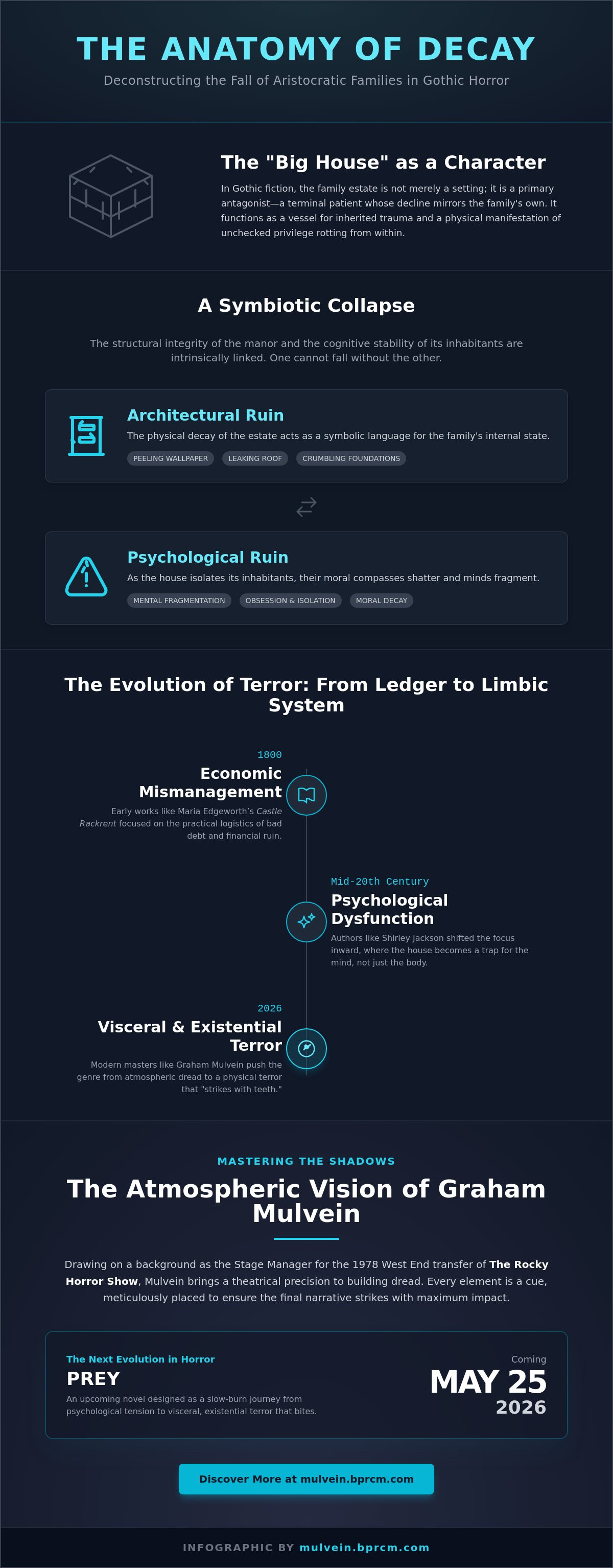
The "Big House" is rarely just a setting in fiction about decaying aristocratic families; it functions as a terminal patient. Aristocratic decay serves as a diagnostic tool for systemic failure, mapping the collapse of a social order that has outlived its utility. Readers find a calculated, voyeuristic satisfaction in the disintegration of inherited power. It's a study of gravity. Watching the elite lose their grip on reality and resources provides a safe distance from which to view our own anxieties regarding legacy and institutional stability.
This fascination isn't merely aesthetic. It's a structural analysis of how systems fail when they stop being productive and start being purely self-referential. In Southern Gothic literature, this collapse often stems from a refusal to adapt to a changing cultural landscape. This mirrors the themes Graham Mulvein's The House explores, where the physical structure becomes an accomplice to the inhabitants' decline. We don't just read these stories for the atmosphere. We read them to understand how legacy becomes a burden that eventually crushes the recipient under its own weight.
The Symbolic Language of Rot
Peeling wallpaper and crumbling foundations act as physical manifestations of psychological fragmentation. When a roof leaks, it signals a breach in the family's protective facade. Isolation accelerates this process by removing the corrective friction of external social norms. Without a functioning social system to ground them, the characters' moral compasses spin wildly into obsession. The aristocratic ghost represents unatoned historical sins that refuse to stay buried within the foundations of the estate.
From Castle Rackrent to Halloran House
The lineage of this genre began with Maria Edgeworth’s 1800 classic, Castle Rackrent, which focused primarily on the logistics of economic mismanagement and bad debt. Over two centuries, the focus has shifted from the ledger to the limbic system. Shirley Jackson’s mid-century masterpieces transitioned the trope into the realm of psychological dysfunction, where the house is a trap rather than a prize.
Modern interpretations continue to evolve toward more unsettling, existential territory. This is evident in the upcoming novel PREY, scheduled for publication on May 25, 2026. It's designed as a slow-burn atmospheric horror that shifts from psychological tension into a terror that bites with teeth. This evolution reflects a shift in our collective fears. We're no longer just worried about losing the estate; we're terrified of what the estate has turned us into. The precision of this narrative arc reflects the same attention to detail required when Graham Mulvein served as the Stage Manager for the original West End transfer of The Rocky Horror Show in 1978, where every cue mattered for the final impact.
The Anatomy of Decay: Architectural vs. Psychological Ruin
In the canon of fiction about decaying aristocratic families, the estate is never merely a backdrop. It functions as a primary antagonist or a silent co-conspirator. The structural integrity of the manor mirrors the cognitive stability of its inhabitants. When a ceiling sags, a moral boundary usually collapses alongside it. This isn't just aesthetic; it's a systemic failure of a lineage that refuses to adapt to a changing world. The decay is both a physical reality and a psychological manifestation of a family's inability to manage its own legacy.
This decline is often witnessed by the "unreliable retainer," a figure like Thady Quirk in Maria Edgeworth’s Castle Rackrent. These characters provide a distorted lens through which we view the collapse. They are bound by a misplaced loyalty that blinds them to the operational dysfunction of the household. This "toxic nostalgia" is a refusal to leave a dying world, choosing instead to perish within the familiar rot rather than seek a new, structured existence elsewhere.
The House as a Living Organism
The gothic mansion breathes. It watches. It eventually consumes those who claim to own it. Shirley Jackson’s work often features settings that are "geometrically flawless" yet fundamentally wrong, creating a jarring sense of unease. This architectural dissonance creates a specific psychological friction that wears down the occupants. In Graham Mulvein’s The House, the atmosphere isn't just thick; it's predatory. The walls don't just hold history; they enforce it through a process of slow-burn atmospheric pressure. The house becomes a machine designed to preserve the past at the expense of the present.
Inherited Trauma and the Weight of Pedigree
Pedigree is a heavy burden when the assets are liquidated but the pride remains. The "sins of the father" manifest as physical hauntings or hereditary madness, creating a claustrophobia of the family name. This is why the decaying aristocrat is a uniquely tragic figure in horror; they are trapped by a ruinous inheritance they can't afford to keep but aren't allowed to lose. To understand the roots of this dysfunction, one should consult this Southern Gothic Primer, which illustrates how fallen aristocrats become prisoners of their own history.
The transition from existential dread to physical threat is a hallmark of this genre. It's a progression I've explored deeply, particularly in how psychological rot eventually develops "with teeth," a theme central to my upcoming novel, PREY, scheduled for publication on May 25, 2026. This narrative arc mirrors the breakdown of any complex system that lacks a logical path forward. If you are interested in the mechanics of narrative structure and suspense, you can find more insights on the Mulvein blog.
Essential Reading: A Curated List of Family Decay and Gothic Dread
Analyzing the collapse of a dynasty requires a focus on the structural failures of the soul and the estate. In the canon of fiction about decaying aristocratic families, the narrative often serves as a forensic audit of moral and financial insolvency. These stories don't just describe ruins; they document the precise moment when tradition becomes a cage.
William Faulkner’s 1929 masterpiece, The Sound and the Fury, provides the definitive blueprint for this dissolution. The Compson family represents a calcified Southern elite, trapped in a cycle of obsession and memory that renders them incapable of functioning in a modernizing world. This specific type of rot is explored deeply in Southern Gothic in Crime Fiction, where the plantation house acts as a site of both historical guilt and inevitable violence. Faulkner’s use of fragmented timelines mirrors the fractured psyche of a family that has lost its purpose but clings to its pride.
Isolation takes a more claustrophobic form in Shirley Jackson’s We Have Always Lived in the Castle. The Blackwood estate is a fortress against a hostile village, yet the true danger resides within the domestic rituals of the sisters. Jackson demonstrates that family secrets are more corrosive than any external threat. Similarly, Emilia Pardo Bazán’s 1886 novel, The House of Ulloa, shifts the lens to the remote Spanish countryside. It examines the "naturalism" of decay, where the environment itself seems to conspire against the refinement of the nobility, dragging them down into a primitive, lawless state.
Modern readers seeking a contemporary examination of these themes should turn to Graham Mulvein’s The House. This work treats memory as a physical architectural element, exploring how the darker edges of a family's past can isolate the living. It moves beyond simple nostalgia to provide a sharp, analytical look at how trauma scales across generations, much like a poorly managed corporate structure eventually collapses under the weight of its own historical errors.
Classic Pillars of Aristocratic Ruin
The "Big House" in Irish literature serves as a potent symbol of political and social friction. Authors like Elizabeth Bowen and Molly Keane utilized these crumbling mansions to represent the Anglo-Irish decline during the 20th century. These houses were not just homes; they were tactical outposts of a fading empire. The literature of this period focuses on the stagnation of the elite who, while surrounded by high walls and silver service, found themselves increasingly irrelevant to the changing world outside their gates.
Contemporary Voices in Modern Gothic
By 2026, indie horror authors have revitalized the genre by injecting explicit psychological horror into traditional settings. The focus has shifted from external ghosts to existential terror. This evolution is evident in female-led narratives such as Silvia Moreno-Garcia’s Mexican Gothic and Catriona Ward’s The Last House on Needless Street. This trend continues with the upcoming publication of PREY on May 25, 2026. It's a slow-burn atmospheric horror that transitions into a physical and existential terror with teeth, proving that fiction about decaying aristocratic families remains a vital tool for exploring the darker side of human heritage.
Beyond the Ghost Story: The Transition to Physical and Existential Terror
Modern fiction about decaying aristocratic families has undergone a significant structural shift. We are seeing a move away from the translucent, ethereal spirits of the Victorian era toward a more visceral, bodily dread. This isn't a mere change in aesthetic preference; it's a strategic evolution in how narrative tension is managed. In these stories, the decay is no longer just a metaphor for a fading social class. It is a biological and architectural reality that consumes the characters from the inside out. The horror is found in the rot of the floorboards and the inherited defects of the bloodline. This transition reflects a deeper anxiety for 2026 readers: the fear that the systems and lineages we rely on are not just failing, but are actively decomposing.
Existential terror in this context functions as the ultimate systemic failure. It's the realization that a family's centuries of history, wealth, and curated legacy amount to nothing more than a pile of organic waste. When the weight of the past becomes too heavy, the structure collapses. This creates a specific type of horror where the protagonist realizes their entire reality is built on a foundation of meaningless cruelty. The dread is rooted in the logic of the inevitable. There is no escape from a lineage that has already decided your fate.
Escalation "With Teeth"
Effective horror requires a transition from psychological unease to inescapable physical danger. I define this as an escalation "with teeth." It's the moment the atmospheric pressure of a crumbling estate becomes a tangible force. For the modern reader, the slow-burn approach is essential for establishing a baseline of reality before the violent disruption occurs. This method ensures the horror feels earned through a logical progression of events. PREY, my upcoming novel scheduled for publication on May 25, 2026, utilizes this precise framework to dismantle the safety of its characters. It's a narrative that begins with the quiet discomfort of a dying house and ends with a visceral, physical confrontation that leaves no room for ambiguity. The genre of fiction about decaying aristocratic families is at its most potent when it stops suggesting ghosts and starts showing the teeth of the past.
The Science of Atmospheric Tension
Creating dread is a process-oriented task that requires meticulous attention to sensory detail. Pacing must be used to simulate the feeling of a house physically closing in on its inhabitants. This is achieved through the systematic layering of specific inputs. The smell of damp rising through floorboards, the distinct sound of settling stone at 3:00 AM, and the tactile sensation of peeling wallpaper all serve to ground the horror in reality. My background in creative consulting for narrative development has taught me that atmosphere is not an accident; it's the result of a well-executed plan. I often apply the same rigour I used as the Stage Manager for the 1978 West End transfer of The Rocky Horror Show to the way I structure a scene. Every movement and every sound must serve the larger objective of building tension. When the environment is calibrated correctly, the reader doesn't just observe the decay; they feel it as a physical weight.
To explore the mechanics of atmospheric horror and the breakdown of legacy, visit the official collection of Graham Mulvein's books.
Mastering the Shadows: The Atmospheric Vision of Graham Mulvein
Graham Mulvein approaches the narrative arc with the calculated precision of a master technician. His authority isn't merely academic; it's forged in the high-stakes environments of professional theater where timing and atmosphere are everything. In 1978, Mulvein served as the Stage Manager for the original West End transfer of The Rocky Horror Show. This specific experience in managing complex tonal shifts and visceral audience reactions directly informs the structural integrity of his literary work. In Graham Mulvein's The House, readers don't just read a story; they encounter a "staged" sense of dread. Every floorboard creak and flickering candle feels intentional, as if the author is pulling levers behind a velvet curtain to maximize the psychological impact on his audience.
This background creates a unique perspective on fiction about decaying aristocratic families. While many authors rely on vague tropes of crumbling masonry, Mulvein treats the setting as a living, breathing entity that requires precise management. His work invites readers into the "World of Horrors" and the "Before the Rooms Woke" project. These initiatives explore the boundaries between memory and physical decay, forcing the reader to confront what happens when the architecture of the past begins to collapse. It's a methodical dismantling of comfort that reflects his deep understanding of how to control a space, whether it's a stage or a page.
The Craft of Gothic Suspense
Mulvein’s brand voice is defined by controlled, intelligent, and often unsettling prose. He rejects the lazy generalizations common in modern horror. Instead, he employs specific, sharp descriptions that pin the reader to the moment. This methodical approach ensures that the tension never dissipates; it only constricts. You can learn more about this rigorous literary journey and professional background on the about page. The focus remains on the process of building fear through structure rather than relying on cheap shocks or predictable jump scares. His prose functions like a well-oiled machine, where every word serves the larger objective of systemic unease.
Preparing for PREY
The anticipation builds for May 25, 2026, with the scheduled release of PREY. This upcoming novel promises to push the boundaries of atmospheric horror by exploring the jagged edges of isolation and the weight of inherited trauma. It starts as a slow-burn meditation on memory before transitioning into a terror that is physical, existential, and, as Mulvein describes it, "with teeth." It represents the next logical step in his exploration of fiction about decaying aristocratic families and the rot that lingers in forgotten spaces. Readers should explore the full collection of Graham Mulvein’s books and prepare for the release of PREY to witness this escalation firsthand. The novel promises to be a masterclass in how isolation can strip away the veneer of civilization.
Mastering the Mechanics of Hereditary Collapse
The study of fiction about decaying aristocratic families reveals a precise intersection between structural collapse and psychological disintegration. We've analyzed how the crumbling estate serves as more than a backdrop; it's a diagnostic tool for the rot within the bloodline itself. This narrative evolution moves from the atmospheric shadows of the past into a modern form of terror that's visceral and uncompromising. It's a process where the weight of history becomes a physical burden, crushing the inhabitants beneath the stones of their own legacy.
Graham Mulvein brings a unique structural discipline to this genre. Drawing from his experience as the Stage Manager for the original 1978 West End transfer of The Rocky Horror Show, he understands the mechanics of tension and the importance of a well-timed reveal. His work, including the immersive World of Horrors series and the acclaimed novel Graham Mulvein’s The House, demonstrates a mastery of the slow-burn. This methodology continues with his upcoming novel, PREY, scheduled for release on May 25, 2026. It promises an atmospheric descent that eventually reveals terror "with teeth."
The shadows are lengthening, but the structure remains sound for those who know where to look. Discover Graham Mulvein’s The House and subscribe for exclusive horror content to begin your journey into the depths of atmospheric dread.
Frequently Asked Questions
What defines fiction about decaying aristocratic families?
Fiction about decaying aristocratic families centers on the structural and moral erosion of once-powerful lineages. These narratives often utilize crumbling estates as physical manifestations of psychological collapse. You'll find themes of inherited debt, social obsolescence, and the claustrophobia of tradition. This subgenre examines how the weight of history eventually crushes those who refuse to adapt to modern reality, often leading to a violent or tragic conclusion.
Why is the "Big House" trope so common in Irish and Southern Gothic literature?
The "Big House" trope persists because it symbolizes the precarious position of a landed class facing inevitable displacement. In Irish literature, such as Elizabeth Bowen’s 1929 novel The Last September, the house represents the Anglo-Irish Ascendancy’s decline. Similarly, Southern Gothic writers like William Faulkner used 1930s settings to explore the South’s refusal to abandon its agrarian, hierarchical past. These structures serve as static monuments in a changing world.
Is Graham Mulvein’s The House considered modern gothic horror?
Graham Mulvein's The House is a definitive example of modern gothic horror that prioritizes psychological disintegration over cheap thrills. It meticulously builds tension within its walls, reflecting the internal rot of its inhabitants through the external decay of the structure. The narrative avoids standard tropes, choosing instead to explore how an environment can systematically dismantle the human psyche. It's a calculated study in atmospheric dread that demands the reader's full attention.
What is the difference between classic gothic and modern psychological horror?
Classic gothic relies on external supernatural elements like 18th-century ghosts or ancient curses, while modern psychological horror focuses on the internal fragility of the mind. In classic works like Horace Walpole’s 1764 novel The Castle of Otranto, the threat is often literal and external. Modern narratives shift this focus, suggesting the true horror resides in trauma, perception, and the systemic failures of the individual. The terror is more intimate and inescapable.
When is Graham Mulvein’s new novel PREY being released?
Graham Mulvein’s new novel PREY is scheduled for publication on May 25, 2026. This upcoming release explores the boundaries of slow-burn atmospheric horror, beginning with subtle psychological shifts before evolving into physical and existential terror. It's a narrative designed to escalate with precision, eventually revealing a darker reality that bites with teeth. Readers can expect a structured descent into a nightmare that challenges their sense of security and logic.
How does the setting of a decaying mansion contribute to the horror elements?
A decaying mansion functions as a physical manifestation of the characters' internal corruption and the central theme of fiction about decaying aristocratic families. The architecture itself becomes a predator, trapping inhabitants in a cycle of isolation and historical guilt. When 100 percent of a character's world is confined to a rotting estate, the boundaries between the self and the structure dissolve. This creates a claustrophobic atmosphere where the house’s structural failures mirror the family’s moral collapse.
Can I read gothic fiction if I don’t like traditional ghost stories?
You can certainly enjoy gothic fiction without an interest in traditional ghost stories, as the genre often prioritizes atmosphere and psychological depth over the supernatural. Many readers prefer the uncanny elements found in 20th-century works where the horror is rooted in social isolation or madness. Instead of transparent spirits, these stories offer a tangible sense of unease. They focus on the weight of the past and the inevitable decay of systems that no longer serve a purpose.
What was Graham Mulvein’s role in The Rocky Horror Show?
Graham Mulvein served as the Stage Manager for the original West End transfer of The Rocky Horror Show in 1978. This role required managing the complex logistical and technical requirements of a production that had already become a cultural phenomenon since its 1973 debut. His involvement during this specific period highlights a career built on precision and the management of intricate creative systems. This professional background informs the structured, meticulous pacing found in his later literary work.